CO-Horts

CO-Horts Blog

Tuesday, May 9, 2017

Junipers: Love 'em or hate 'em?

Posted by: Alison O'Connor, Larimer County Extension

Junipers. Every time you mention this plant, you get a variety of reactions--anything from the wrinkled nose to the nod of appreciation. Junipers seem to be one of those "love 'em or hate 'em" plants.
Junipers! Sited properly at Centerra Shopping Mall in Loveland.
For those who've heard me teach, I'm usually trash-talking these sturdy evergreen plants. But I recently had an epiphany: I don't actually hate junipers; I hate what people do to them.
Juniper "art"? (Photo by Eric Hammond)
I hate that people shear them within an inch of their life. I hate that people whack them back to keep them from growing on the sidewalk. I hate that people put them in the wrong spot and then torture the junipers (through pruning) to get them to behave.
Sheared. To death. (Photo by Deryn Davidson)
Stay off the lawn, juniper! (Photo by Eric Hammond)
Sited properly, junipers are, quite possibly, one of the most tolerant, drought-loving plants we have in the nursery trade. They come in a variety of shapes, sizes and colors and are one of the few plants that can actually fit into the "I have a 5-foot wide space but need a plant that grows 20 feet tall" request.

Did I really just defend junipers? Wow.

But really, junipers definitely have a place in the landscape, but it needs to be the right place. Sure, they collect trash and other debris and it's nearly impossible to remove grass growing through the foliage, and pruning them properly results in an itchy rash on the body, but they can look quite nice. And while they are a favorite of voles, they are a sturdy groundcover.
Junipers and all sorts of ugly. But a good plant choice for this location!
So give junipers a chance...a fighting chance. A legitimate chance to do good. And don't mistreat them or plan on shearing them. In their natural shape, junipers can be quite attractive. But when humans get involved, that's where things get ugly. What do you think? Did I convince any of you to appreciate this plant, even a little?

Monday, May 1, 2017

Saving Seed


Written by Yvette Henson
CSU Extension San Miguel and West Montrose Counties

When our ancestors came to the U.S., the often brought seeds with them, seeds from home.  These seeds were important because they were a source of food—often the seeds they brought were of plants that were a culturally important food, a medicine or a favorite door yard flower.  These seeds planted something from the homeland into the new land and they might have preserved a long time heirloom.  Many indigenous cultures have and still preserve their own regionally adapted plant varieties by saving the seed.  In the early days of our country the USDA had a seed giveaway program.  It was often the local Extension Agent who was responsible to distribute these seeds to local people.  Around this same time, there were many seed companies who sold many varieties of seeds.  In the early to mid-1900’s things began to change -- less people lived on small family farms, less people gardened at home and hybrid seeds were developed.  There were fewer regional seed companies and many varieties were lost.  (See the following diagram.)


Preventing further loss of genetic diversity in our seed source is just one reason to make the extra effort it takes to properly save seeds.  Here are a few more reasons to consider:
  • To preserve a cultural or heritage seed
  • To develop or maintain regional, farm or garden adapted varieties
  • To be more resilient or self sufficient
  • To ensure you have a source of your favorite varieties
  • To share!
  • Save money (the labor and space needed may not always result in savings)
  • For a fun challenge
  • To be in partnership with nature
  • It’s really ‘local’


Following are some basic terms that one needs to understand in order to save seed successfully. 


Open Pollinated (OP) varieties can produce stable offspring that breed true to type if properly managed.  “Stable” means there will be consistent uniformity between individuals in the plant population grown from the seeds saved.   OP varieties are allowed to cross pollinate in the field.  Open pollinated varieties can be just as vigorous as F1 hybrids, depending on selection.  OP varieties are not hybrids and they are not always heirlooms.
Definitions differ for what an heirloom plant variety is.  The most common definition of an heirloom is a variety that has been grown, seeds saved and regrown for at least 50 years.  But to others a variety that is being maintained by a family or in a region and passed down, even if it hasn’t been done for as long as 50 years is an heirloom.  Usually an heirloom is an OP variety but not always.  For instance, a noteworthy hybrid developed by a famous plant breeder in the past might be considered an heirloom by some.

Hybrid varieties result from natural or unnatural pollination between genetically distinct parents of a species.  Commercially, the parents used to produce hybrids (F1) are usually inbred for specific characteristics.  Hybrids can have increased uniformity and sometimes increased vigor and disease resistance, than either of the parent plants.  Seed saved from hybrids will not grow true-to-type and sometimes it’s sterile.


GMO’s (Genetically Modified Organism) varieties have had genes have inserted into their DNA.  The genes that are inserted are often from different species, genera, or even kingdoms.  Most, if not all, GMO varieties are hybrids but not all hybrids are GMO’s.  


The basic steps to save seed successfully are:
  • Start with an open pollinated variety so you can get plants true to type.
  • Learn about the characteristics and needs of the species of plant that you are growing so you can grow it to be as healthy and productive as possible. 
  • Knowledge about your plant species will give you the information you need to protect your variety from cross pollination with related plants.  This can be done by planting a single variety, by covering and/or hand pollinating or by separating similar varieties by enough distance to prevent cross pollination. 
  • Plant a large enough population size to get adequate pollination among your plants to maintain genetic vigor of your seed.  Save seeds from the healthiest plants that have the traits that you want and get rid of the plants that don’t.
  • Harvest at the correct time to get good seed.  This may mean you don’t get to eat all of the fruit of your labor—some plants might need to be saved for seed. 
  • Process your seed for the type of plant it is. 
  • Store your seed properly to ensure it remains viable.   Generally, keep seeds dry, cool and dark.  Replant and repeat!   Over time, you will get a more locally adapted variety with the characteristics you want and that will perform well in your area.
Things are coming back around.  More people are gardening at home, there are an increasing number of small farms, plant breeders, seed companies and non-profits dedicated to finding, developing and preserving seed varieties and genetics.  Community seed libraries and seed banks are sprouting up everywhere! 


If you want to know more about Saving Seeds see the following resources:
CSU Extension Fact Sheets: 
Organic Seed Alliance      www.seedalliance.org
Rocky Mountain Seed Alliance    www.rockymountainseeds.org
Seed to Seed: Seed Saving and Growing Techniques for Vegetable Gardeners by Suzanne Ashworth and Kent Whealy, Seed Saver Exchange, 2nd Edition, 2002.
The Seed Garden: The Art and Practice of Seed Saving, Butalla, Lee and Siegel, Shanyn, Seed Savers Exchange.  2015.
Breed Your Own Vegetable Varieties by Carol Deppe.  Chelsea Green, 2nd Edition, 2010.


Friday, April 28, 2017

To Cover, or Not to Cover? (winter is back!)

Posted by: Deryn Davidson, Boulder County

For the past several weeks it's seemed that the warm weather was here to stay. But, we all have to remember that we live in Colorado and you NEVER know what Mother Nature has in store for us here. Over the next two days, much of CO is predicted to get below freezing temps overnight and many people are asking if their plants will survive. Well, as usual, it depends...

A freeze is when the temps drop low enough to cause the water in plant tissue to turn into tiny ice crystals and the next day your plants turn to mush (destroyed plant tissue). A frost is when there is a lot of water vapor in the air and temps drop low enough to freeze that vapor. The result is frost on top of plants. We can get light frosts, that don't actually freeze plant tissue. The different is based on: how low (below 32F) the temperature get, how long the low temp lasts, what species of plant you have, and where the plant is located (sheltered or out in the open).

There are some plants that will be affected by this cold-snap and there are measures you can take to help protect them:

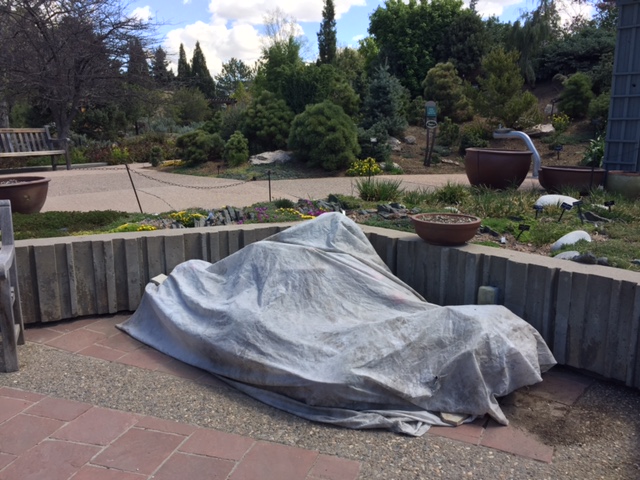
  • Covering plants is the most common. You can use old sheets, blankets, frost cloth, burlap sacks, etc. Flower pots or large trash cans turned upside down can also be placed over plants. If you use something heavy like a blanket be sure that you have stakes or something else besides the plant to hold up the blanket. You don't want to crush the plant while you're trying to save it from the freeze! Cover the plant in the evening to try to trap some of the heat that has built up during the day, then UN-cover the plants the next morning once the sun is out. 


Grouping of pots at DBG covered for late April freeze
Nursery stock covered in preparation for the April freeze

  • Watering plants can help, but you would have needed to do that a few days ago. Moist soil retains more heat and will raise humidity levels which can help reduce frost damage.
  • Mulch can provide some protection if you have a nice layer down. You can mound it up around plants, but delicate/tender plants won't like to be covered with a thick layer of mulch. 
These precautions can help, but we all have to realize that some plants just won't take the cold well and may be set back by the low temperatures, others will make it through just fine. If you have plants that seem particularly tender, go ahead and give them some extra protection. 

I have to give a nod to Jack Frost and Mother Nature, always keeping us gardeners on our toes here in CO!! Good luck everyone, I hope your gardens come through just fine!!


Wednesday, April 26, 2017

Plantin' in the Rain I'm Plantin' in the Rain

Posted by: Curtis Utley Jefferson County Extension

While a reality or drudgery in many parts of the US, the opportunity to plant in the rain is a luxury not often possible in Colorado. The benefits of being able to plant at the beginning of a rainstorm are many. Purchased potted plants require some root manipulation before planting.

Container plant root ball
You must either cut the outer inch of the rootball off to prevent the continuation of circling roots or you must tease the rootball apart so you can lay the root system out carefully into the planting hole.
Digging planting hole
This all takes time and plant roots are extremely sensitive to dry air which is common in Colorado. By planting in a rainstorm you afford yourself some time to tease the root system out of the ball and provides a larger window of time to adjust the root system in the planting hole as you layer in the backfill soil.
Laying out the root system
Close-up of root system re-orientation 
In dryer times if too much time is taken in transplanting transplant shock can occur when the root system desiccates. Drought stress may also occur as the water demand by the leaves for transpiration is not met. These stress factors are greatly avoided when planting during a rain shower because the root system doesn't desiccate and the leaves of the plant are not actively transpiring water to cool themselves when raindrops are falling.
 I found three Jostaberry plants for a song at a local garden center and bought them with excited anticipation of jam in my future.
Rain can also help settle the soil around the root system. It is not advisable to plant after a lot of rain has fallen because the soil has the potential to become compacted as you plant. When the soil particles are well lubricated it's best to stay off of the soil to avoid destroying soil structure, but at the beginning of a rainstorm, before the soil is saturated  is a great time to install new plants in your garden. It may not be the most comfortable time for you to be out in the garden but gardening is a labor of love and if you can establish new plants when they are less stressed you will have more gardening success. Keep in mind that Colorado rain events can be intermittent or short at best.
Watering to settle the soil around the root system
In this situation it is still advisable to water in your newly planted plants to allow the soil to settle around the root system. If air pockets remain around the root system of your new plants, the roots can still desiccate and the plant will not thrive.
A flooded planting hole assures the elimination of air pockets 

Monday, April 24, 2017

Dwarf Mistletoe in Ponderosa Pines posted by Mark J. Platten


I’ve received numerous calls regarding southwest dwarf mistletoe (Arceuthobium vaginatum subsp. cryptopodum) in ponderosa pines over the years.  They are leafless, parasitic plants that infect several species of conifers, producing root-like structures that grow in the living tissue, where they extract both nutrients and water from their host plants.  
The southwest dwarf mistletoe is relatively host-specific and generally doesn’t affect other tree species in our region other than the occasional limber or bristlecone pine. 


Symptoms and Signs
From a distance, coniferous trees infected with dwarf mistletoes may appear to have yellow foliage, reduced foliage, abnormally dense green and distorted foliage known as witches’ brooms, and mortality of the upper portion of the affected tree.
The first symptom of dwarf mistletoe infection is a slight swelling of the bark at the infection site.  The parasite is identifiable when shoots protrude two to three years after infection. 

Damage to Host Trees
The mistletoe and subsequent witches’ brooms extract resources from the tree and may cause mortality.  Death of the host tree occurs slowly in most cases and depends on the severity of infection, vigor, and size of the tree.
Mistletoe severity is established by dividing the crown into equal thirds and rating each.  If there are no visible infections, that third of the crown is rated 0; if 1 to 50 percent of the branches are infected, the rating is 1; and if more than 50 percent of the branches are infected, the rating is 2.
Add the ratings of each third to get a total rating.  Ratings of 3 or less are considered light, 4-5 moderate, and 6 heavy.  Life expectancy is based on tree diameter and severity of infestation.  For diameters of nine inches or less, the range is 7-30 years.  For diameters greater than nine inches, life expectancy is in the range of 10-60 years; with the low number reflective of heavy rating and the high end based on light ratings.


Spread
Their life cycle, from initial seed germination to producing fruiting bodies, is 6-8 years, providing time for management.  The sticky seeds literally explode via hydrostatic pressure at almost 60 miles per hour!  Seeds that adhere to young branches of susceptible trees germinate and the mistletoe rootlet penetrates the bark.  Dwarf mistletoe seeds generally are dispersed in August and early September.  Birds and other animals can occasionally spread the seeds some distance to uninfected trees. 

Management
Although mistletoes cause a gradual decline of plant health, trees may become stressed, attracting mountain pine beetles, Ips beetles, and twig beetles that may kill the tree.  Mistletoe management options include branch pruning, tree removal, and planting resistant tree species.

Branch Pruning and Tree Removal
Pruning witches’ brooms and removing infected trees is the best management measure available to reduce or eliminate dwarf mistletoe infestations in stands of high-value trees.  First, remove severely infected trees (trees rated 5 and 6) or those with only a few live branches.  It is not necessary to completely eradicate the mistletoe, since this may require removal of all trees.  Pruning infected branches and removal of a few heavily infected trees can keep a green forest on the property.
Pruning the lower and the largest witches’ brooms from lightly to moderately infected trees (trees rated 1 to 4) can improve the health and allow these trees to survive for decades.  Examine trees every two or three years, removing any newly infected branches.  Mistletoe shoots die as soon as the tree branch is cut, so no special disposal is needed.  If space allows, create a 50 foot buffer zone between infected trees and healthy trees that may be affected.  Contact a professional forester, the Colorado State Forest Service, or other professionals to obtain help in these decisions.

Hawksworth Six–class method for evaluating dwarf mistletoe infection (Hawksworth 1977)


Plant Resistant Tree Species
Planting resistant or non-host tree species in areas with infected trees will ensure that trees will be in the area even after the infected trees are remove.

Chemical Sprays
Ethephon is a growth-regulating chemical that can be used to remove mistletoe shoots and reduce seed production.  This treatment does not kill the entire mistletoe plant, just the shoot. Re-treatment is necessary until infected trees are removed, mistletoe infections are pruned from the tree, or new non-host trees are planted.

For more information on dwarf mistletoe, please see CSUE Fact Sheet:  http://www.ext.colostate.edu/pubs/garden/02925.html