CO-Horts

CO-Horts Blog

Showing posts with label Eric Hammond. Show all posts

Thursday, April 12, 2018

Low Tunnels- Another Option for Season Extension for Backyard Gardeners


Recently I decided to install a couple of low tunnels in our home vegetable garden.  For those who may not be familiar with these contraptions, they are basically a series of short arches placed over a garden bed that are used to support a covering of some type.  The idea is to heat the air and soil under the covering during the day then to retain some of that heat, especially the heat radiated by the warm soil, during the night.

Low tunnel over a raised bed.
We went with a simple design which only required some old rebar we had laying around, PVC pipe and some plastic greenhouse covering we bought online.   Essentially, we pounded the rebar into soil at regular intervals along the bed then slipped the PVC pipes over them on one side of the bed.  Each pipe was then bent and slipped over another piece of rebar on the opposite side.  There are formulas available online to  determine the length of the PVC you need form to an arch of a given height but essentially if your beds are three to four feet in width you want to cut the PVC pipe to a length about one foot wider than the bed.  We chose to install four arches per eight foot bed.  We might have been able to get away with three but the more arches you have the better the tunnel will hold up vs. wind and snow.   
PVC pipe slid over rebar

After installing the arches we placed the greenhouse plastic over them and secured it with clamps.  They make really slick clamps designed specifically for this purpose.  I have ordered some of these but they have not yet arrived.  In the meantime, we are using simple woodworking clamps.

Hoops installed.

Greenhouse plastic is available from online retailers and some garden centers.  Cut to size. this piece is enough for several low tunnels. 
   
Plastic secured to tunnel with woodworking clamps.  We placed old bits of fabric between the clamp and the plastic to avoid damaging it.

Nifty clamps specifically for low tunnels and similar applications.  Image from Johnny's Seeds.
 Again this is a simple and inexpensive design and does have some drawbacks.  The PVC pipe will oxidize in the sun and become brittle over time.  Eventually it will have to be replaced.  I’m planning on spray painting the ones we used this summer to extend their life.  There are also stronger designs out there that utilize metal hoops.  A quick internet search will yield lots of interesting designs which are almost certainly stronger and more durable.

So, is it worth the effort?  We have had the tunnels out in our garden for almost two months and for us it certainly has been.  We planted cool season greens, as well as some broccoli, in the tunnels late in February and they germinated incredibly uniformly.  I assume this was due to both more constant and warmer soil temperature under the tunnel and possibly to the elevated humidity in the tunnel.  In the middle of March the afternoon soil temperature under the tunnel was over 10 degrees warmer than the soil in one of our uncovered beds.  We are hoping to use the bump in soil temperature to give an early start to our peppers this year.
Soil under the tunnels as was nearly 70 degrees mid March this year. 


Spinach and radishes in one tunnel.

The tunnels do require some maintenance and have some limitations.   Chiefly they need be to opened and then closed on warm and\or sunny days to prevent the plants inside from cooking.  In the late spring you will need to do this nearly every day which kind of ties you to garden. The covering also will normally have to be taken completely off once the season gets started and reattached in the fall.   It can be difficult or impossible to get taller crops under the tunnels in the fall.

Tunnel open for ventilation on a warm day.


On the whole though, I think that low tunnels are a great option for many backyard veggie gardeners. They are relatively cheap and easy to install and can be a very effective way of adding a few weeks or more to both ends of the growing season.

Friday, December 16, 2016

Moving Large Trees at the Plant Environmental Research Center.

Posted by: Eric Hammond, Adams County Extension

Late month many of the more unique trees planted around the perennial demonstration garden at the Plant Environmental Research Center (PERC) on campus at CSU were moved via tree spade to new locations.   The gardens and the trees are being moved to make way for several practices fields which are going to be installed alongside the new stadium on campus.  In all 19 trees were moved including several very large trees which required a 120 inch wide spade.  It was pretty interesting to watch and I thought I would share some pictures and videos of the move.
120 inch tree spade which was used to move the largest of the tree salvaged from PERC.  Larger trees require larger spades in order to dig a large enough portion of their root system for successful transplant.
A slightly smaller tree spade also used in the project.

A slightly smaller spade preparing to dig a linden.
When an established tree is moved with a spade a large portion of its root system and a particularly large proportion of its fine feeder roots are left behind.  This means spaded trees need to be watered diligently for several growing season after they are transplanted.  Water should be applied relatively more frequently with relatively smaller amounts of water compared to an established tree to keep the tree's root system moist without creating a pond at the bottom of hole created by the spade.  
Severed roots can be seen along the side of the hole left by a tree spade circled in red.  A large portion of an established tree's root system is left behind when it is moved with a tree spade. 
It can take a number of years for a spaded tree to establish its root system after transplant and until they do canopy growth is often limited.  Staking recently moved trees is often advisable due to their reduced root system.
Hole left after a tree was lifted with a tree spade.
Here is a sequence of photos and videos of a large upright European hornbeam being moved (thanks to Josh Lambright for the videos):

Digging the hole for transplant.


A upright European hornbeam being dug with the 120 inch spade.

A large spruce being set in place at its new location
Close up of the "root ball" brought with the tree.  The tree root system was likely 2 to 5 times the width of its canopy before transplant.
  
Large upright European hornbeam after transplant.

Sunday, November 27, 2016

It's Time to Wrap Your Trees!

Posted by: Alison O'Connor, CSU Extension in Larimer County

The end of November marks many things, including the frenzy of college football, events where you eat more food than you probably should...and wrapping your young, thin-barked trees for winter. Not every tree needs to be wrapped, but if you recently planted trees (in the last two or three years), it's worth considering. Trees with thin bark like linden, maple, ginkgo, redbud, crabapple and others need to be wrapped until their bark hardens. If you have young bur oaks, you can usually skip the wrap because of their corky bark. We wrap trees to prevent sunscald and frost cracks, both of which are temperature related.

My crabapple that was planted about a year ago still needs to be wrapped for the 2016-2017 winter.
But instead of writing how to wrap trees, check out this super-cool video that fellow CO-Hort Eric Hammond and I made. (We're aware that it's a bit geeky.)


Happy wrapping...remember to use the right material and remove your wrap in April!

Friday, September 16, 2016

Is your maple looking a little (or maybe very) yellow?

Is your maple looking a little yellow?  It’s possible that it is experiencing an iron deficiency. Red maple and the freeman type maples (of which autumn blaze maple is the most common) as well as red oak and several other species of trees common to our area are all prone to iron deficiencies in alkaline soils (soils with a high pH) like those common to Colorado’s Front Range.    

Posted by: Eric Hammond, Adams County Extension
        Chloroctic Freeman type maple
These trees struggle to take up iron  (as well as other micronutrients such as zinc and molybdenum) from our soils even though there is normally plenty of iron in the soil.  Under high pH conditions iron tends to be insoluble forms that are more difficult for plants to absorb.  Some plants have evolved mechanisms to overcome this difficulty, however, other species, like the maples listed above, have not. This is likely because they had no need as these species are natives to the eastern portions of the continent where soils generally have a lower pH (in fact sometimes too low) and would gain no great advantage from having evolved specialized and energy intensive iron uptake mechanisms.  Cultural factors may also lead to or worsen the issue by making iron less available or hindering root growth. Such factors include soil compaction and over watering both or which lower soil oxygen levels.

Chlorotic leaves which are beginning to scorch
So how do you know your tree has a deficiency?  Symptoms of iron deficiency are chlorosis (yellowing) of leaves and in severe cases scorching or even premature dropping of leaves.   Iron is not very mobile within a plant so symptoms are worse on the newer leaves. In simple terms the plant uses the iron it has in the first leaves and runs out so the leaves produced later tend to be more chlorotic. Symptoms also tend to get worse as the season goes on, though in really bad or very far along cases plants may be chlorotic even early in the season. If deficiencies are prolonged they will lead to the decline of the tree and eventually its death. 
Freeman type maple in decline due to prolonged micronutrient deficiency 

The best way to deal with this issue is to avoid planting species which are intolerant of our soils.  However, there are several potential treatments.  You can have an arborist inject an iron solution into the trunk of the tree every few years to deal with the issue. However each time you do this you are wounding the tree which creates potential avenues for decay and is generally stressful for the tree.  You can also apply a chelated iron fertilizer.  These products consist of iron bound up in organic molecules which are stable in our soil. Make sure to use products labeled as EDDHA. There are many types and this is type is best for our high pH soils. These are somewhat expensive and need to be applied annually or near annually depending on the severity of the deficiency . Foliar applications of iron are also a possible treatment but they have their own list of drawbacks.  They only green the leaves they are sprayed on so improper application can lead to the tree appearing striped.  They can also stain driveways, sidewalks, patios and other elements of the landscape.  Foliar iron fertilizers will need to be applied annually.  Since it is possible that spring time over watering or issues creating stress for the plant such as soil compaction and girdling roots may be aggravating the issue. Make sure you watch your watering and if possible core aerate around the tree.


Friday, July 15, 2016

Multi-Site Woody Plant Trial 2006 Planting: Woodward Columnar Juniper

A mature Woodward juniper at the Colorado State University Arboretum 


The Colorado Multi-Site Trial of Woody Plants evaluates the suitability of “new” and underused woody plants across the various climates of the Colorado.  For more information about the trial and test sites see this previous post.  

The 2006 planting of the trial contained a number of interesting plants.  Some of which were very successful  and some which struggled or failed to survive.

The 2006 planting at Harding's Nursery outside of Colorado Springs

2006 Planting:
·       Acer monspessulanum (Montpelier maple)
·       Juniperus scopulorum ‘Woodward’ (Woodward columnar juniper)
·       Larix decidua (European larch)
·       Prunus serrotina (Black cherry)
·       Pyrus ussuriensis ‘Burgundy’ (‘Burgundy’ ussurian pear)
·       Quercus polymorpha (Monterey oak, Netleaf white oak)
·       Quercus undulate (Wavy leaf oak)


One of the plants which is particularly promising based on its performance during the five year trial period is the Woodward columnar juniper.   I know using the word “promising” in the same sentence as “juniper” has caused me to lose credibility with a significant portion of those reading this but hear me out; this is a really worthy plant.  Woodward performed well in the trial and consistently demonstrated both adaptability to our climate and ornamental features which would make it an asset in a variety of landscapes.


Woodward columnar juniper in Fort Collins in the spring of 2016. 


 Woodward was “rediscovered” by Front Range horticulturalists growing at the then defunct Cheyenne Horticultural Field Station.   It is a cultivar of Rocky Mountain juniper selected for its upright habit and strong apical dominance.  As a species, Rocky Mountain juniper (Juniperus scopulorum) is valued as a reliably cold hardy (Zone 3) and drought tolerant conifer.  This bore out with Woodward in the trial.   Across all the sites only a handful of plants did not survive the five year trial.  We observed little winter desiccation, wind burn or pest issues on any of the trial plants.  It is even more notable that we did not observe any damage from snow loading as such damage often plagues woody plants with upright habits.   This may be due to Woodward’s relatively small and shorter lateral branches and strong apical dominance.  The trial plants retained their narrow form and were remarkably consistent in their width across all five planting sites.   More than all this, they were attractive. They had a soft blueish green needle color and a “stately” form.

  
Mean width data for Juniperus scopulorum 'Woodward' the trial five sites.

Based on the data from the trial it appears Woodward columnar juniper is a tough plant which can be grow successful throughout the state.  Its well suited for small landscapes or tight spaces and could be used as a screen or even as an interesting specimen.  It was promoted by Plant Select in 2015 and was in high demand.  So, if you are interested in planting one get to the nursery early next year!    

Woodward juniper in Orchard Mesa in 2010

Thursday, March 31, 2016

Colorado Multi-Site Woody Plant Trials

Colorado Multi-Site Woody Plant Trials
Dr. James Klett, Eric Hammond, Jane Rozum and Rob McDonald
Colorado State University, Department of Horticulture and Landscape Architecture
and Adams County Extension

Manzano Bigtooth Maple (Acer grandidentatum 'Manzano') Planted in 2013


Colorado can be a tough place to be a plant.  Options for woody plants and particularly tree selection are limited in much of the state due to climate, soils, and disease and insect issues.  Late and early frosts, dry winters with fluctuating temperatures, and calcareous alkaline soils have traditionally limited the diversity of species which can successfully be grown in many parts of the state.  Increasingly limited and expensive water resources coupled with a dry climate also make many mesic species less desirable.  At the same time, many commonly planted species have been affected by serious disease or insect issues such as Dutch elm disease, thousand cankers disease and emerald ash borer.

   
Pests such as emerald ash borer
 are one limiting factor in species selection


In response to this, Colorado State University (CSU) began a multi-site woody plant evaluation program to trial underused and “new” woody plants with the goal of enlarging the size of the plant palate available in the state.  The trial was started in 2002 at five different sites throughout the state.  Since 2002, there have been twelve plantings evaluating a total of sixty-four (64) different taxa.  Trial plants are evaluated based on survival, growth, ornamental appeal, and their potential to be invasive over a five year period.  In 2002, we started with five co-operating sites including three private sector nurseries, Boxelder Creek Nursery (south of Hudson, CO); Harding’s (Calhan); and Little Valley (Brighton) and two CSU research sites, the Horticultural Research Center in Fort Collins (now ARDEC South) and Western Colorado Research Center – Orchard Mesa in Grand Junction.  Originally ten replications of each plant were planted in a randomized block design.   However, in later planting the number of replications was reduced to eight.


The 2015 trial planting at Little Valley Wholesale Nursery
Over the years some of the sites changed.  A major hail storm in 2009 destroyed the planting at Boxelder Creek and that site was lost.  In 2015, we moved the Harding’s Nursery site to the Colorado Agricultural Leadership Foundation near Castle Rock, CO.  Planting continues yearly. In 2015 we planted five taxa and in 2016 plan to plant another five taxa.  We continue to take growth and performance data on woody plants to determine if any merit introduction into Colorado and Rocky Mountain Landscapes with the Plant Select® designation.
Dr. Jim Klett taking data on the 2011 planting
Woodward Juniper (Juniperus scopulorum 'Woodward') a 2015 Plantselect® 
selection and part of the 2006 trial planting

Some of these woody plants have been recommended or introduced through the Plant Select® program including Acer tataricum ‘GarAnn’PP15023 (Hotwings® Tatarian Maple); Arctostaphylos x coloradoensis (Mock Bearberry Manzanita); Arctostaphylos x coloradoensis (Panchito Manzanita); Heptacodium miconioides (Seven-son Flower) and Juniperus scopulorum ‘Woodward’ (Woodward Juniper).  I plan to highlight these and other plants which have stood out in the trials in future posts.
The 2006 plant at Harding's Nursery during the summer of 2014


Support for this project comes from Colorado Horticulture Research and Education Foundation, Plant Select®, Colorado State University Agricultural Experiment Station, and cooperating nurseries mentioned above.


Tuesday, February 16, 2016

Shrubs for Winter Interest


Just because its winter (don't let the 60 degree weather fool you) does not mean your landscape has to be boring.   There are lots of plants that add winter interest to an outdoor space from ornamental grasses to evergreen trees.  Even the seed heads of some herbaceous perennial plants can look attractive in the winter.   One group of plants which shines in during the winter due to the variety of feature and types of interest they can create during the season is shrubs.

Some shrubs have twigs which are an attractive color or provide and interest texture to a landscape.  For example, red twig dogwood (also known as redosier dogwood- Cornus sericea) has showy twigs that bring color to a winter landscape.


Red twig dogwood- each year remove around 1/3 of the  the

 oldest stems to help plants retain their color


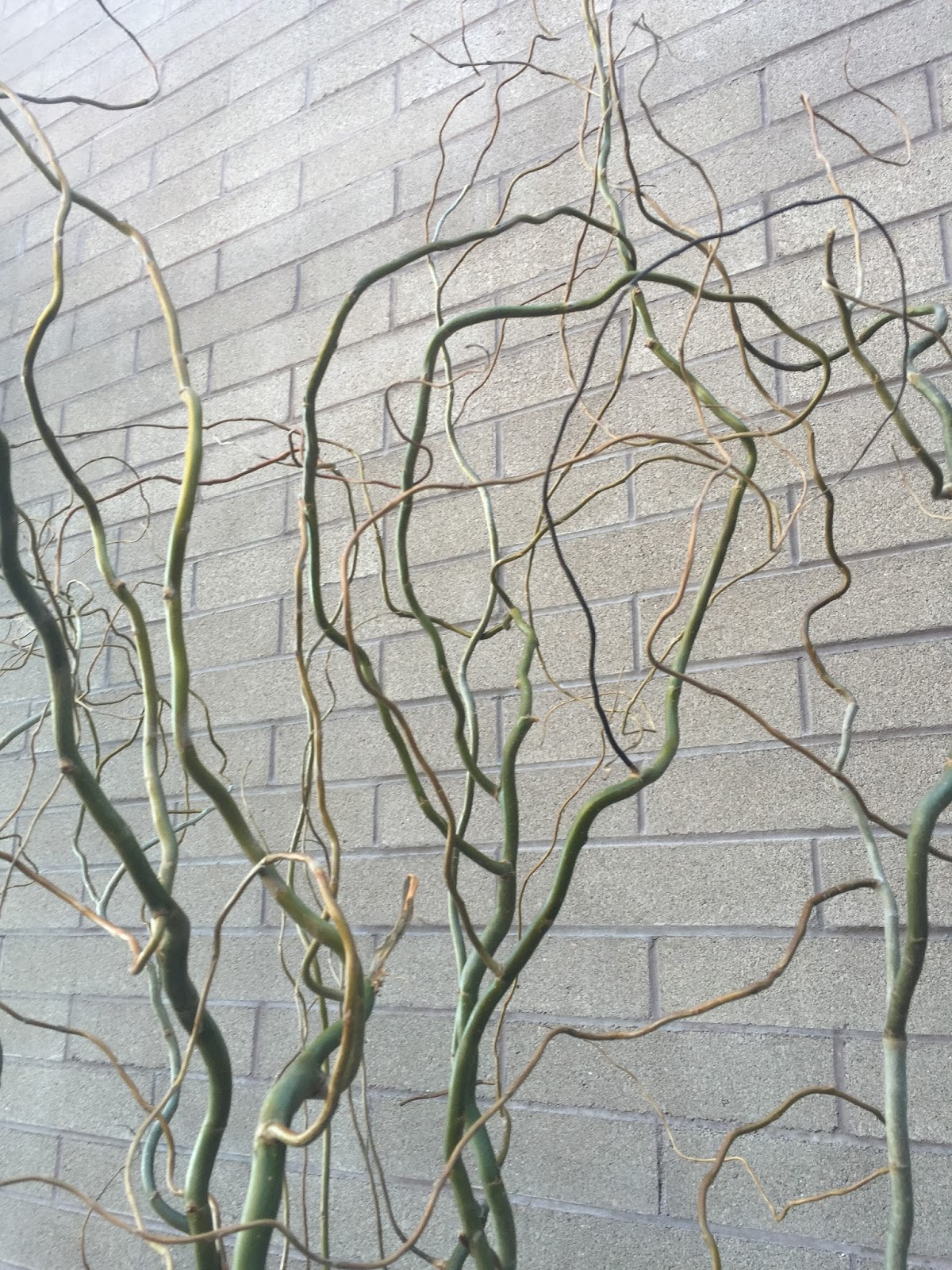
Harry Lauder’s Walking Stick (Corylus avellana 'Contorta') as well as several species of Willows (Salix sp.) have contorted habits which add texture to a landscape.

Contorted Shrub Willow

Other shrubs retain their fruit into the winter which can add interest and color to a winter landscape as well as attracting birds. Many species of hawthorn (Cratagus sp.) retain their fruit into the winter along with shrubs like firethorn and some crabapples.


Due to their spreading suckering growth habits some sumacs (Rhus sp.) should be used with care in smaller landscapes.  However, many species of sumac keep their interesting red fruits through winter.
Fruit of Staghorn Sumac (Rhus typhina)


Curlleaf Mountain Mahogany 
Most people are familiar with the more common evergreens like pines, spruces and junipers.  However many are less familiar with broad leafed evergreens.  These plants retain their leaves all winter and add both color and texture to a winter landscape.  There are actually quite a few broadleaf evergreens which can be grown in our area including,  curl leaf mountain mahogany, mountain mahogany, winter creeper euonymus, Manhattan euonymus, English ivy, Oregon grape holly, creeping grape holly, manzanita, joint fir, Spanish broom and firethorn.  All of these plants will benefit from winter watering and many will do better in sites which are protected from drying winter winds.   


Creeping Mahonia


Tuesday, October 20, 2015

What Happens When You Give Four Horticulturists a Camera


Posted by: Eric Hammond, Adams County Extension

A couple of months ago Dr. Alison O'Connor (CSU Extension), Dr. Tony Koski (CSU Extension), Tyler Mason (Horticulturist at Cheyenne Botanic Gardens) and I got together to film some short videos on tree selection and care.   This was a really interesting experiment in what happens when you give four people with no training in videography a camera.

Our fearless (and only slightly bossy) director.
Notice the use of cutting edge equipment like tripods.


By the end of the day we had purposely bare-rooted container nursery stock, did our best to kill a callery pear with a string trimmer and learned the importance of team work when lifting heavy objects.
  
We learned a lot and all things considered, I think it turned out pretty well.  Here is the final product (eventually we may break it into shorter videos):
  

A special thanks to Adams County Colorado Master Gardener Anthony Pressgrove who volunteered his time to edit the video for us.


Saturday, August 1, 2015

Ash leaves Curling?


Posted by Eric Hammond Adams County

The wet weather which much of the state has experienced this year has been great for water bills, lawns and many plants in the garden.  However, it has also created some challenges.   One pest which has thrived under the moist and humid conditions is the ash leaf curl aphid (Prociphilus fraxinifolli).

Curling leaves on a mature ash
 
These insects are a type of wooly aphid which begins feeding on the underside of terminal leaves of green ash (Fraxinus pennsylvanica) in the spring.  Their feeding causes the leaves to curl (thus the aphid’s name).   Late in the summer winged individuals are produced which migrate to the roots of ash trees.

Leaves curled by ash leaf curl aphid
 

The damage caused by this pest is showy and often alarming to tree owners.   However, it is mostly a cosmetic issue and is normally not a serious concern to the tree’s health.   Normally treatment with insecticides is not warranted and sprays are ineffective once the leaves have curled, providing protection for the aphids within.   There are systemic treatments available but they can take several weeks or more to be affective and, again, are not normally necessary for the health of the tree.   If the curled appearance of the terminal leaves is distressing they can be removed from the tree.


Another nuisance associated with the insect is the sticky excrement they produce which is known as “honeydew”.   This sugary substance drips from affected trees in such quantity that it can coat cars, patio furniture, sidewalks or any other element of the landscape which is unlucky enough to be below the trees.   The honeydew is not only sticky and unpleasant but it is also commonly colonized by gray sooty mold which give it a black appearance with often appears to stain whatever it has dripped on.
Ash leaf curl aphids produce a white waxy substance as well as a sticky excrement
know as "Honeydew"


However, while all of this is a pain (pain in the Ash?), the issues associated with ash leaf curl aphid are still mainly aesthetic nuisances and it is not a serious threat to the tree’s health.  In most cases tolerance is the best option for dealing with the pest.   More information can be found in the “Aphid on Shade Trees and Ornimentals” Factsheet located here.

Thursday, June 18, 2015

Options for Small Flowering Trees

Options for Smaller Flowering Trees

Posted by: Eric Hammond Adams County Extension


Newport Plumb Damaged by Last November's Sudden Hard Frost


As other bloggers have noted, this last winter was hard on woody plants throughout much of the state.  One of hardest hit groups, at least in Adams County, were the traditional smaller ornamental trees, including many ornamental and tart cherries, plums of all types and, to a lesser degree, some varieties of crabapples.   Many of these trees are dead or have severe die back.  


Damage to Crabapple


Some of the species and selections that were affected had been reliable for years and likely still deserve a place in our landscapes.  However, in the interest of promoting diverse plantings I thought I would highlight a few potential replacements which seem to have come through the challenges we have experienced this past winter.


Damage to Crabapple
 

Tatarian maple (Acer tataricum)-


Hot Wings Tatarian Maples

 
This maple is a smaller tree with a spreading to rounded habit which is often somewhat wider than it is tall.  White flowers occur after it leafs out and develop into a double samara fruit by early summer.  This fruit is reddish and persists through the summer providing interest throughout the season.  This fruit is especially showy on selections such as Hot Wings (Acer tataricum 'GarAnn'- a Plant Select introduction).  In the fall the leaves of the tatarian maple turn an eye-catching red-orange. 


Tatarian Maple Flowers
 
Fruit of Hot Wings Tatarian Maple 

 
Russian hawthorn (Crataegus ambigua)-

 
Russian Hawthorn in Bloom

This tree has a rounded habit and attractive gold-yellow bark.  It has white flowers which appear in mid-May in most years and develop into a red fruit.  This fruit persists on the plant into the fall and, at least in our garden, is mostly eaten by birds before it can fall to the ground and become a mess.  The fall color of Russian hawthorn is an attractive yellow with undertones of purple.  Plants will tolerate minimal watering once established.

 
Russian Hawthorn Late Summer
Russian Hawthorn Fruit


Japanese Tree Lilac (Syringa reticulata)-

 
Japanese Tree Lilac Early Summer


This plant is small tree with an oval habit and dark green leaves.  It is related to the more common shrub lilacs but has white flowers which occur after its shrubby relations are done blooming (there is one outside our office which actually still is in bloom).  This tree develops a yellow fall color which varies greatly in quality from year to year depending on the conditions during the fall.   
Japanese Tree Lilac Flower