Posted by: Alison O'Connor, horticulture agent in Larimer County
I never feel like I’m on top of trends, whether it be
clothing, cars or electronics. [Really? It’s not fashionable to wear plaid pajama
pants in public?] And when it comes to my garden, I tend to stick with plants
that are “tried and true.” Sure, I've planted a few novelties in the past—some make
it; others turn into compost. Most of my experiments are planting vegetable
cultivars that I never eat.
My brother works for a large wholesale nursery in Oregon, and a few
weeks ago I was telling him (whining, really) about all the plants in my garden
that didn't make it through the winter. Being the nice brother he is, he sent
me a plant care package! With fabulous perennials! I’d heard of a few, but most
I had to Google to get an idea of what they looked like...and find out their mature size.
I have a Heuchera
(coral bells) collection, which is where most of my "popular" plants are located.
Anytime I see a coral bell that I don’t think I have, I buy it or ask Jeff to
find it for me (remember he lives in Oregon—the mecca of the plant world). Plus the
names make you salivate: Caramel, Southern Comfort, Blackberry Crisp, Chocolate
Ruffles, Peach Melba, Lime Marmalade, Berry Smoothie, Grape Soda. Truly, I've
lost count of the ones I have...as well as all the name tags. But these plants do
really well in my part-sun garden with minimal irrigation. They do need to be
mulched prior to winter and are slow to wake up in spring, but I adore coral
bells, especially the flowers that dance above the foliage. And hooray—they are
rabbit resistant!
 |
[Photo from Terra Nova Nursery: www.terranovanurseries.com]
Blackberry Crisp coral bells |
I am also the proud owner of the 2014 Perennial Plant of the
Year:
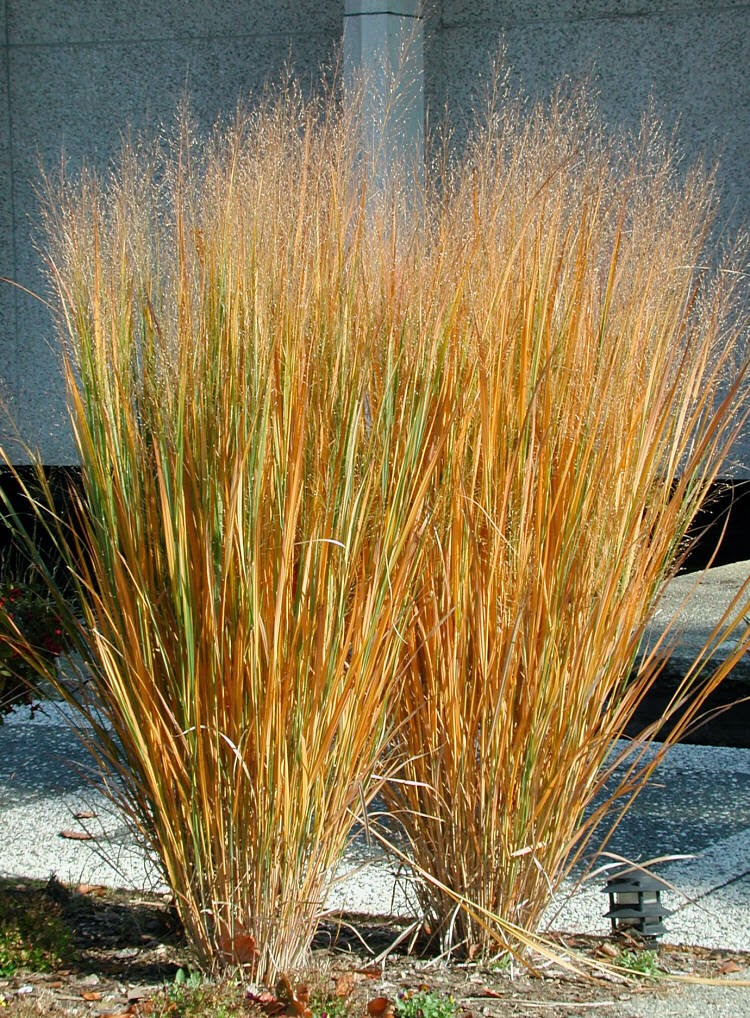
Panicum virgatum ‘Northwind’.
Switchgrass. Just the name alone sounds like fall. Switchgrasses are drought
tolerant, sturdy and stay as a nice clump. Northwind’s foliage turns gold in
fall. Can’t you just picture the fall sun glinting through the leaves? Wow. A
2014 plant of the year in my garden! Check out more on the
Perennial Plant Association.
 |
[Photo from the Perennial Plant Association: www.perennialplant.org]
Northwind switchgrass in fall |
Another Panicum in
the shipment was ‘Shenandoah’. Jane Rozum, who just graduated from CSU and is
now the hort agent in Douglas County, had this species in her ornamental grass
trials. Let me tell you—I love this grass. Green foliage turns to maroon
foliage in fall with ruby-colored wispy flowers. It is awesome. I’m so excited
to welcome this to my landscape. It’s big too, with a height of up to 6’ and 3’
spread.
 |
[Photo by Jane Rozum]
Shenandoah switchgrass |
Another grass in the package was prairie dropseed (Sporobolus heterolepis). No, this isn’t
a new plant or a fancy cultivar, but it’s a fantastic ornamental grass. And
guess what? It’s a native! It’s tough, drought tolerant, virtually pest-free
and really pretty.
 |
[Photo by Karl Foord, University of Minnesota]
Prairie dropseed |
He also sent a Stachys
(which most of you know as the genus lamb’s ear). I have an extreme fondness
for lamb’s ear. I fell in love with this fuzzy darling during my undergrad and
joked that one day I would have a lawn of lamb’s ear in which to roll around. Though
many hate the flowers (I simply cut them off) and it’s in the mint family (i.e.
aggressive), lamb’s ear is a great selection for spaces where you need to fill
large gaps in dry places. But the Stachys
my brother sent is actually Stachys
officinalis ‘Pink Cotton Candy’ (a cousin of the plant we know). Now, I
don’t know much about this plant, except for the pictures I saw online, but
it’s a clump-former with pale pink upright flowers. It blooms in early summer
and will repeat bloom if flowers are cut back. Has anyone grown this in
Colorado…or was this plant so-2004? I'm excited about it.
 |
[Photo from Chicagoland Grows(R): www.chicagolandgrows.org]
Pink Cotton Candy Stachys |
 |
[Photo from Chicagoland Grows(R): www.chicagolandgrows.org]
Ooooh...fantastic pink flowers! |
I’m looking forward to seeing these plants sleep (first
year), creep (second year) and leap (third year). Just like my ginkgo…which, by
the way, is fully leafed out!


