CO-Horts

CO-Horts Blog

Showing posts with label Linda Langelo. Show all posts

Monday, July 1, 2024

Coming Soon: County Fairs

 Posted by Linda Langelo, Golden Plains Horticulture Specialist

The county fair has something for everyone. Exhibiting is only part of it. Come out and see 4-H. The 4-H members work hard throughout the year and come to the fair to be judged on showmanship competition with their animals.

Open Class Horticulture Entries. Yuma County Fair 2023.

Fairs are about community. As a community member, if you have a craft or hobby such as quilting or photography, exhibit and show people what you do. Just follow the instructions in the fair book and you will be off to a good start! The rules are clearly written. For exhibiting for Open Class there are general rules to follow. If you are exhibiting in horticulture to show off your flowers, the rule might be to use a certain vase. Other rules might be asking you to bring a clean container and one that is weed-free. Be sure to bring the freshest flowers that are pest and disease-free.

"Flowers for Mom" class at the Yuma County Fair. 

Bring your vegetables and exhibit them. Different fairs have different types of exhibits. There is one where the longest zucchini wins! Another is the heaviest zucchini wins! Enjoy the food vendors! Bring your family and bring your friends. Some fairs have rides, and some fairs have concerts. Make it a fun time!

Most fairs have individual plant categories you can enter. 

Come out to the fair and enter.  Give it a try. Nothing ventured, nothing gained! Happy fair time!

Monday, April 10, 2023

Did You Know Who Coined the Term "Nativar"?

 Posted by: Linda Langelo, Horticulture Specialist, Golden Plains Area Extension


                                                Photo Credit: Wikipedia

Allan Armitage, author of Armitage's Garden Perennials, horticulturist and 
professor at Georgia University coined the term "nativar" "to show customers
that the industry was offering what they wanted: garden plants developed
from documented native sources, known in the scientific community as 
genotypes" from "What's in a Nativar?" by Carol Becker. A nativar is a
cultivated variety of a native plant that some ecological value in the 
environment. Nativars can be a native plant that is a genetic variant found in 
nature. That plant is then selected and propagated to retain a particular or 
unique aspect. Nativars can also be obtained through the process of artificial
selection in which plant breeders grow plants with desirable characteristics and
eliminate those with less desirable characteristics according to Wildones.org.

According to Ryan McEnaney, Bailey Nurseries' Communications and Public
Relations Specialist, "Nativars allow us to retain the ecological benefits of native
species while making them adaptable and accessible for a modern landscape.
Whether that means a more compact size, cleaner foliage, better color, or a tidier
appearance, nativars solve problems that can arise with the genotype." At your 
nurseries and greenhouses, you may be finding more compact sizes of favorite
native plants with bigger blooms and better color with more disease resistance.

The next question is to plant or not to plant? According to Mary Phillips of the
National Wildlife Federation, it is good to plant 80% native plants and 20% 
cultivars or nativars so that specialist feeders still get what they need to survive. 
Doug Tallamy, American entomologist, ecologist,conservationist and author 
recommends that using  70% native plants and 30% cultivars or nativars is good.
Though Phillips and Tallamy might differ in percentages, the higher the percent 
of native plants the better. 

Let's look at Echinacea purpurea 'White Swan' for a moment. It is a nativar
because it is a cultivated variety of the native species with a white flower. It
is a plant that lives a long time. Another new nativar of Echinacea is
'Snow Cone' another white flowering coneflower with a compact size 
up to 2 1/2 feet for the front of a perennial border. With Echinacea 
alone there are many new nativars to choose to add to your perennial areas. 

                                            Photo credit: Mt Cuba Center

With some nativars, they will feed the indigenous pollinators while being 
resistant to fungal issues, disease and insects. The cultivated plants 
have larger, more color-saturated corollas which are more enticing to 
insects and hummingbirds according to Catherine Winter of 
Morningchores.com in her article, "What are Nativars and Are They 
Beneficial or Detrimental?"

The key to a healthy landscape is the same thing the doctor might say to 
you about moderation and balance in your diet. (Too bad chocolate 
isn't a vegetable.) Apply that in the landscape. Doing so brings about
diversity. If you have all lilacs and daylilies, if a disease or an insect
comes on your property and attacks the daylilies, then you have lost
a great deal of your landscape. Using a variety of plants keeps your 
landscape healthy. Every plant has a purpose and a place. 


Tuesday, April 19, 2022

Old Mulching Technique


Old Mulching Technique
By CSU Horticulture Agent, Linda Langelo


                                  Liquidambar styraciflua 'Volcano'

                                             Photo credit: Anonymous

You might ask yourself, "Is the author for real?" This is not a cultivated variety. Unfortunately, the technique of volcano mulch practice is still alive and well. This practice was considered the best practice during my parent's lifetimes in the 1940's. As Maya Angelou has said, "When we know better, we do better." Hopefully.

Liquidambar styraciflua is commonly called Sweetgum. It grows in zones 5-9 on wet river bottoms, swamps that frequently flood and sometimes on drier uplands. According to the Colorado Tree Coalition there is a sweetgum that is The Colorado State Champion Sweetgum (DBH 17"/Height 57') in Fort Collins. Sweetgum can grow to be 80-120 feet tall and 4 feet wide. But this depends on many environmental factors such as growing it in a moist soil with no high winds, hail damage or temperature extremes from 75 degrees Fahrenheit to -5 within in a few hours. It is a medium to fast grower. In aklaline soils iron chlorosis is a problem along with webworms, scale, bleeding necrosis and leaf spots.

As a tree hugger, seeing the volcano style mulch I should have titlted this blog article, How to Kill a Tree in Two Years or Less. I might add the person who sent this to me is not a tree hugger but sensed that this was not the right thing to do. Knowing that we already have Sweetgum as a Champion Tree why not give Sweetgum Trees everywhere the same opportunity? Or for that matter any tree the opportunity to become a Champion Tree or just to be an old tree?

Here is what can happen when trees are mulched this deeply:

1)the foliage starts to yellow or become off-color

2)there are abnormally small leaves

3)poor twig growth and dieback of limbs

What happens when you bury the root flare? Because the root flare has different tissues than other roots, piling mulch heavily decreases the gas exchange stressing the inner bark. These are lenticels which are pores the tree uses for gas exchange. Blocking them or waterlogging them with a barrier of mulch begins to affect the health of the tree. When the inner bark dies, roots become malnourished and weak. It would be no different than planting the tree too deep. 

By having a volcano of mulch around the trunk, this encourages diseases. Bacterial and fungal diseases require moisture. These diseases are opportunistic and mulching like this gives them the conditions they need to survive and prosper. These diseases can stop both the flow and storage of sugars produced in photosynthesis placing the tree in decline. Many borers are known to be attracted to trees in decline.

As if oxygen deprivation and starvation are not enough in over-mulching a tree, excess heat is another issue caused as the mulch decomposes. The high temperatures again affect the inner bark. With young trees if the trunk flare is not hardened off before a hard freeze, this results in damaged tissues.

Lastly, rodents and field voles like cover whether it is tall grass or deep mulch. Add girdling the trunk to the list of possibilities. There is no way of saving the tree when this happens. 

What is the solution? Leave the root flare free of mulch. Mulch 2-3 inches on the edge of the shoulders of the root ball. Here are some links to proper tree planting and mulching: 

https://cmg.extension.colostate.edu/Gardennotes/658.pdf

https://static.colostate.edu/client-files/csfs/pdfs/TreePlanting_636.pdf

Share this post. Spread the word. Help stop volcano mulching forever!


Monday, January 17, 2022

Coneflowers


Coneflowers

By CSU Horticulture Agent, Linda Langelo

                                        Photo credit: Fossil Creek Tree Farm, Cheyenne Spirit


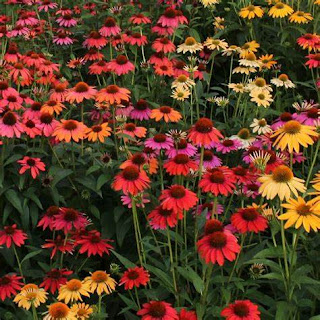
New research is being done all the time with cultivated varieties. One such garden that does trials on coneflowers and many other perennials is Mt Cuba Center. This garden is a botanical garden that studies native plants and plant conservation.

Coneflowers are native to central and eastern United States. Coneflower or Echinacea is a clump-forming herbaceous perennial. Echinacea purpurea produces roots that are more fibrous while other species produce roots that are taproots. This allows them to grow in areas that experience drought and in areas that have heavy competition from other plant's roots. All coneflowers require well-drained soils. The fibrous root system of Echinacea purpurea makes it an ideal plant for many garden sites that have a perennial mix.

Some of the nine species Mt Cuba Center studied grow here in Colorado. The observation of these plants was over a two-year period. Both the performance and visitation of various pollinators was recorded. No fungicides were used during the two-year period. Supplemental water was provided in the first season only to allow the plant's roots to become established.

Of all the Echinacea purpurea species trialed at Mt Cuba Center, the cultivated varieties that performed the best were Echinacea purpurea 'Pica Bella' and Echinacea purpurea 'Fragrant Angel'. Why were they chosen? Their overall habits were sturdy, semi-compact that resisted flopping. There was no need of staking.

Echinacea purpurea 'Pica Bella' is a cultivated variety that most resembles the straight species, Echinacea purpurea in its floral display. This variety also ranked ver high in the number and types of pollinators that were found on the prominent orange cones during the late June to mid-July bloom time. Among the types of pollinators were butterflies, bees, and wasps. The plant will reach a height of only two feet compared to the four feet of straight species. 

                                     Photo credit: Missouri Botanic Garden - Pica Bella


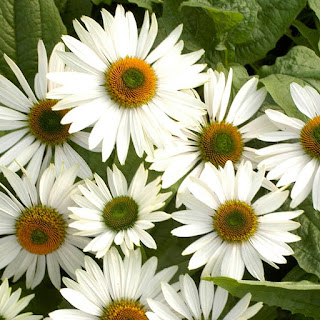
Echinacea purpurea 'Fragrant Angel' is the highest rated of all the cultivated varieties of a white flowering Echinacea. The blossoms are around four and a half inches wide that flower from July into August. This plant is also ranked very high for attracting pollinators such as bees, wasps, and butterflies.

                                            Photo credit: White Flower Farm - Fragrant Angel


Overall, Echinacea are short-lived plants unless they are started from seed. They also have an incurable systemic disease called Aster yellows. It is a pathogen called a phytoplasma, a microorganism that is spread from plant to plant by leafhopper insects. The only way to reduce the spread of the disease is to get rid of the infected plants. 

The other issue with Echinacea is eriophyid mites which can cause unusal growth in the floral cones. In this case the removal of the floral cone can help to control the mites. The symptoms for eriophyid mites are localized infection with the lack of green leafy growth originating from the flowers.

In Sedgwick County Extension, we started a trial garden of Echinacea in 2021. We will see which ones overwintered and how prolific and disease free they are in 2022. The cultivated varieties we chose were based on local availability in the nurseries. These were the following Echinacea

  • 'Cheyenne Spirit (Echinacea hybrida)
  • 'Prairie Giant'
  • 'Kim's Knee High'
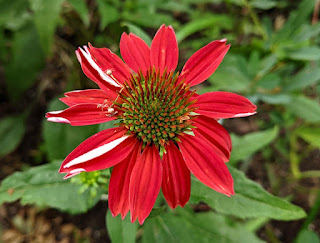
  • 'Solar Flare'
    
Photo credit: Missouri Botanic Garden - Prairie Giant


We wished we could have purchased Echinacea 'TNECHKR' and Echinacea paradoxa. According to Mt Cuba Center they were very prolific with flowers and had the greatest garden adaptablility. Echinacea paradoxa, a yellow flowering coneflower also produced vigorous, disease-free plants. Who doesn't want that for their gardens.

                                 Photo credit: garden.virtualindustry.org-Paradoxa


Photo credit: reddit - Solar Flare


Monday, December 27, 2021

Harison's Yellow Rose

Posted by: Linda Langelo, Golden Plains Area Extension

Driving around our small rural towns you will notice a yellow shrub rose. This yellow shrub rose has many names such as Pioneer Rose, Oregon Trail Rose, the Yellow Rose of Texas, Yellow Hogg's Rose, and Yellow Sweet Brier. Some of the locals here have called it Traveler's Rose or Settler's rose who have had the rose on their farm or homestead through the decades. And that's just a few of its names, but a rose by any other name would smell as sweet, right? Its real name is Harison’s Yellow rose.
Harison's Yellow rose
Harison's Yellow rose (photo by Linda Langelo)
This was the first rose of yellow color in this country. This rose has traveled the country from east to west and back again. In the 1800s Richard and George Harison were amateur rosarians and kept a rose garden at their home in Manhattan on their estate Mount Sinai in a semirural area. Today Eighth and Ninth Avenue between 30th and 31st streets are now what was once their garden. The Harison brothers kept Persian Yellow (Rosa foetida) and Scotch Briar (Rosa spinosissima) in their garden. The parentage is still uncertain, but most agree that this must have been a chance hybridization between the Persian Yellow and Scotch Briar growing in Harison's garden.

After being discovered in Manhattan it was to be given to several nurserymen. Two of the nurserymen were Thomas Hogg and Williams Nursery. Some accounts say it was marketed in 1830 while others say it went on sale in 1835 at the Prince Nursery in Fleming, New York called 'Harison's Yellow'.

As the pioneers came west some of the pioneer women sewed the roots deep into their hems of their linsey-woolsey skirts. As they walked through the prairie grasses, the dew would moisten their skirts and keep the roots alive. More specifically, it came to Texas from the Prince Nursery by way of Emily D. West, a freeborn African American who contracted with the entrepreneur James Morgan to work as a servant in the town of New Washington. When the revolution for Texan independence from Mexico engulfed New Washington, Emily West became a hero. On April 21, 1836, at Santa Ana Camp Emily distracted the revolutionary leader Sam Houston long enough to give her countrymen time to stage a surprise attack. After 1837, she went back to New York and was never heard from again except in song and lyrics from a folk tune titled, “The Yellow Rose of Texas”. Emily, the maid of Morgan’s Point was of mixed race, a mulatto. With her light complexion she was known colloquially as “yellow”. She was memorialized as “the sweetest little rosebud, that Texas ever knew.”

Texans of the Knights of the Yellow Rose use a yellow rose to pin to their lapels when they convene every April on the site of Santa Ana camp and pay tribute to Emily West. The Dallas Area Historical Rose Society’s newsletter, The Yellow Rose, annually features a yellow rose on the cover. The Harison’s Yellow rose has been used among other yellow roses.
Harison's Yellow rose in the author's landscape
Harison's Yellow rose in my landscape (photo by Linda Langelo)
Today this rose is found in many mountain and prairie communities across Colorado growing best in zone 3. This rose grows in cool, dry weather. It has sharp thorns and forms suckers on its own roots. The best part is that it is hardy. It tolerates full sun to part shade, drought, poor soils, and pests. It is said it takes more than one attempt to get this established. I have not found that to be so. My neighbor gave me permission to take one root and shoot from my neighbor's yard, and it is 5 feet tall and 5 feet wide three years later. Truly this plant thrives on neglect.

Thursday, August 19, 2021

Change the Future: Plant a Tree


 Photo Credit: Bruce Marlin, Morton Arboretum


By CSU Horticulture Agent Linda Langelo

Trees are more valuable to us because they are an integral part of our lives.  Without trees we would have less oxygen since they take in carbon dioxide and release oxygen. Trees cool the atmosphere. Trees give us food and materials to build our homes and so much more. If you have space in your landscape, consider adding another tree. Here are two reasons why:

1)      It is good to have a diversity of trees in your landscape. If they are all the same, when one is effected by a disease the other trees are not a host to it.  But there are many more benefits to trees. They cool the air, land and water if strategically placed. According to the Arbor Day Foundation trees cool shaded surfaces between 20 to 45 degrees Fahrenheit below the peak temperature of any surface in full sun nearby.  

2)      As for larger towns and cities, trees can be used to cool the street and homes. Trees release water vapor into the air through their leaves cooling the town or city down 10 degrees Fahrenheit. In fact, one single small tree has the capacity to cool as much as 10 single room air conditioners over a 20 hour period. The best part is it doesn't impact your electric bill to cool the environment around you. Well almost. You do need to water the tree. Trees need water during extended periods of drought and during fall and winter. Here is a Colorado State University Extension Fact Sheet on Fall and Winter Watering:
Fall and Winter Watering (colostate.edu)

On a global scale, forests remove about one-third of fossil fuel emissions annually from 1990 to 2007.  Trees remove pollution such as the 26,000 tons removed from Greater Kansas City each year. Wildfires occurring in the west and other places globally, lessen the capacity of forests to remove fossil fuels or add to the cooling capacity of the environment.

However, new research in a paper titled, "Trees, forests and water: Cool insights for a hot worldpublished in the journal of Global Environmental Change had 22 co-authors from the United States, Australia, Britain, France, Sweden, Norway, the Netherlands, Peru, Indonesia, Ethiopia, the Czech Republic, Italy, and Belgium all stated, the more important process that trees assist with in our environment is the redistribution of water. According to David Ellison, they redistribute water and simultaneously cool planetary surfaces. These scientists are determining that deeper roots, trees can maintain their cooling function even during long-lasting heat waves.  In Extension, we teach water deeply and less frequently with all plants from trees to vegetables.  Trees are a very important part of the hydrologic cycle. 

According to the Arbor Day Foundation, 180 million Americans depend on forest watersheds for their drinking water. The natural water filtration trees provide can lower costs associated with drinking water treatment.  

The U.S. Forest Service states that trees properly placed around buildings can reduce air conditioning needs by 30% and can save 20-50% in energy used for heating.  On a larger scale in Cincinnati community trees save the average household $56 annually in cooling costs by reducing electricity use. 

Overall, the U.S. Forest Service states “every dollar spent on planting and caring for a community tree yields benefits that are two to five times that investment. Why? Trees clean our air, lower energy costs, improve water quality and storm water control and increase property values”.  

If you are not sure of what trees to plant and where, then test the soil and find trees that do well in the soil in your landscape.  Be sure to place them with enough space for them to grow. If you need planting instructions here is a link: https://static.colostate.edu/client-files/csfs/pdfs/TreePlanting_636.pdf

If you need tree suggestions here is a link to Plant Select which has all types of plants that after being trialed are selected as some of the best plants for Colorado: https://plantselect.org/

If you need suggestions for Small Deciduous trees, here is a CSU Fact Sheet: https://extension.colostate.edu/topic-areas/yard-garden/small-deciduous-trees-7-418/

If you need suggestions for Large Deciduous trees, here is a CSU Fact Sheet: https://extension.colostate.edu/topic-areas/yard-garden/large-deciduous-trees-7-419/

If you still have questions after reviewing the fact sheets and other materials, please contact your local Extension Office. We can help better inform you towards making the right choice.  I hope if you have the space that you decide to plant a tree.


Saturday, January 30, 2021

Beekeepers Head to California


By CSU Linda Langelo, Horticulture Agent

           Hives being dropped for placement/Photo credit: Jessica Filla


It is time for the almond orchards to start coming in bloom by February and March. Beekeepers from all over descend upon California whose second largest crop is almonds and/or sometimes milk. Why? Almonds are nutritious for honey bees. The pollen provides 10 of the amino acids needed in their diets.
 
A local commercial beekeeper, from Akron, Colorado called Filla Honey travels each year to Chowchilla, California in South Central Valley. They arrive starting in November to set-up and place the hives and then leave. They make multiple trips until the end of March.  These trips are for feeding and maintenance.  Why so early when almond trees start blooming in February? Bees much like plants need to be acclimated to their new environment.

Their hives are also subjected to California Department of Food and Agriculture quarantine regulations to prevent entry of colonies contaminated with varroa or tracheal mites harmful to the bees. Their hives could be turned away at great cost to their business.
 
During the process they are met with challenges such as the 4 inches of rain which happened this past week. The soil in some places is a rich clay, and in that much rain things get very sticky. In other parts of the orchards, it is very sandy. 
 
Photo credit: Jessica Filla
 
 
The beekeepers strategically place the hives based on the age of the trees. Then wait for them to produce their flowers. The Almond Board in California has encouraged almond farmers to plant pollinator habitat in or adjacent to their orchards for additional food.
 
How many hives does Filla Honey bring? They bring 900 hives. They are part of a family co-op which adds several hundred hives to that number.  The final total will end up being 4,000 hives that they need to feed and maintain until the flowers start blooming.
 
                       Filla Honey Semi Truck/Photo credit: Jessica Filla
 
The average cost for the recommended 2 colonies (2 hives) per acre is $400 to lease hives for the almond orchard farmer.  This is for two months of pollination where the bees will use both nectar and pollen from the blossoms.  If the season turns out to be cold and wet, the bees will spend less time outside the hive.  That's bad for business and not just for beekeepers. Why? According to ABC in their data collection of the almond orchards, California produces 80% of the world's almond production.

                    Photo credit: Almond Board of California/ABC


Each semi holds approximately 480 hives.  So just for their initial hives of 900 that makes two semi trucks to California. Each semi has a net over the hives to capture any adventurous bees attempting an escape. 

                       Hives waiting to be placed./Photo credit: Jessica Filla
 
When Filla honey collects all the honey from their hives it will be a darker honey.  The almond honey can be confused with buckwheat honey since they are both a darker honey.  But very different tastes. Try both honey sometime, if you haven't. You may become hooked.

Thursday, January 28, 2021

Teach a Child to Garden

                           By CSU Horticulture Agent, Linda Langelo


            Photo credit: Linda Langelo, Sherry Brandt with Kylie & Carlie

If for some reason you were not able to teach your child how to start gardening, then maybe in 2021 growing season you can.  Here are some very simple ways to engage your child:


  • Ask if they are interested in learning about gardening.
  • Share with them every step in the process.
  • Start at the beginning of looking through catalogues and selecting seeds.
  • Show them how to grow squash, watermelon, and cantaloupe in a container.
  • Provide a calendar that is separate for gardening tasks.
  • Mark dates on the calendar for starting certain seeds, frost free dates and so on.

Above all, give them responsibility. Naturally, the responsibility you assign each child will differ with their age. Responsibility to do certain small tasks you know they can handle such as watering the newly planted squash seeds and marking the calendar when they have watered them.  That way everyone knows. 

Make clear and simple explanations for why you are doing certain tasks when you are doing them. Children are inquisitive and imaginative.  Encourage these qualities by helping them explore.  What happens when you do not plant the onion bulb in deep enough or with the basil end facing the soil surface. Let them plant one onion bulb incorrectly and use a stake to mark it. Watching and wondering what will happen is half the fun.  When the onion sprouts along with the others is when you explain geotropism to them.

Giving them the opportunity to explore and encourage their curiosity which can engage them further with gardening. By doing these things you are giving your children a hand in every aspect of the family garden.  When I was only eight years old, my grandmother told me about the importance of working in fertilizer and sometimes coffee grounds around her roses.  She showed me how and then gave me the responsibility to get it done.  Your child may not grow up to have a career in horticulture like I have had, but they may have gardening as a hobby for the rest of their life.  When times get tough, they know how to grow their own food.

For more information to help assist you in this endeavor, here is a link to a CSU article by a CSU Master Garden in Larimer titled “Growing Food and Growing Gardeners” : https://extension.colostate.edu/topic-areas/yard-garden/growing-food-and-growing-gardeners/

At the bottom of the article posted above are CSU Fact Sheets to help you with growing vegetables.  In 2021 growing season, Grow and Give will continue.  Consider taking part if you did not in 2020. For more information go to the following link: https://cmg.extension.colostate.edu/grow-give/

Also, get in contact with your local Extension Office or Master Gardeners in your area.

 If you need more assistance with gardening activities here is a short list of links for different age levels:

 https://kidsgardening.org/garden-activities/

https://garden.org/