CO-Horts

CO-Horts Blog

Showing posts with label Tomatoes. Show all posts

Wednesday, October 25, 2023

Ripening Tomatoes Indoors

by Denyse Schrenker, CSU Extension, Eagle County

The temperatures are consistently below freezing at my house and I am ready to put my gardening tools up for the season. Now I need to decide what to do with all of my unripe tomatoes that have been stuck in purgatory for most of October; not progressing under their frost blankets but also not dying. I can only handle so many fried green tomatoes and green tomato relish and salsa so I sort my tomatoes into those that will ripen off the vine and those that will not.
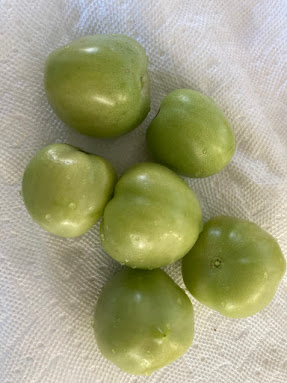

Some of the green tomatoes I separated for relish.

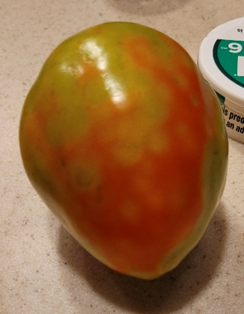
Tomatoes that are starting to develop a pink blush will ripen off the vine without any loss of flavor; this is called the breaker stage. Tomatoes that are a shiny green and have a white to light green star shape on the blossom end of the fruit have reached the mature green stage. These fruits will ripen off the vine but their flavor will not fully develop - a small sacrifice I am willing to make to eat fresh garden tomatoes well into November. Tomatoes that are a more matte green have not reached the mature green stage and will not ripen off the vine, these tomatoes can be used for green tomato recipes.
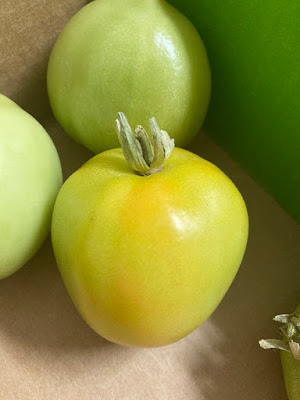

Tomato starting to develop blush color.

Once I have separated out the tomatoes I want to ripen, I remove any stems and wash and air dry the fruit on a clean paper towel out of direct sunlight. The dry tomatoes are then placed in layers 1-2 tomatoes deep in a covered box or a container with newspaper or cardboard covering them. I keep them in a dark cool location out of direct sunlight to ripen. Store the tomatoes at a temperature between 70°F and 55°F. Tomatoes stored closer to 70°F will ripen in a couple of weeks and tomatoes stored closer to 55°F will ripen in about a month. Tomatoes ripened below 50°F will be bland.
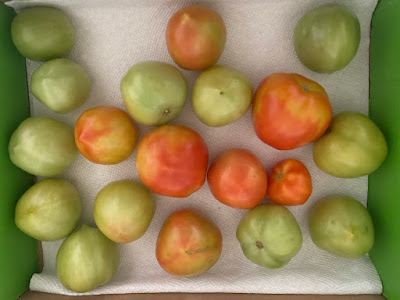

Washed, dried and ready to store for ripening.

Humidity can cause issues when ripening tomatoes indoors. Too much humidity causes the fruit to mold and too little humidity causes the fruit to shrivel. I typically have more trouble with too little humidity. To help increase the humidity, the tomatoes can be placed in a strainer or blanching pan and then placed in a covered container with water at the bottom. Make sure the tomatoes are not touching the water though. I check the tomatoes every couple of days and remove tomatoes that are ripe or nearly ripe. If I want the tomatoes to ripen more quickly I will add a banana or one or two red tomatoes to the green tomatoes.

Ripening tomatoes indoors does not need to be reserved for last ditch end of the season efforts! I try to pick most of my tomatoes when they develop that light blush color. I find that I get better yields harvesting them at this stage and then ripening indoors because I do not lose as many tomatoes to sunscald, critters, or simply missing them before they become over ripe. It may be the end of the gardening season but I am looking forward to having tomatoes all through the fall!

PlantTalk: Ripening Tomatoes Indoors

Thursday, September 1, 2022

Test, Don't Guess!!!


Welcome back to another edition of: “Who Wants to be a Plant Diagnostician?” with your hosts, the Jefferson County Plant Diagnostic Clinic. This week, we wanted to focus on the mantra, “Test, Don’t Guess!”, as it applies to plant diagnostics. In the world of plants, there are many pathologies that present similarly, so it’s critical to thoroughly evaluate the problem at hand and the possible causes in order to best create a management plan. Below, we’ve put together a few examples of some lookalikes that have recently come into our clinic…

Test, Don’t Guess!

***

When you hear the words “spots” and “tomatoes” in the same sentence, you may automatically assume tomato spotted wilt virus (TSWV), a virus vectored by adult thrips. And in some cases, you may be correct. For example, we received a recent inquiry regarding tomatoes presenting with chlorotic rings (shown below), a classic indicator of TSWV:


Tomatoes believed to have tomato spotted wilt virus (TSWV).

However, this assumption does not always hold up. In another recent tomato inquiry, we received photos of tomatoes that also have yellow spots (shown below); these spots, we think, are caused by stink bug feeding. Stink bugs typically feed on green fruit and produce dark pinpricks, surrounded by white tissue. However, as the fruit ripens, these damaged areas turn yellow.


Tomatoes with spots believed to be from stinkbug feeding. 

We say “we believe” the first example of tomatoes has TSWV and the second example was fed on by stink bugs because we haven’t received physical samples to the clinic yet. These are our initial suspicions and, to confirm, we need to TEST! To differentiate between TSWV and stink bug feeding, we would first evaluate the plant for other symptoms. TSWV may result in bronzing leaves, leaves with small, dark spots, tip dieback, streaked terminal stems, or drooping leaves. Conversely, stink bug damage should be confined to the fruit itself. At the end of the day, symptoms may be variable for TSWV though, so, fortunately, we have a great tool at our clinic to rule-out TSWV: a TSWV antibody test! As TSWV and stink bugs have very different implications for management and the fate of the plants, TESTING, and not GUESSING, is key!

***

Switching over now to woody plants, we received an inquiry regarding spruce trees that were experiencing browning/purpling of needles (see below) and extensive interior needle drop. Due to the cultural characteristics of the affected trees (very mature, very closely-spaced together, located near greater exposure to temperature extremes and winds, etc.) and the purpling of the needles, we felt confident that the trees were experiencing a cycle of high competition for water, drought stress, and winter dessication. However, due to the browning of the needles, needle shedding, and dark banding observed on some needles (see second image below), there was concern regarding fungal colonization of the spruce (i.e. needle cast fungi).


Discoloration and dark bands found on spruce, likely due to water stress and winter desiccation.

Although needle cast diseases are rarely found in dry environments, we made sure to TEST, not GUESS! Roughly one week after plating a number of suspicious areas of needle discoloration onto growth media, we had several different-looking fungal growths on our plates! In examining these various fungal growths under the microscope, we found no evidence of needle cast fungi; rather, we saw several types of saprophytic fungi (see example below) that are typically found in our environment and would not cause damage to spruce. Better to be safe than sorry!

Hyphae of saprophytic fungi (consistent with Alternaria/Ulocladium).

***

Our last example of the day deals with another woody plant: the Austrian pine. We’ve had a handful of individuals bring samples into the clinic lately, all highly concerned about Pine Wilt/Pinewood Nematode (PWN). The trees generally present with needle discoloration and rapid dieback or death of the tree, which is consistent with PWN. Additionally, some of the samples reveal bluestain fungus in the wood (shown below), which is another indicator of PWN. However, none of these symptoms are conclusive of PWN, so we always have to...you guessed it...test, not guess!

Blue stain found on Austrian pine.

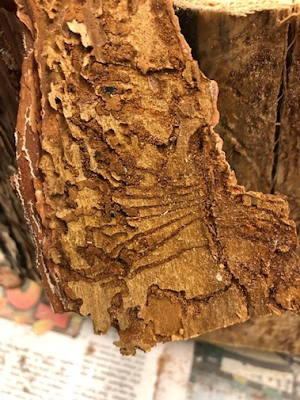
Further examination of the specific sample shown above revealed exit holes, galleries, and Ips pini beetles (see below). Egg galleries of Ips are usually Y- or H-shaped; upon hatching, larvae create smaller lateral galleries from the main gallery. Due to Ips tunneling, affected parts of the tree discolor and die, consistent with the symptoms of our samples. However, Ips typically attack already stressed and weakened trees, so while we have clear evidence of Ips, we can’t rule out PWN without a further test! 


Exit holes (top-right of top image) and galleries/frass (both images) made by Ips pini, found in Austrian pine.

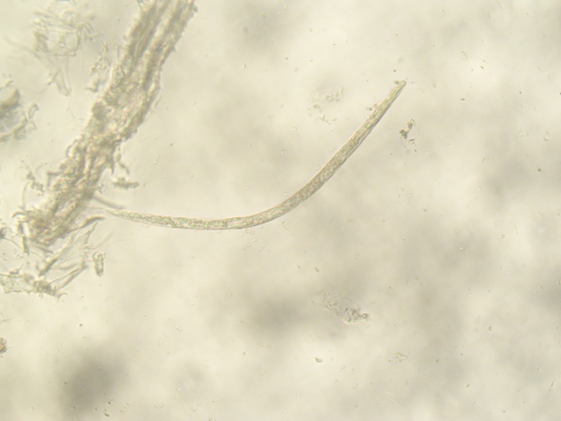
By running a PWN-specific test, we can extract and identify the nematodes responsible for Pine Wilt Disease, if present. Most of our samples came back negative for PWN; however, we did find a few nematodes in the sample (shown below)! BUT, they don’t have the same physical features as PWN…so, on to another test: we’re working through the identification of these nematodes to identify whether they are the Pine Wilt Nematode, Bursephalenchus xylophilus, or one of the many non-pathogenic nematodes that live in and around the tree.

Our unidentified nematode, approximately 300-350 microns in length.


This is an adult, male Pine Wilt Nematode; length approximately 1000 microns. Photo Credit: Pest and Diseases Image Library, Bugwood.org.

And that concludes today's edition of "Who Wants to be a Plant Diagnostician"! While I've most certainly overused this phrase throughout the course of this blogpost, I'm going to reiterate it one more time...TEST, DON'T GUESS!!!

Monday, February 7, 2022

Think Tomatoes!

Posted by: Alison O'Connor, Larimer County Extension

It’s official. Punxsutawney Phil saw his shadow and there’s more winter ahead. For those who’ve lived in Colorado for a few years, you know our snowiest months are usually February and March, but gardeners can use these days to dream of spring. Since 2019, the Larimer County Master Gardeners, under the supervision of fellow CMG Jon Weiss, have conducted tomato trials, trying to determine some of the most fruitful (and tasty) tomatoes for northern Colorado.

Jon Weiss, Master Gardener 'Celebrity', and mastermind of the tomato trials

Jon and his cadre of volunteer cohorts designed and managed two trials: the first was an in-ground study conducted in 2019 and 2021 at the ARDEC-South Experiment Station in Fort Collins; the other was a container study at the CSU Annual Trial Gardens on Remington Street.

Field Trials

With a pause in field research in 2020 due to Covid, this study started in 2019 and was replicated in 2021. Jon selected 12 tomato varieties, both hybrid and open-pollinated selections. There were three replications with five plants per replication of each variety. In working with the elements and challenges of an outdoor field study, the crops experienced all types of weather (including hail) and varying lengths of growing seasons. In addition to collecting data on when the tomatoes started maturing, average size of fruit and total yield was documented. New Girl was the earliest maturing variety and had the highest fruit yield for 2019 and 2021. While fruit size for this variety is small, those looking for high yields and large fruit may want to consider Carbon and/or Big Beef.

But how do they taste? Jon conducted taste-test studies with all 12 of the tomato varieties (thank you taste-testers!) and New Girl had an average flavor of 3.3 (out of 5) for the average of the two growing seasons.

All field-grown tomatoes were blind taste-tested. Participants tasted all 12 varieties and rated them for several flavor profiles. 

Master Gardener Anne Wuerslin jots down notes during the taste test.

Container Trials

In thinking about gardeners with smaller spaces, Jon also selected tomatoes to grow in containers. Tomatoes were not staked and left to grow in their natural habit, which was variable among the three varieties. Cherry Falls was an early maturing variety with a compact, somewhat open growth habit. Totem had a dense growth habit and was the latest maturing of the three. Patio Choice Yellow was as early as Cherry Falls, with larger fruit, and higher yield.

So if you like yellow tomatoes with big yield (an average of eight pounds of fruit per plant), Patio Choice Yellow might be a good one to add to your garden this summer.

It should be noted that all harvested fruit was donated to the Larimer County Food Bank, with several hundred pounds donated in 2021. For more results, check out the summaries here.

Going forward, Jon is planning to move on from tomatoes and will be conducting a sweet pepper trial in 2022, including bell peppers and “lunch box” types. Our thanks and appreciation to the staff at ARDEC-South and the CSU Annual Trials Gardens: Drs. Mark Uchanski and Jim Klett, Jane Davey, and David Staats for their support of these trials.

Saturday, September 4, 2021

What's in season at your farmers' market?

Posted by: Alison O'Connor, Larimer County Extension

For 24 weeks every year, I spend my Saturdays at the Larimer County Farmers' Market in Old Town Fort Collins. The market is powered by Master Gardener volunteers who support daily operations and part of my job is market management. It's been a Fort Collins staple for 45 seasons and we're proud to have over 100 vendors sell with us during the season and connect Extension to the community. 

So when it comes to growing produce in my own gardens, I'm not super motivated, because I have weekly access to beautiful fruits and veggies grown by experts (as well as meat, baked goods, dog treats, and more!). I know many of you are growing your own, but consider stopping by your local market to see what else you might need! Everything is in season right now. Thanks to Master Gardener Karen Collins for taking these photos.

Who else has made sweet corn a meal? Yep, it's that good.

PEACHES! I'm on a two-peaches-a-day meal plan.


If you're a "tomato head" you probably grow lots of different varieties already. But market vendors might have one that you just have to try.

Fresh flowers make the perfect gift...or addition to your home or office. The sunflowers, dahlias, and zinnias are in full glorious bloom right now. (On the left is Mitzi, Master Gardener and market vendor!)

I had never heard of roasted chiles until I moved to Colorado (I'm from Minnesota!). And now I freeze green chiles for fall and winter meals. Are you a spicy or mild pepper fan?

When I did grow summer squash, I never harvested frequently enough to avoid the baseball bats that lurked in the garden. It's nice to buy zucchini that is a reasonable size. My favorite way to eat it is to sauté with toasted slivered almonds and parmesan.

The diversity of eggplant is wonderful! And it's one of the most beautiful fruits.

Farmers' Markets support local agriculture and small businesses. Plus, they are fun to visit! Many have special events, live music, and feature local non-profit organizations. If you're in Fort Collins on September 11, stop by for the first annual Chicken Olympics. Backyard athletes from my flock will be competing for the glory...and the gold medal!


Monday, July 13, 2020

Garden Problem Tour

By Sherie Caffey, Horticulture Agent, CSU Extension-Pueblo County


   This summer, COVID-19 has the Extension office in Pueblo closed down, so I have been working from home. This has given me a chance to look around at things going on in my yard and garden that I haven’t had time to pay attention to in previous years. Of course there is a lot going right, but here is a little tour of the issues I have found this year. Maybe you have some of the same issues, and I can offer some suggestions on what you can do to remedy them.
   I have several trees in my yard that were here when I moved in. While doing some much needed trimming earlier this year, I noticed one of my American Elms had a very black trunk and branches. Upon further inspection, I noticed small brown and white structures in the cracks of the bark that looked similar to mealy bugs. What I have is a pretty bad case of European Elm Scale. The black color on the trunk and branches is black mold and is commonly associated with scale infections. There aren’t many control mechanisms that work well, but if you have Elm Scale you can see your options here: https://planttalk.colostate.edu/topics/insects-diseases/1400-24-european-elm-scale/. For me, this tree is not in a great place and runs into my power lines so I won’t be sad to lose it and therefore probably won’t treat it. If my neighbors or myself had other American Elms it could spread to this might be more of an issue.
   The next problem I saw in my yard was in my lawn. It looked really great earlier in the year, but with the extremely hot weather we have been seeing in Pueblo I’ve been seeing some brown spots appearing. There are many potential causes of brown spots in lawns, but by far the most common cause is a lack of water due to poor irrigation coverage. I’m sure this is the problem that I am seeing, but to be sure I will be performing a simple at home lawn irrigation audit. To do this, set out identical containers in different spots in your lawn (brown spots and green spots) and run your system. You can measure the amount of water in each container to see if the brown spots are getting less water. To read more about brown spots in lawns click here: https://planttalk.colostate.edu/topics/lawns/1553-brown-spots-lawn/#:~:text=1553%20%E2%80%93%20Brown%20Spots%20in%20the,to%20maintain%20a%20healthy%20lawn.
   Next, I checked out my vegetable garden and noticed my zucchini plant had leaves that looked white and powdery. This is a common fungus you might see on cucurbits, called powdery mildew. It’s caused most often by poor air circulation and too much shade. Shade is definitely my problem. Neem and horticultural oils can be used on existing infections, but can damage plants if used improperly so always read the label and check out this link for extra information: https://planttalk.colostate.edu/topics/vegetables/1833-powdery-mildew-vegetables/. I’ve made my first application of Neem oil and am hoping for good results.
   Also in my vegetable garden, I noticed some of the tomatoes were getting cracks and indentions. This can be caused by inconsistent watering. The plants get a bit dry, and then suddenly get a bunch of water, and the fruit basically outgrows its skin and cracks. I think I will try to be better about the watering schedule, and also add some grass clippings or straw as mulch to stabilize the soil moisture. I know a lot of people have various problems with tomatoes. This fact sheet is amazing for narrowing down the problem: https://extension.colostate.edu/topic-areas/yard-garden/recognizing-tomato-problems-2-949/.
   So that’s a tour through the yard and garden issues I am having. I hope someone will see one of my shortcomings and be helped by it!

Monday, February 5, 2018

Hydroponic Gardening

Posted by: Andie Wommack, Douglas County Extension

Our growing season in Colorado leaves something to be desired, especially by those of us who have transplanted from other areas of the country. Coming from the Idaho Palouse, I am used to a longer growing season, better soil, and more moisture than we get here along the Front Range. One of the solutions to increasing the potential for food production is greenhouse gardening. Greenhouse gardening extends our growing season and greatly improves our growing conditions. Greenhouses also help protect against some of the environmental factors that can adversely affect our plants like wind, hail, or late season frosts.
 
One particular method of greenhouse growing I would like to talk about is hydroponics, aquaculture and aquaponics. Hydroponics is the raising of plants without soil. Nutrients are added to the water which replicates the nutrients present in soil. Aquaponics is the mixture of hydroponics and aquaculture so the fish water is used to feed the plants. And finally, aquaculture is the raising of fish. If you are growing plants hydroponically you need to ensure that your water solution contains all of the essential plant nutrients since there is no soil to provide these nutrients for the plants: Macro Nutrients: nitrogen, phosphorus, potassium; Secondary Nutrients: calcium, magnesium; Trace Elements: iron, manganese, boron, zinc, copper, and molybdenum. The grower is responsible for balancing all chemical and physical conditions surrounding the roots of your plants. Since the grower has total control over the environment in which their plants are growing, the production capacity can be maximized. Another way to maximize efficiency and production can be done with the use of climate controlling technology.
Greenhouses, regardless of their complexity, all help control the climate of the growing area. Hoop houses help increase temperatures to extend the growing season. If you are interested in a hydroponic system, a greenhouse with heating would be recommended because you are dealing with water flow. A frozen system can not only kill your plants, but it can also severely damage your system. If you do not want to invest in a heating system, you would have to shut down production when the risk of heavy frost and low temperatures come around.

Hydroponic systems are closed systems that recirculate water throughout the system continuously. There are a variety of growing medias that can be used in a hydroponic system such as expanded clay, rockwool, or gravel. However, when growing hydroponically, water is the most important component. Maintaining water quality, pH, and nutrient availability will greatly affect the production and health of the plants being grown in the system. Depending on the type and size of your system, water should be changed or added to on a weekly basis. If you are utilizing an aquaculture system (combing fish production with plant production), one of the main things you will want to monitor is the ammonia levels in the water. Adding water weekly to these systems help lower these levels. You will also lose water because the plants are utilizing water to complete the process of photosynthesis. In a temperature controlled environment, it will also be warm enough to have potentially significant water loss to evaporation. Water levels not only affect the growing environment for your fish and plants, it can also affect your system. A hydroponic, aquaculture, or aquaponics system all rely on at least one pump to circulate water throughout the system. If the water levels get too low, you run the risk of burning up your pump or damaging other equipment used in the system. 


Hydroponics and aquaponics can be a great way to increase your production capacity and extend the growing season here in Colorado. Initial startup costs are quite a bit higher than traditional gardening methods, but the return you get in being able to grow your own food all year long can help recoup those costs.

Monday, September 18, 2017

Tomato Uh-oh!

Posted by Mary Small, State Master Gardener Coordinator
No, this isn’t a new game – the title comes from something my kids would say when they were little. It usually meant that something (usually not good) just happened.

Our tomatoes had some uh-ohs this season that produced (in addition to delicious fruit!) lively discussion and internet searches for information. We grew a few hybrid varieties and one heirloom that produces beefsteak tomatoes. Of course, I failed to write down the name and the writing on the tag has faded. I think it might be Black Krim, though. It was the variety with the most interesting symptoms.
Catfacing (Forestry Images.org)
  Catfacing – this is a cute name for distorted fruit that results from abnormal development of female flower parts. It can be caused by low temperatures during flowering (below 58 degrees F) and 2,4-D. In addition, beefsteak and some heirloom types are genetically more susceptible. At the front end of the season and now late in the season, cool temps at flowering certainly could have happened. But the only cause for this in mid- summer that makes sense is the cultivar and type of fruit.


Zippering

Zippering –This one is caused by the male flower parts (anthers) sticking to the developing fruit. Cool weather during fruit set and genetics can play a role.


 Concentric growth cracks – this happens when the insides of the tomato grow faster than the skin. The skin can’t keep up with the interior tissue expansion so it cracks or splits. It can be caused by extreme fluctuations in water and temperature as well as genetic susceptibility. Any of these three causes could have figured in this season – but only the heirloom has the problem. 
Concentric growth cracks


Green or yellow shoulder
Green (or yellow) shoulder – the tomato "shoulders" (the stem end of the fruit) stay green or yellow and hard. Adverse tomato growing weather, soil nutrition and genetics (again!) are possible causes – but the exact reason hasn’t been determined.  Only one hybrid variety had this symptom.

Psyllid nymphs


  Psyllids –These were thankfully NIMG – not in my garden - although I have dealt with them other years. The insects feed on sap and inject toxic saliva into the plant. This stops growth, stunts leaves and causes them to turn yellow and/or purple. Tomato fruit is abundant – but tasteless. The little stinkers aren’t easy to find until you a) check the undersides of leaves for the nymphs or b) find what looks like sugar or salt accumulating on leaves, stems or the soil underneath plants. While there are insecticides available– and sulfur works well – it may be too late depending on when you discover the problem.

This has been one of the most entertaining, educational and delicious tomato years we’ve had in a long time. Can’t wait for next years’ adventures!

Thursday, August 4, 2016

Sample some Love Apples

Posted by Carol O'Meara, Boulder County Extension

  My neighbors might be catching on that living near a gardener is a good thing.  Sure, there are a few quirks to put up with, like earsplitting shrieks when squirrel damage is noticed on pumpkins or alarming noises as I rise up from crouching to weed.  But these small eccentricities fade once harvest sets in, because they know I’ll start sharing the bounty with those who wander by.
As they stroll past with their pets, I call them into the garden with friendly invitations like “you, with the Shih-Tzu, want some beans?” or “Hey, parrot-walking man!  I’ve got plenty of kale to share!”  I've contemplated tying bags of produce to cats' collars so they take them home with them, but those rascals are harder to catch than the dogs are. 

Most neighbors have gotten produce from me before and accept it with smiles, even though they know I’ll toss in a zucchini for good measure.  Right now the beans are coming in like there’s no tomorrow, but fast on their heels is a bumper crop of tomatoes.   And once they start, everyone in the neighborhood gets love apples. 

Big, little, red, yellow, purple, and orange – we’re entering tomato season with its wealth of rainbow colors.  Cherry tomatoes like Green Doctors, Isis, Sungold, and Jasper may be little in size but big in flavor.  Each of these tasty morsels is sweet enough to woo new devotees to growing them.  Matt’s Wild Cherry, a currant type, is a tiny, prolific tomato about the size of a pea. 

Salad tomatoes that shake your kitchen up with new flavors and colors are Green Zebra, Lemon Boy, or Japanese Black trifele.  Each has bold enough flavor to stand on their own, but combined in a colorful Caprese salad, they shine. 
I’m experimenting with paste tomatoes this year, because I sauce a lot of them and an Italian-American friend told me, proudly, that for real Italian sauces, you need San Marzano tomatoes.  But I love the flavor of Amish Paste and you can’t beat Roma for performance. 

Although I’m a tomato geek and love them big and small, I will admit that when the beefsteaks come in, it’s my favorite part of the summer.  Huge, brightly colored, and heavy with the promise of outstanding taste, the beefsteaks are the late season love apples that finish summer with a bang.
Of the big ones, it’s hard to beat Brandywine, but Pineapple, Amana Orange, Black Krim, Cherokee Purple, and Paul Robeson give it a run for the money.  Sweet and balanced with acid, Pineapple is a large yellow tomato streaked with red. 

Gardeners, if you’ve wondered what those tempting tomatoes taste like, but don’t have room to grow them all, head out to the Taste of Tomato in Boulder.  Sponsored by Harlequin’s Gardens and Colorado State University Extension in Boulder County, the Taste of Tomato is an opportunity to sample the love apple in its many forms - stripes, color, shape, and size.
Scheduled for Saturday, August 27, 10 am to 1 p.m. at Gateway Park 4800 N. 28th St. in Boulder, the Taste of Tomato is where gardeners can bring their tomatoes for others to try and sample the products others are growing.  Each year, tomato enthusiasts gather to taste nearly 100 varieties and vote on the tastiest of the lot. 

Entry is free if you bring three or more medium to large tomatoes or 10 cherry tomatoes of one kind, with the variety name on a card, to donate to the tasting. All entries must be home-grown.  If you have no tomatoes to bring, there will be a $5 entrance fee. 

Thursday, November 12, 2015

Fall is here! A Re-cap of the Season from Colorado's Western Slope

Posted by: Susan Carter, Tri River Area Extension horticulture agent

Mr. Eggplant from the garden
Fall is here. Sometimes I wonder where times goes.  In review, it was a great long season on the western slope and particularly the Grand Valley for the garden.  The Master Gardeners in the Tri River Area installed a vegetable garden that kept on giving. We just removed the tomato plants on November 1st. Many vegetables were shared by staff and Master Gardeners, given to the Food Bank, and of course you could catch our Director out eating a tomato for a snack. The tomato viruses that plagued us in 2014 were much less in 2015. 

In the commercial trade, a better spring actually produced a cherry crop.  Peach thinning was assisted by frost, producing large juicy peaches this year. And apples were very abundant.  Only an area in Delta County had some losses due to cold. My personal Fuji tree   
Granny Smith apples
was so loaded, we had to install supports. I did not thin nearly enough, lesson learned.  My granny smiths were perfect, large crunchy tart apples. My husband also has a degree in Horticulture and took care of the frequent spraying for codling moth. If you have an apple tree, you have to do some kind of preventative spraying or the bugs will win and get the apples. There is a great Fact Sheet on apple care from CSU Extension.

We had several very successful festivals. If you live on the Front Range, come and visit the Lavender Festival, Peach Festival or Wine Festival. All three crops did well this year. 

We are watching some new insects that have arrived including the spotted wing drosophila, several aphids, one on Zelkova trees and one on wheat, and grape seed chalcid.

Pumpkins also did well on the western slope. My kids and I went to a local patch and came home with four different colors. We'll plant in spring for next year’s crop. There were minimal problems with the pumpkin crop. One was the weather was so warm close to Halloween, spoilage was a concern and the other main issue was powdery mildew from all the rain.  The spring rains also brought issues on some ornamental plants. Plants in the rose family like crabapples and ornamental pears had fire blight. Typically this issue is seen on the front range but not on the western slope.  We took the prune and wait method.  When is the weather ever the same year after year in Colorado?
Gorgeous pumpkins!

Tuesday, September 1, 2015

To-may-to, To-mah-to

 
Jane Rozum, Horticulture Agent, CSU Extension Douglas County

...But though an old man, I am but a young gardener."  - Thomas Jefferson, 1811

I think of this quote every time gardening pulls a fast one on me. I refuse to think of myself as old (and it’s not polite to ask, I’ll remind you!), but I am often amazed when I follow all the researched-based information from CSU, and still find my skills as a gardener wanting.
Let’s take growing tomatoes as an example.

My new garden space seemed like a great place to start a small vegetable garden. Raised bed, decent soil (results from a CSU soil test) and ample sun. I started zucchini from seed, bought peppers and some tomatoes from a big box store and started to plant. While at a farmer’s market, I bought a few more heirloom tomato plants. A wonderful Douglas County Master Gardener shared a couple cherry tomato plants with me.
Though the garden was slow to start, the plant’s growth leaped once the weather turned warm. My heirloom tomato (Italian Heirloom) was gorgeous with large developing tomatoes. I was salivating with anticipation of those beautiful fruits. I wasn’t able to check my plants for over a week, but knew I’d come back to many large, deep red, sweet fruit.
When I returned to the garden, those beautiful tomatoes weren’t red, but a mottled reddish orange-yellow. What? How could this happen?

A closer look showed that the lush foliage had spots on the new leaves, which were also smaller and cupped.

My beautiful tomato plant had contracted Tomato Spotted Wilt Virus (TSWV). This is a serious disease of many plants, and my beautiful heirloom was infected. I didn’t notice if psyllids, a tiny insect that can transmit the disease was on the plant, but it could also have come from my transplants. What to do when you have TSWV? Pull the plant…and don’t compost and hope the other tomatoes have resistance and aren’t infected.  Lesson learned: Though I love heirlooms, I will now buy disease resistant varieties.
As I was mourning my loss, I also noticed other problems on my tomato plants. Early blight (photo2 ) is a fungal infection which tends to affect older leaves.  You can treat with sulfur dust, but I pruned out the diseased leaves and applied mulch around the base of the plant so the spores don’t splash up and infect more leaves.  Lesson learned: Get mulch around the base of the plants sooner, rather than later.


I also noticed that my Brandywine tomato had a blossom end rot on some fruit. I realized that consistent watering and fertilization or excessive heat (or cold) during blossom set may have caused the problem. Lesson learned: Practice consistent watering and fertilization  to prevent blossom end rot.

Is there any wonder that CSU has an entire fact sheet devoted to tomato-growing problems? Check out ‘Recognizing Tomato Problems’ if you have these and other symptoms on your tomato plants.
Maybe next year, I should just stick with zucchini. Now that’s a plant that just keeps on giving…and giving….