CO-Horts

CO-Horts Blog

Thursday, September 26, 2013

The Man, The Myth: The Apple

Posted by: Darrin Parmenter, La Plata County Extension

Years ago my Master Gardener Volunteers bestowed upon me a plate. Unbeknownst to me, this wasn’t a plate that one would eat dessert from, but instead the plate you display on a shelf. Painted upon it is a man, with a tin pot on his head and rags for clothes, smiling at a little girl holding a perfect apple.
 

http://en.wikipedia.org/wiki/Johnny_Appleseed

The man, John Chapman, aka Johnny Appleseed, has become legendary for planting apple trees throughout the country (now you see why I didn’t think it was a bad idea to eat apple crisp off that plate). Some stories have him walking, or even skipping around the land, sprinkling apples seeds as he traveled; others depict him dressed in nothing but rags.

In actuality, Mr. Chapman, while being very giving, caring, and thrifty (he didn’t wear shoes in winter to save money on leather), was also quite the businessman. He didn’t plant apple seeds here and there, but rather expansive orchards in advance of the westerly-moving population. He quickly realized that as the new folks staked their land, they would most likely desire a fruit tree. And lo and behold, once they reached their destination there was a nursery nearby full of trees ready to transplant. 

As his name implies, he planted all his trees by seed rather than by grafting (he felt that grafting was against his religious beliefs of tampering with the natural world), which is the way 99.5% of trees today are grown.

Quick horticultural lesson: apple trees grown from seed do not pass on the genetic traits from their parent plant – it is literally a crapshoot as to what you might grow. Similarly, seeded fruit frequently lack in taste compared to anything you would find (even a store-bought apple in June) today. But Johnny, in his infamous wisdom, didn’t really care about taste, nor did the new landowners. Folks were interested in only one use of these bitter apples: hard cider.

Life on the plains was rough and up until the end of the 19th century, hard cider was their only choice for alcohol. This imbibing continued until Carrie “Hatchet” Nation and her followers vilified the immoral apple and the resulting cider.  The bad rap continued until the early 1900’s when growers and researchers cloned the sweetest apples by grafting, and started the resurgence of the apple as the ultimate healthy food and the bane of doctors everywhere.
 
So, here in Durango, on Sunday, October 6th, we will celebrate the apple, and to a certain extent, Johnny Appleseed, with the 6th Annual Home Grown Apple Days Festival. Sponsored by the Growing Partners of Southwest Colorado, the free-for-all Apple Days has become a highlight of our fall season, and will occur in Buckley Park from 11 to 4pm. We will have apples to share (you just have to help press them) or purchase, a ton of games and crafts for the kids, local food, live music, educational tents, fruit trees and shrubs, and more smiles than you count. For more information, go to the website.

Who knows? The spirit of Johnny might make his presence known.

Monday, September 23, 2013

The Colorado Master Gardener Program and Colorado Gardener Certificate – There’s Something for Everyone!

Posted by: Micaela Truslove, Broomfield County Extension


If you are a plant junkie like the rest of us CSU horticulture folks, then we’ve got just the thing for you.  Right now CSU Extension offices across Colorado are recruiting for the 2014 Colorado Master Gardener and Colorado Gardener Certificate Programs.

A Colorado Master Gardener Volunteer answers questions at an Ask-a-Master Gardener event.
A Larimer County Colorado Master Gardener 
Volunteer answers questions at a community event.
Photo: A. O'Connor
If you are a lover of all things gardening, this is a great way to meet other like-minded gardeners and self-styled “plant geeks” while expanding your horticultural knowledge.

After completing the program, Colorado Master Gardener Volunteers have the opportunity to participate in a variety of community projects, from teaching classes at a local community garden, to answering the public’s gardening questions at an “Ask A Master Gardener” event, to organizing Master Gardener plant sales and workshops.  Each county offers unique events tailored to that community’s needs.

But the program certainly isn’t limited to those looking for a volunteer opportunity.  The Colorado Gardener Certificate Program is also great for those in the green industry to receive continuing education.  The classes cover a variety of in-depth training topics that are relevant to landscape maintenance professionals, such as turf care; woody plant care, including tree planting, plant selection and pruning; diagnosing landscape problems; and irrigation management.

The Colorado Gardener Certificate Program is also an excellent way for those just looking for an opportunity to learn more about gardening but without the volunteer commitment.

CMG and CGC participants come away from the 
program with research-based horticultural information 
and the confidence to tackle difficult landscape issues.
Photo: A. O'Connor
Participants have the knowledge of CSU horticultural staff and faculty at their disposal, and the training offers a chance to interact with students and horticultural professionals that specialize in many different areas.  The training incorporates the most up-to-date research-based information out there and it is tailored specifically to our unique growing climate.

Each county has varying application deadlines, training locations and training schedules, so be sure to contact your local County Extension Office for specific program information and training schedules.  You can also learn more about both programs by going to the Colorado Master Gardener Program website at http://www.cmg.colostate.edu/.

Goodness knows that gardening in Colorado can be a challenge at best.  Completing the Colorado Master Gardener or Colorado Gardener Certificate training will give you the confidence to solve just about any landscape issue.  You will also come away knowing what resources are available to you as a gardener and landscape professional.  You'll also meet a lot of other wonderful and interesting folks that are as crazy about gardening as you!

Thursday, September 19, 2013

The Spiders and the Cat

Posted by: Susan Rose, Tri-River Area Extension

Grand Junction - This summer, Dr. Whitney Cranshaw was seeking volunteers on the western slope to put out sticky traps to monitor indoor spiders. He's working on a paper on them in Colorado, and wanted some data over here to supplement what he already has for the Front Range.  As I live in a 104 year old house in downtown Grand Junction which is definitely not spider-proof, I offered to set some traps.

While the spiders basically ignored the traps, the project gave me some opportunity for observation and reflection.

When we moved to Grand Junction in 1975, the old family house had been empty for several months.  We discovered a healthy population of widow spiders (probably Latrodectus hesperus, the western widow) especially in the basement - a matter of concern with a five-year-old child.  A couple of years later though, the cellar spiders (Pholcidae) moved in and within a few years we saw a significant decline in the widow population.

I thought this might be a case of competition, as the widows basically park, and the cellar spiders are highly mobile and appear to cover large territories.  In a discussion with Whitney about this, he thought the answer might be a bit more straightforward: the cellar spiders' diet consists primarily of other spiders, which they actively hunt.  Whatever the reason, the result appeared pretty positive to me and I decided to tolerate a small permanent herd of the long-legged good guys.

Miss Molly...the spider huntress
Enter Miss Molly, stage right.  My six year old brown-point Himalayan kittie fancies herself a mighty huntress but since she's strictly an indoor girl she doesn't get a lot of opportunities.  She has shredded the front porch screen climbing after pigeons and necessitating the purchase of the more expensive "pet screen" which she now disdains to climb.  It's currently open season on field crickets (the house definitely isn't cricket-proof either) to her great delight, but for most of the year all she has to chase are those spiders.

Slowly over the last several years, there has been another population shift and while the cellar spiders still predominate, I am seeing fewer of them and more of the widows.  In fact, I had a rather too close encounter with one a couple months ago, though Bob Hammon, Tri River Area's wonderful entomologist, was skeptical.  I reached my conclusion based on the tell-tale double puncture wound, the amount of swelling and pain, and the duration of the truly infernal itch.  And, oh yes, the dead spider in my bed where I had apparently rolled over on her.  I wouldn't wish this experience on anyone, except maybe for skeptical entomologists (just so you'd really know!)

I don't know for certain that Miss Molly (yes, I confess, she was named for the old song) has effected this population shift, but it's what I suspect.  It's that mobility of the cellar spiders - they frequently do come within three feet of the floor where they are fair game.  She'd rather play with them than eat them, but they rarely survive her attentions and the result seems to be this slow alteration in the spider ecology at the Rose residence.  


It's a little early for a Hallowe'en story, but I found it pretty interesting and would like to hear your thoughts.

Tuesday, September 17, 2013

Garden Produce and Flooded Fields

Posted by: Carol O'Meara, Horticulture Entomologist, Boulder County Extension
UPDATED: September 19, 2013


If you’re cleaning up your vegetable garden after the flood waters recede, consider the safety of eating produce from the garden.  If rain, and only rain, fell on the garden everything is fine, but if it was touched by or near flood water, your produce is risky-to-dangerous to consume. 

Flood waters can contain sewage, pollutants such as oil, gasoline, solvents, etc., bacteria and parasites such as Giardia, Cryptosporidium, E. coli, Shigella, Hepatitis A, and a host of other unsavory contaminants.  Young children, seniors, pregnant women, and people with compromised immune systems are at highest risk for serious effects from consuming contaminated food and should not eat any produce that was in or near floodwater. 

In every case where the edible portion of the plant came into contact with flood water – submerged or splashed - there is risk, regardless of whether it is above or below ground.  In many cases, there is no effective way for washing the contaminants off of the produce. 
To help you sort through what to do for crops that were near to flood waters, here are quick tips: 

All crops eaten raw should be discarded, such as lettuce, mustards, spinach, cabbage, collards, Swiss chard, arugula, or micro greens.  Soft fruits like strawberries, raspberries, or blackberries as well as leafy vegetables such as spinach, chard, beet tops, or kale may be impossible to clean well and must be cooked before eating; avoid eating them raw.  Because rain or sprinklers can splash contaminated soil back onto these plants and contaminants can become embedded in the leaves, stems, petioles, etc., the area is not safe for growing for 90 days, minimum.

Root crops, including carrots, radishes,  parsnips, beets, or potatoes should be washed and rinsed in clean, potable (safe for drinking) water, sanitized in a dilute bleach solution, and then rinsed in potable water.  They should also be peeled and cooked before consuming.

Make your sanitizing solution by mixing a scant tablespoon of food grade bleach, without fragrances or thickeners, to one gallon of potable water.  Wash the produce with clean, potable water, using a vegetable brush to clean in crevices.  Rinse, then dip into the sanitizing solution for two minutes, then rinse in clean water.  

Peas, beans, tomatoes, peppers, eggplant, summer squash and other soft skinned crops that are present during the flood should be discarded.  Winter squash, winter melons, and pumpkins, with their thick rinds, can be washed and rinsed in potable water, then sanitized in the dilute bleach solution described for root crops, and rinsed.

Questions on stage of plant growth versus potential for contamination can be summed up in this very good Purdue University response from Liz Maynard, Regional Extension Specialist, Commercial Vegetable and Floriculture Crops: “Risks can be described as follows:

•Edible portion of crop present: Very High Risk.  Fresh produce is considered adulterated.
•Plant emerged, edible portion not present: High Risk.  The potential presence of microorganisms in the plant as well as in the soil could result in indirect contamination of the crop post flooding (splashing onto plant, etc.).
•Planted but not emerged: Still High Risk for reasons given above from post flooding contamination in soil.
•Pre-planting: Moderate Risk.

Soil contamination may be as dangerous as that of uncomposted manure. Tilling in the soil and a minimum of 90 days between the recession of waters and harvest are needed to reduce this risk from pathogens, but recovering soil from chemical pollutants may take longer.

To protect crops and areas not directly touched by flood water, wash your hands before and after you’re in the garden, leave your garden shoes just outside your door, and change out of clothing you wore to work the vegetable patch.

 For more information on post-flood issues, visit the Colorado State University Extension website at www.extension.colostate.edu/boulder/index.shtml  or http://emergency.cdc.gov/disasters/disease/infectious.asp

Monday, September 16, 2013

Flood Damage on Trees

By David Whiting, Extension Consumer Horticulture Specialist, Dept. of Horticulture & LA, Colorado State University


Trees can suffer from many different types of injury in flooding situations.  In rapid stream flows, trees may be washed out.  Soil may be washed away from the root system. 

When soil is washed away from the Root Plate or Zone of Rapid Taper, the tree becomes susceptible to failure in winds.  The Root Plate is the primary large roots coming out from the trunk and is the primary support of the tree in winds up to 40 mph.  The approximate spread (radius) of the root plate is 3-6 times the trunk diameter at DSH (4.5 feet).  In our compacted soils, 6 times is probably the better estimate. 

Tree Failure caused by failure of the root plate.
 
 
When soil is washed away from the transport and absorbing roots, this will reduce water and nutrient uptake and wind stability with winds above 40 mph.  However, the influence on a tree’s health and vigor depends on how much of the transport and absorbing roots were actually affected.  Some minor loss will not be a problem for healthy trees.  Refer to CMG GardenNotes #103, Diagnosing Root and Soil Disorders on Landscape Trees for a discussion on the minimum size of the Tree Protection Zone.

Another major type of damage in flooding is mechanical damage to the bark from debris in the water.  When bark is removed down to the wood, it stops the flow of photosynthetic to the roots being feed on that side of the tree and the roots starve over time.  As a rule of thumb, if bark is removed less than one-fourth of the way around a trunk, the damage is considered minor.  If the bark is removed more than half of the way around the tree’s trunk, the tree is considered to be lost (having no value).  This does not mean that the tree will immediately die, just that the future growth potential of the tree is bleak.
 
When water stands over the root system of trees, roots will suffocate over time.  Some species (such as Prunus and Malus) and trees under severe stress are extremely intolerant of standing water.  Most species will tolerate standing water for a few days (the likely situation here in Colorado).  Some species are rather tolerant of standing water for weeks.


Monday, September 9, 2013

Edible ornamentals light up your garden

Posted by Irene Shonle, CSU Extension in Gilpin County


As I was out in my garden yesterday, I was struck by the charm of the edible ornamentals that I had planted around my rhubarb.   In mountain gardens, where cool season crops are the mainstays, the typical vegetable garden is just variations in the key of green.  While this can be quite lovely in it its own right,
    
Swiss chard and lacinato kale


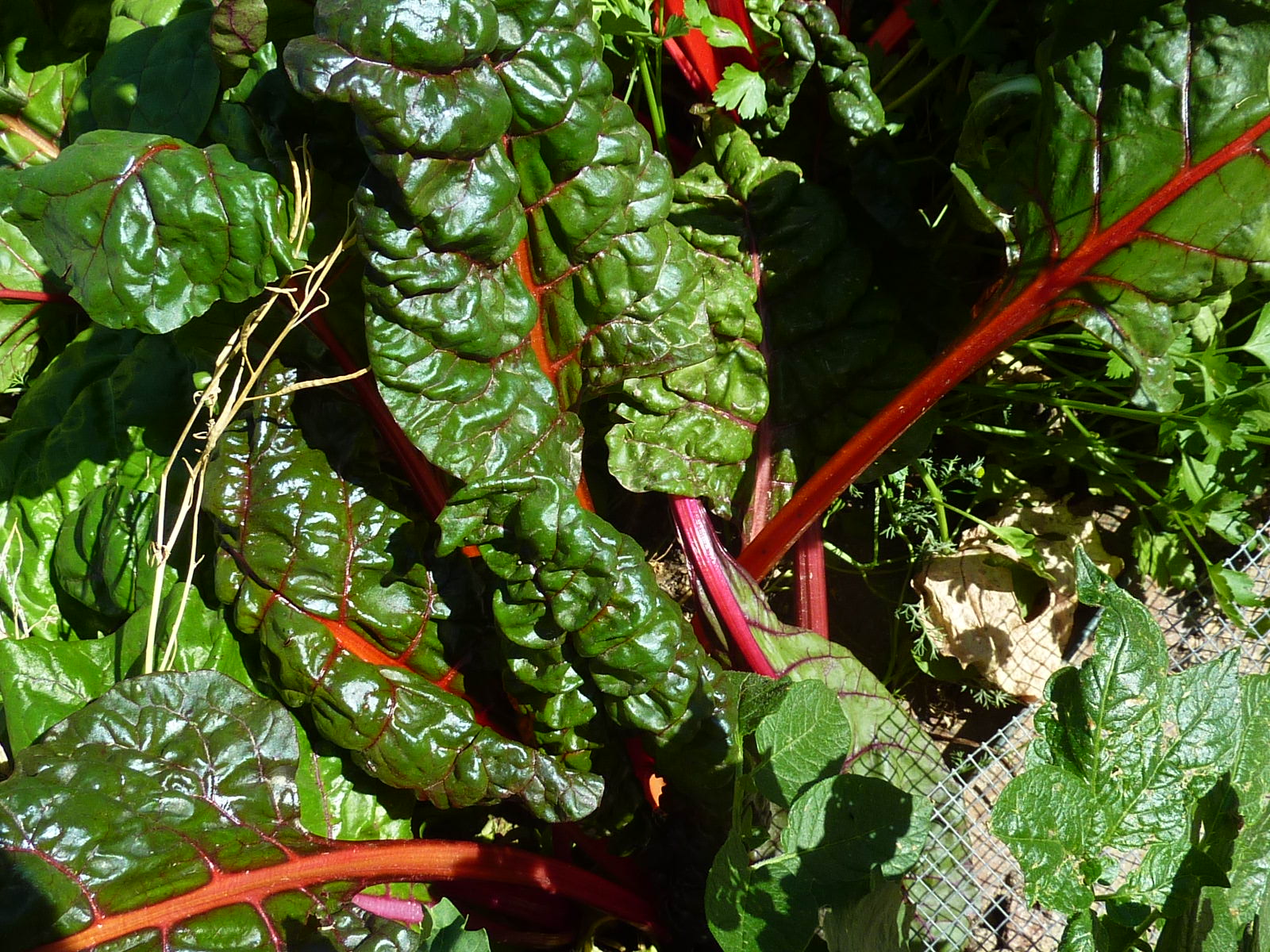
sometimes it's nice to see other color.  Swiss chard stems are another trick for cool-season color, and of course, some of the lettuces and beets can provide lovely reds.
The bright stems of some swiss chard can be another great splash of color for the mountain gardener.

However, none of these have quite the effect that flowers do. So, in the spring, I planted seeds of borage, sunflower, nasturtiums, violas and calendula in the garden, around the emerging rhubarb.  These are all great edible flowers to jazz up summer dishes and salads, but they are also just plain beautiful in the garden!  Plus, the bumblebees are having a grand time buzzing around the borage.  The hummingbirds are partial to the nasturtium, and I've seen hummingbird moths and butterflies in the sunflowers.
Calendula, sunflowers, borage and nasturtiums around my rhubarb.
These have really come into their own just when the rhubarb has mostly been harvested and is starting to look a little sad.  Makes me feel cheerful just looking at them!