CO-Horts

CO-Horts Blog

Showing posts with label Colorado wildflowers. Show all posts

Wednesday, May 15, 2024

Western Slope Wildflowers (And a Shrub)

By Mollie Freilicher, Residential Horticulture Specialist, Tri-River Area

The march of native, spring wildflowers continues in the Grand Valley. While not quite the same show we had after last year’s wet winter, we’re still seeing a lot of our favorites, including many that are also at home in our gardens and planted landscapes. 

Here are a few recent finds:

Colorado paper flower (Psilostrophe bakeri). Colorado paper flower is found in western Colorado as well as in Idaho. Its bright yellow flowers, salt tolerance, and ability to thrive in irrigated and non-irrigated conditions makes this member of the Asteraceae family a nice choice for waterwise gardens.

Colorado paper flower (Psilostrophe bakeri)
flowering in Mesa County in May.

Jones’ bluestar (Amsonia jonesii). This member of the Apocynaceae or dogbane family is one of my all-time favorites and I almost missed seeing it flower this year. It is prolific at one site in Grand Junction. Luckily, this past weekend, I was able to catch the very tail-end of its flowering. 

Jones’ bluestar has whitish-blue flowers that are reminiscent of little stars. And the smell! It is definitely worth getting down to give these beauties a sniff. They have a sweet smell, a little like a lilac. This perennial is a Plant Select and is available at nurseries.  Once established Jones’ bluestar does not need any supplemental water.

Jones' bluestar (Amsonia jonesii) in Mesa County in May 2024. 


Jones' bluestar (Amsonia jonesii) in Mesa County in April 2022.

Fremont’s barberry/ Fremont mahonia (Berberis fremontii). This member of the barberry family (Berberidaceae) is at home on pinyon juniper slopes, as well as in our gardens. This evergreen shrub has blue-green prickly leaves throughout the year and abundant yellow flowers in spring that attract a number of different pollinators. 

At the CSU Extension office in Grand Junction, there is a Fremont’s barberry in the cactus garden that has been trained to a single stem (and others in the Ute Learning Garden) that are more shrubby. This is another native with a sweet, almost honey-scented flower.


Fremont's barberry (Berberis fremontii) flowering in
April. This is the single-stem specimen in the cactus garden.


Fremont's barberry (Berberis fremontii) in flower.

Golden sulphur flower (Eriogonum umbellatum var. aureum). So far this year, I have only seen this member of the buckwheat family (Polygonaceae) flowering in front of the CSU Extension office in Grand Junction. There, we have planted Kannah Creek® buckwheat and it is flowering prolifically right now. The flowers are in umbellate inflorescences and attract a ton of pollinators, including lots of flies. The flowers have a distinct odor, though it isn’t one I linger on, like I do with the bluestar or the Fremont’s barberry. The flowers turn more orangey as they mature, adding some additional color to the landscape. In the fall, the leaves turn reddish-purple, providing some great color over the winter. This is a Plant Select plant that was originally collected around the Grand Mesa.

Kannah Creek® Buckwheat flowering in April.


Kannah Creek® Buckwheat and a honey bee.

Seek out these plants as you make your way around the Western Slope or around nurseries and native seed catalogs. 

Sources:

Ackerfield, J. 2022. Flora of Colorado, 2nd Ed. BRIT: Fort Worth, TX.

Cox, R.W., and J.E. Klett. 1984. Evaluation of Some Indigenous Western Plants for Xeric Landscapes. HortScience 19(6):856-858.

Plant Select, https://plantselect.org/


Thursday, October 6, 2022

Favorite Fall Wildflowers

 by Yvette Henson, San Miguel Basin CSU Extension 

I am a person who transitions slowly but our extended fall season, with its azure-blue skies and golden- aspen, fall-color explosion eases the transition from glorious mountain summer to snowy, gray winter.  The tops of the mountains, where the tundra is, are green from June to mid-August until high-elevation frosty nights put an end to the fleeting summer wildflower show. Then the tops of the mountains turn from green to gold and finally to white.  

I'd like to share of few of my favorite wildflowers that lead up to and last through the seasonal shift from summer to winter.  I am cheered to see them return, year after year.

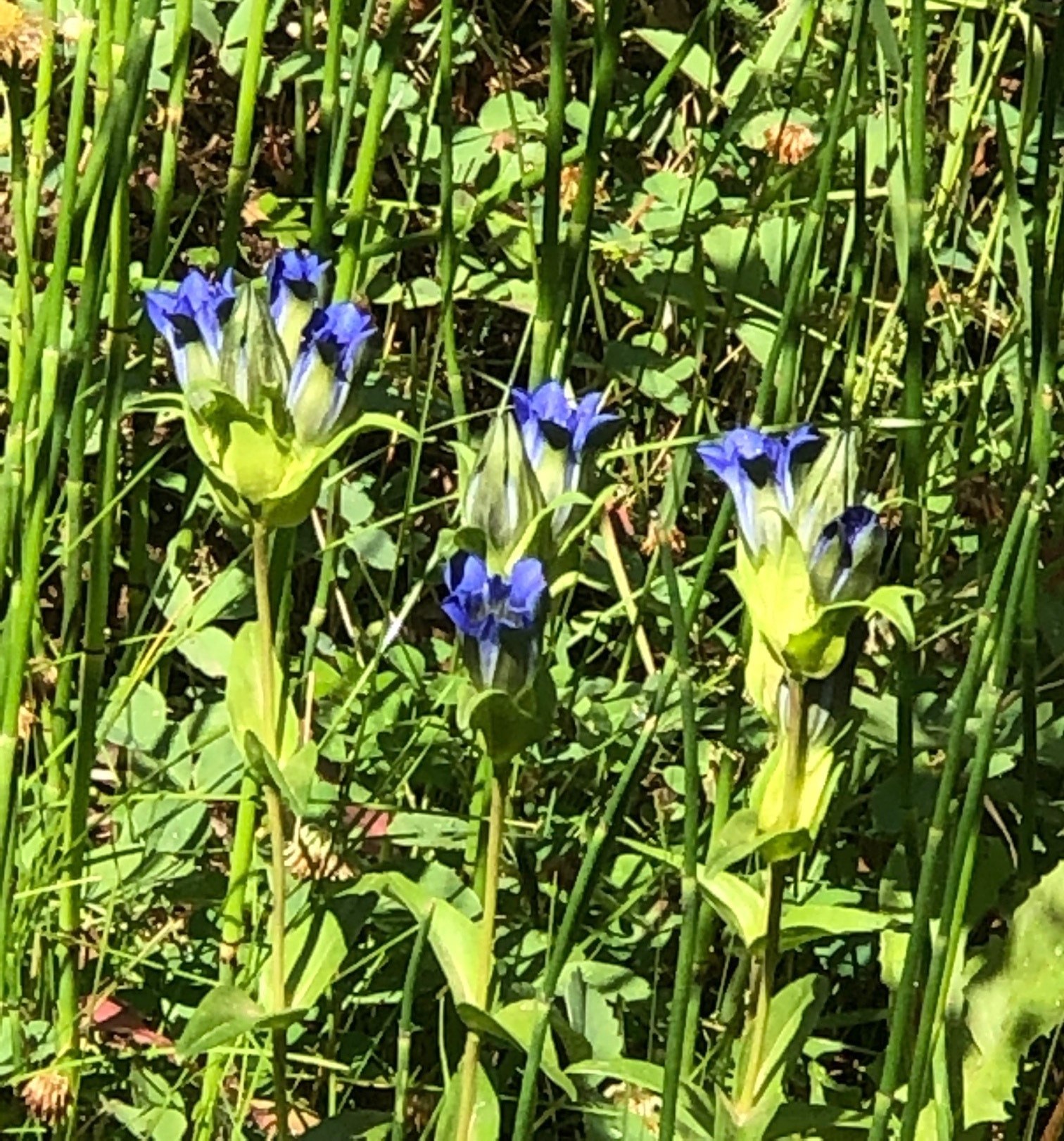
Gentiana parryi, Parry’s gentian, signals that summer is soon-to-end. The goblet-shaped blooms are a true blue, which is rare as a flower color.  It can be found July through September on the forest edge, in moist meadows and along stream banks at elevations between 7,500 and 13,200 feet. Look closely at the bloom to appreciate the detail!

A close-up Gentiana parryi bloom
(photo Yvette Henson)

Gentiana parryi plants
(photo Yvette Henson)

Rudbeckia laciniata var. ampla, cut-leaf coneflower, comes into bloom about the same time. I admire its stature, it's deeply lobed leaves and its domed center-disk with droopy ray flowers.  It weaves a ribbon along the creek bank of one of my favorite jeep roads.  It also grows in damp ditches.  It can be found from 5,000 to 9,000 feet elevation, late June through September.  I’ve collected seeds of this plant for our seed library but haven’t tried them at home because of my dry site.  However, I saw them featured in a British gardening publication, where they were grown in ‘regular’ garden conditions so I will give them a try next year.

Someone else enjoys Rudbeckia laciniata var. ampla almost as much as I do! 
(photo Yvette Henson)

Solidago velutina, velvet goldenrod, grows on its own in my yard.  It grows along the path to my door where it welcomes me home on summer evenings. I often sit down beside it just to watch the many pollinators enjoying its bright yellow blooms.  Velvet goldenrod begins blooming in late July and is still blooming at my house today.  When its flowers all wither, I know it is almost winter.  It does well in dry soil at elevations from 5,500 to 10,500 feet. 

Solidago velutina
(photo Yvette Henson)

There is an unidentified (to me) 'aster' that blooms all along the highway, through a local mountain town at almost 9,000.  Maybe it is really an Erigeron?  Or maybe it was a cultivated aster that escaped?  I have yet to figure it out.  The ray flowers are a deep purple, a much richer hue than the similar purple fall 'asters' that grow in other mountain communities near me.  I look for this particular aster each year.  I always say I am going to collect seed but since it’s an hour and a half drive from home, all its seeds have usually blown away before I make it back.


My favorite fall 'aster', growing in one of my favorite mountain towns
(photo Yvette Henson)

Gentiana algida, arctic gentian, blooms in the high alpine tundra after most of the summer blooms have faded.  The Flora of Colorado says it is one of the last plants to bloom in the alpine and can be found July-September, 10,000 to 14,000' elevation. The entire plant is rarely more than 6” tall, including the blooms, and to me it's like a magical fairy plant with its comparatively-large, tubular white flowers, streaked in purple and spotted in green.  

Gentiana algida -- perhaps I should call it 'farewell to summer' 
(Photo Yvette Henson)