
Tony Koski, Extension Turf Specialist
 |
| African bermudagrass (Cynodon transvaalensis) |
Beginning in 2014, I began
receiving questions about a “new” turfgrass – being sold under the name Dog
Tuff ™ African Dogtooth Grass. The sellers of this grass suggest that its
Latin/scientific name is Cynodon hybrida. I have searched databases for this grass and
run it by prominent bermudagrass breeders and researchers – with no one
recognizing any turfgrass (or grass, for that matter) with the Latin name C. hybrida. For you plant nerds out there, you can check
the validity of any scientific/Latin name at The Plant List, a working list of all
plant species (currently contains over 1 million plant species names). If you
want to be uber nerdy, you can even see a photo
of the earliest specimen of this grass (housed in the herbarium of the Royal Botanic
Gardens, Kew), collected in Africa in 1919. The species was
officially named in 1921.
 |
| C. transvaalensis is a non-native grass, introduced from the Transvaal region of South Africa. |
Soooooo, this is far from a “new”
grass. It is a species of bermudagrass, African bermudagrass (Cynodon
transvaalensis Burtt-Davy), used by turfgrass breeders since the 1950s to develop new, interspecific turf-type bermudagrass
cultivars. Tifway bermudagrass, released in 1960, has C. transvaalensis as one of its parents. African bermudagrass (AKA
couchgrass, African dogstooth grass) is a native of the Transvaal region of
South Africa, where it can be found growing on the high grass prairie (veld).
This region of South Africa experiences sharp day (70s-80s)/night (30s-50s)
temperature differences, and receives 18-24 inches of precipitation annually.
 |
| C. transvaalensis can produce a dense turf. |
I have been growing this grass at
CSU for many years, after finding it in a Denver lawn during the 2002 drought. It
forms an attractive, dense sod. The leaves are very fine textured, and the
grass spreads aggressively via stolons and rhizomes. It has excellent cold
hardiness (one
reason it is used as a parent in bermudagrass breeding programs). Left
unmowed, it grows to a height of 3-6 inches, depending on how much water and
fertilizer it receives. Because of its aggressive, dense growth, few weeds will
appear in this turf. However, during the warmest times of the year, mowing will
often result in scalping – causing a brownish appearance. Because of this
tendency to scalp when mowed, it will probably look more attractive if left unmowed
(or if mowed frequently…as in 2-3 times weekly during the summer).
 |
| Like all bermudagrasses, C. transvaalensis spreads by aggressive stolons ('runners') |
 |
| Bermudagrass is one of few grass species that spreads by both rhizomes and stolons - a growth habit that makes it both a traffic-tolerant turf and a potentially troublesome and difficult-to-control landscape weed |
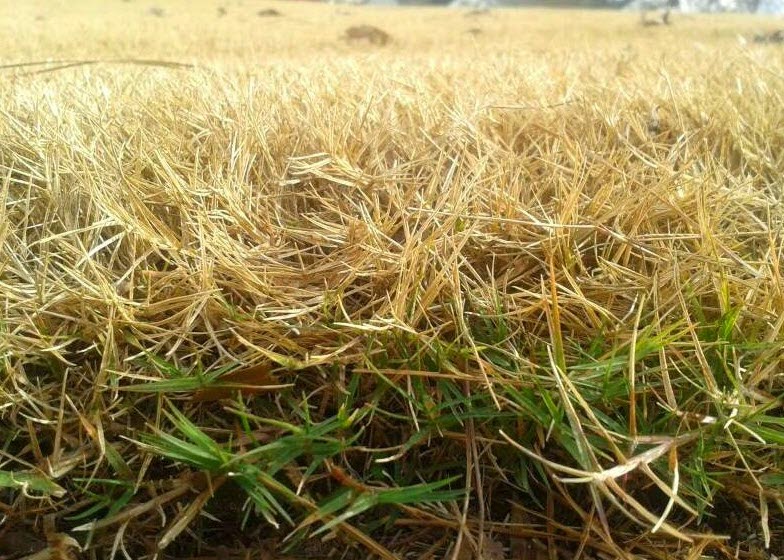 |
| Bermuda is a warm-season grass, so will have a long winter dormant period in Colorado |
So, yes, it is in many ways a
tough grass – because it is bermudagrass. Remember: the perfect turfgrass (for
every lawn situation) has not yet been discovered or developed by breeders.
Every species has its positive and negative sides – and this one is no
exception.
