CO-Horts

CO-Horts Blog

Showing posts with label cold weather effects on plants. Show all posts

Thursday, May 19, 2022

Winter is on it's way back...for a day

Posted by: Deryn Davidson, Boulder County

This blog was originally posted on April 28th, 2017...but here we are again with wintery weather on it's way to the Front Range so I thought it would be a good idea to post again! Yes, this is the second post on the same day, so be sure to check out the previous post, The Role of a Bumble Bee too!!!
---------------------------------------------------------------------------------
For the past several weeks it's seemed that the warm weather was here to stay. But, we all have to remember that we live in Colorado and you NEVER know what Mother Nature has in store for us here. Over the next two days, much of CO is predicted to get below freezing temps overnight and many people are asking if their plants will survive. Well, as usual, it depends...

A freeze is when the temps drop low enough to cause the water in plant tissue to turn into tiny ice crystals and the next day your plants turn to mush (destroyed plant tissue). A frost is when there is a lot of water vapor in the air and temps drop low enough to freeze that vapor. The result is frost on top of plants. We can get light frosts, that don't actually freeze plant tissue. The different is based on: how low (below 32F) the temperature get, how long the low temp lasts, what species of plant you have, and where the plant is located (sheltered or out in the open).

There are some plants that will be affected by this cold-snap and there are measures you can take to help protect them:
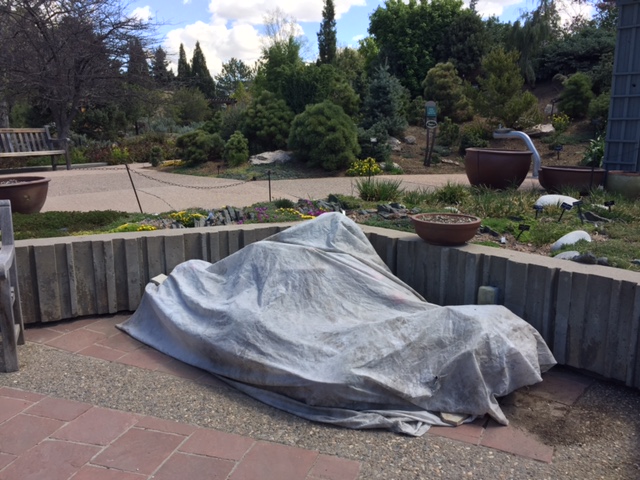
  • Covering plants is the most common. You can use old sheets, blankets, frost cloth, burlap sacks, etc. Flower pots or large trash cans turned upside down can also be placed over plants. If you use something heavy like a blanket be sure that you have stakes or something else besides the plant to hold up the blanket. You don't want to crush the plant while you're trying to save it from the freeze! Cover the plant in the evening to try to trap some of the heat that has built up during the day, then UN-cover the plants the next morning once the sun is out. 

Grouping of pots at DBG covered for late April freeze

Nursery stock covered in preparation for the April freeze

  • Watering plants can help, but you would have needed to do that a few days ago. Moist soil retains more heat and will raise humidity levels which can help reduce frost damage.
  • Mulch can provide some protection if you have a nice layer down. You can mound it up around plants, but delicate/tender plants won't like to be covered with a thick layer of mulch. 
These precautions can help, but we all have to realize that some plants just won't take the cold well and may be set back by the low temperatures, others will make it through just fine. If you have plants that seem particularly tender, go ahead and give them some extra protection. 

I have to give a nod to Jack Frost and Mother Nature, always keeping us gardeners on our toes here in CO!! Good luck everyone, I hope your gardens come through just fine!!

Tuesday, May 16, 2017

Cold snap alert: cover those plants


By Carol O'Meara, CSU Extension Boulder County


The cold snap predicted for Thursday and Friday is not going to be kind to the garden.  Yes, we can use the rain, but the snow and below freezing temps means gardeners should get ready to cover up.  Grab tarps, plastic sheets, buckets, and keep your therapist on speed dial for the inevitable call to cry on their shoulder; this freeze is catching us after we’ve planted.

Tender vegetables like tomatoes, peppers, eggplant, cucumbers, napa cabbage, or squash should be capped with an extra bucket, coffee can, Mason jar – anything that will trap the heat from the soil.  If the planted area is too large for individual buckets, set up a tent to cover the plants with plastic.  The trick is to trap the soil heat, so ensure that the plastic reaches the ground on all sides.  Weigh it down so the wind doesn’t blow it to Kansas and keep the plastic from touching the plants you’d like to protect.

Potatoes, onions, beets, and other root crops nosing up from the soil will be fine under a thick, warm blanket of mulch.  Pile the straw or grass clippings up over the plants to keep them snug under at least six inches of mulch.  You can uncover them after the freeze is over.

There’s not much we can do for the trees but if you have smaller perennials or roses you’d like to protect, swaddle them in plastic as well.  If possible, pull containers into the garage to protect them or cover them with buckets or plastic.  To keep pots from freezing, group them close together and stack bales of straw around them, then cap them with a blanket or tarp.

Make sure that you uncover the plants as soon as the cold snap passes by; things heat up very quickly under plastic and you don’t want to steam cook your plants.


Monday, July 20, 2015

Frozen IV: The Aftermath of November 2014 Cold Snap

 
Jane Rozum, Horticulture Agent,  CSU Extension – Douglas County
I first want to thank all that responded to the Frozen III, the CO-Hort blog article I wrote on 4/28/15. Your comments on the trees and shrubs affected by last November’s Cold Snap were confirmation of the magnitude of the problem. Willows, boxwoods, fruit trees, elms were mentioned by readers as trees and shrubs that hadn’t yet recovered in your landscapes by the end of April.
Dead hedge July 2015
 Our ‘wait and see’ recommendation about whether plants would recover from the sudden November 2014 temperature plunge was again thwarted by another ill-timed frost. On Mother’s Day 2015, many areas around the Front Range received snow and temperatures below 26 degrees F. This occurred while some trees and shrubs were in a critical stage of leafing out, and much of the new growth froze and turned brown. Ash, Honeylocust, Hackberry and Maple were among trees where new growth froze in Douglas County; other trees and shrubs could have been affected in your locale. While I’m happy to report that many trees re-leafed in my area, there are still trees and shrubs that did not or had areas in the canopy that had poor growth.
Freeze injury (left) and regrowth 2 weeks later (above)                                 
It’s time to evaluate our ‘wait and see’ approach and decide whether landscape plants that were affected by the Cold Snap and Mother’s Day storms will recover. First, I’ve observed that many trees and shrubs along the Front Range have either made full recoveries or have had some dieback but do not have to be removed.
April 2015 (left) same shrub July 2015 (right)


Second, I’d like to preface my comment with a very small botany lesson. Plants need leaves so that photosynthesis can occur: Energy from the sun is converted to energy that the plant needs to grow. So, it stands to reason that without leaves, photosynthesis doesn’t occur and therefore the plant cannot provide the necessary nutrients for survival. If there is no food, plant tissue will die. I’m going to go out on a limb (no pun intended!) and say if your tree doesn’t have leaves now, the landscape plant probably won’t leaf out. Plants don’t have the reserve energy stored in the roots to take a year off from growing; there is no long-term savings account of energy for plants. So, if your plant looks dead now, it most likely will remain that way.
Hibiscus, July 2015 with cold snap damage
One question I’ve received is: There is sucker growth from the base of the trunk, but no growth in the canopy, is my tree O.K? Unfortunately, the sucker growth is the tree’s last ditch effort at survival. Since many landscape trees (especially fruit trees) are grafted onto hardy root stock, suckers from the root stock will not have the same ornamental characteristics as the original tree.   If the canopy did not leaf out, it probably won’t.
Cold damage water sprout growth on Linden
Still not sure whether your tree or shrub is viable? There are people you can contact to check this out. First, call your local Extension office and ask to speak with a Colorado Master Gardener or Horticulture professional. They can examine photos of your landscape plant and offer some advice on your situation. Find your county office information here. Some offices along the Front Range have ‘tree teams’ that will send out trained CMGs for a consultation (for a fee).

 You can also have a Certified Arborist come and evaluate your landscape plants. Many Extension offices have lists of local International Society of Arborists (ISA) that will consult and will also prune/remove trees and shrubs. This is also a fee-based service.

Are the trees and shrubs that survived the storms now safe? Unfortunately, there is no crystal ball that can tell us. These weather events were stressors to the plants and though they survived thus far, it does not mean that they will survive another ill-timed storm. We've had many stressful weather events before the November Cold Snap (drought, etc.), and will continue to have weather-related landscape plant issues.  Colorado’s weather is difficult on trees and shrubs and, for that matter, the people that care for them.

Thursday, May 7, 2015

Soil Temperatures, Frosts and Planting Dates

Posted by Eric Hammond Adams County
As the first week of May comes to a close, impatient gardeners everywhere are asking, “Is it time to plant my tomatoes yet”? The answer to this question is probably, “Not just yet”.   

Appropriate planting times for vegetables are based on both air and soil temperatures.  Air temperature is fairly straightforward.  While cool season crops will tolerate varying degrees of cold weather, most warm season crops, like tomatoes, squash and peppers are tender - meaning they will not tolerate a frost.   It’s not difficult to look at the forecast and see if there is potential for freezing temperatures.  In fact, in my neck of the woods it looks like there is a good chance that we are going to have frost Monday morning.   However, even if the air temperature is not prohibitively cold, you also have to take soil temperatures into account.

The soil in my raised beds was around 52°F
this morning
If soil is too cold seeds may not germinate and transplants may be slow to establish and grow.  Ideal soil temperatures range from 45°F for crops like spinach or Fava beans to 70°F for many squash and melons.   Tomato transplants prefer a temperature between 60 -65°F.   I measured the temperature of the soil in my raised beds all week and temperatures ranged from 50°F to 52°F.  So, at least in my garden, the soil is too cool for tomatoes and many other warm season crops. 
The recent rains which have saturated Front Range soils will mean that they will be slower to warm, as more energy is needed to warm both the solid components of the soil and the water the soil is now holding, than would be required to warm the solid components alone if the soil were dry.


Soil Thermometer
Soil temperature can easily be measured with a thermometer.  They make specialized soil thermometers which you can purchase at many local garden centers or online.   You can also use a meat thermometer, though if you do I would recommend designating it as your full-time soil thermometer, retiring it from duty in the kitchen and buying a new one for your meats.  To measure the soil temperature for plant growth, insert the thermometer around 4 inches into the soil.  Temperature should be measured early in the morning, when the soil is its coolest, and you may want to take measurements from several locations. 

Insert the thermometer to a depth of about 4 inches
As mentioned in a previous blog, there are several ways you can speed the warming of soil in the spring, ranging from building raised beds to covering your beds with plastic.  

It’s not quite time to plant most warm season crops quite yet.  So, all you tomato junkies out there, watch the forecast for potential frosts, check your soil temperature and bide your time.  You’re almost there.

Wednesday, January 7, 2015

When It's Cold Outside...

Posted by: Linda Langelo, Horticulture Agent, Golden Plains Area

....you can always add more layers to your clothing.  But not your plants, they are open to the elements.  When plants are exposed to high winds, fluctuating temperatures from warm to cold, there is water loss within the foliage.  This is called desiccation.  What is the best care for your plants? Here are some tips:
  • Knowledge of proper site selection for all your plants reduces stress and helps with winter injury, even with tender evergreens and perennials.
  • Providing protection for your plants by appropriately placing them nearby structures and other plantings.
  • Watering well before the ground freezes in late autumn hydrates plants giving them a good start.  When the ground freezes, the root system cannot uptake any water.
  • Fertilizing plants appropriately will help reduce plant stress.
  • Mulching around plants in the fall helps protect the root system by helping to maintain a steady soil temperature.  Do not mulch shallow rooted plants too deeply such as carpet bugle, thyme or blue fescue.  A mulch of about 2 inches will suffice.  Other plants can tolerate mulch up to 4 inches.  Too much mulch mitigates the oxygen in the soil available for the roots.  Shallow roots can get pushed out of the soil during the freezing and thawing of the soil over winter.  When mulching around trees, do not place mulch against the trunk which creates a condition of excess moisture.  This moisture attracts mold, fungus and insects to the bark.
  •  Using burlap as screening about 18 inches from the evergreen tree or shrub to help reduce the impact of winter winds.  However, if you live on the plains this option can be helpful for certain plants in your landscape plantings but impossible for any windbreak.  Rather pay attention to the first two tips mentioned above.
    Burlap protects evergreen plants from prevailing winds.
    (Photo from "sunny" Ohio; Alison O'Connor)
  • Winter mulches such as straw or evergreen boughs are good to use for perennials, bulbs, groundcovers and strawberry plantings.
  •  Pray for snow.  Snow provides insulation for plants.
How can you tell if your plants are desiccated?  Damage appears as browning at the tips and margins of needles and leaves of plants.  Some evergreens may exhibit yellowing or bronzing of their needles. The injury will appear on the side exposed to predominant winter winds.  
Browning and bronzing of evergreen needles.
(Photo courtesy of the University of Maryland)

Yellowing needles on evergreens from cold injury.
(Photo courtesy of the University of Maryland)
On some shrubs, freezing and thawing can turn to browning and blighting of the shrub.  Another sign of winter injury is blackened buds or buds that are dry and brown.  In trees, the bark can split due to the fluctuation in winter temperatures.  As in the picture below, courtesy of University of Maryland Extension, de-icing products can cause leaf scorch on plants by the sidewalk or roadway. 
Salt injury to evergreen foliage from de-icing products.
(Photo courtesy of the University of Maryland)
In spring do not rush to prune off those browned or bronzed needles of your evergreen plants.  Wait until the weather warms up which may be the middle of May to early June for some of us.  Don’t let the brown foliage fool you.  Check the stems and look for any new growth.