CO-Horts

CO-Horts Blog

Showing posts with label manure. Show all posts

Thursday, February 13, 2020

The Basics of Composting


Published by Kara Harders, Small Acreage Management Specialist 


Composting is a natural process we can utilize to help break down and recycle materials which would have otherwise been considered trash or waste. Materials including food scraps, garden byproducts, and other organic “trash” can become the magical soil amendment we know as compost!

Because composting is a natural process, it can be induced by following some basic rules and creating ideal conditions for the process to happen. While people may think they are the ones composting it is really bacteria, fungi, molds, and worms doing all the heavy lifting. When we compost it is important to keep these organisms happy and healthy so they can do what they do best, turn trash into soil gold! Luckily, they only need a few things to do what they do best.

Food! (Nitrogen and carbon rich)
These composting critters work best when given about a 30:1 Carbon to Nitrogen ratio. The carbon source could be dead plants, bedding, grass clipping, leaves or even shredded office paper. The nitrogen source could be fresh grass cuttings, food scraps or animal manure.

Moisture
Like all living things, water is essential to the life in your compost heap. Most of the organisms breaking down materials in your compost pile live in the film of moisture around the “ingredients” in the pile. Too little moisture and they will die or become dormant and too much moisture and they will drown (and the pile will smell BAD). Aim for a pile that feels damp, like a wrung-out sponge. If the pile gets too dry spray it lightly with a garden hose and try to keep it covered with a tarp in a shady area to retain moisture and to keep out heavy rains. 

Form
Compost needs to be grouped to maintain moisture and heat; therefore, the structure of your compost needs to be in a heap of sorts. This may seem obvious, but there are a few critical details.
Consider where you are putting your pile, avoid spots in direct sunlight for much of the day as this can dry out your pile. You should also avoid areas where water collects or drains. Compost piles are rich in nutrients that can be harmful to water ways and contribute to nutrient pollution. Think about keeping water from running through the pile when it rains or snow melts.
An ideal size is about on cubic yard, a pile this size can be built over time (cool composting) or all at once (hot composting), a benefit to doing hot composting is the sterilization of some weed seeds. Large heaps made all at once with the correct balance of materials and moisture can break down materials so fast the internal temperatures of these piles can reach 160ºF! Smaller piles wont hold heat as well and can dry out quickly if done outside of a container, but they will be easier to turn. Speaking of turning…

Aeration
All those composting organisms you are after also need to breath, in addition to design, to get them oxygen you will need to “turn” the pile.
Ideally, your compost pile will sit on some coarse materials to help allow air travel in from the base. When setting up the pile make an effort to use materials which create air pockets, such as stems, stalks, wood chips and other rigid materials. These will help to draw air up and out of the pile.
Use a composting thermometer to gauge the inside temperature. When it reaches 140ºF, give it a turn and water as needed. Turning the compost will also help get air to the organisms doing the dirty work. You can turn the compost as often as the temperature reaches 140ºF. It is recommended to let the pile go through three heating cycles to help sterilize weed seeds.

Particle size
While it is not always possible or realistic to select items for your compost pile by size it can make it more efficient. Because the organisms breaking down material work on the outer surface of the composted materials, they work much quicker when the surface area is large in relation to the particle size’s mass, in other words, small pieces break down much faster. You can mulch logs/branches, cut stalks to less than 5”, mow leaves with the lawn mower, and break up manure clumps.
 

Tuesday, October 6, 2015

Which Manure is right for your garden?

Posted by: Carol O'Meara, Boulder County Extension

Set aside your coffee and breakfast, gentle reader; the following is not fit for mealtime conversation.  Fall is approaching, and with it a ritual of the garden: manuring.  We pile it on to improve the soil, enhancing tilth, microbes, and fertility.  Enfolding it into the ground sets us up for a wonderful bounty next year.
(Photo from Washing State University)
Before you go out and get just any manure, take a trip with me through the wonderful world of the ruminant digestive system, where we’ll ponder that age-old question of “which is better – cow, sheep, chicken, or horse?” 

“That depends on what you want in your soil.  Chicken has hardly any fiber, but lots of nitrogen.  Horses have a lot of long fibers that add tilth to the soil,” says Frank Garry, Veterinarian and Professor of Clinical Sciences at Colorado State University.  “Monogastric systems are simple.  We’re monogastric, so are pigs, dogs, or cats.  We have enzymes and acids in the stomach to break down food to a certain point,” he says. “Our intestines absorb nutrients but some things won’t break down, like fiber.  So what goes in comes out.”
Poultry poo has a lot of nitrogen (photo by Fred McClanahan, Jr.)
Ruminants, such as cows, sheep, goats, deer, elk, bison, moose, and yaks have a multi-compartment stomach where they use the power of microbes to ferment their food.  In combination with ruminating, - chewing their cud - ruminants very efficiently break down what they’ve eaten. 

“Ruminants are designed to eat fast, then hide in the woods; they’ll walk away to find a safe spot where they rechew what they ate to break it down further. We only get one chance at macerating our food, but ruminants spit it up over and over, chewing it to bits so it can be fermented further, releasing nutrients.  It’s a cool dance that the lowly monogastric doesn’t have,” said Garry. 

This fermentation-based system allows ruminants to be excellent recyclers of food waste produced by humans.  Able to adapt to a wide range of food, the discards from breweries, sugar beet pulp, wheat mids, French fry manufacturing, cotton, or corn ethanol production are being fed to livestock.  Known as commodity feeds, they’re taken and blended based on nutrient contents to create customized combinations targeted at individual herd needs.

Material only passes once it’s broken into tiny particles, so cow pies are comprised of small bits; this is useful as building blocks for soil fertility and organic matter.  Most of the ruminant manure has more phosphorus than people want, because it’s present in high quantities in plants that they eat.

Rabbits and horses aren’t set up the same way, so aren’t as efficient at breaking down the plants they eat.  “They have a similar system of fermentation, but it’s in the hind gut (with no rumination).  As a result their waste has more long-stem fiber.  But it really depends on the plants they eat,” said Garry.  Horse manure is an excellent source for building organic matter and improving tilth.
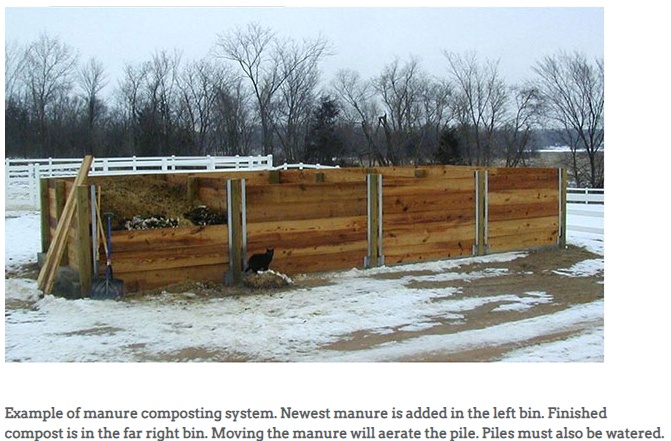
Horse manure as far as the eye can see (Photo from University of Minnesota Extension)
Weed seeds can slip past the process occasionally, but the relative amounts of weeds you’ll get from the different poo depends largely on what the animal eats.  Goats and sheep are browsers, chomping down more weeds.  Elk and deer browse too, but prefer more leafy fare.  Horses and cows graze grass, typically, but might nosh on a few weeds in the process.

Should you just want to boost the nitrogen amount in your soil, chicken manure is an excellent choice.  Younger gardens, which need more organic matter to improve the soil, benefit from horse dung.  For all-around good maintenance, cow, sheep, goat, yak, and other ruminant manure works well.  Follow your nose to the manure that’s perfect for your garden, and you’ll set yourself up this fall for success next spring.

Tuesday, February 11, 2014

Chickens in the Garden

Micaela Truslove, Broomfield County Extension

My husband and I jumped on the urban poultry bandwagon about two years ago, and we haven’t looked back. Once you get used to the saffron-yellow yolks of homegrown chicken eggs, there’s no going back to the watery, pale yellow grocery store variety. You’ll find no shortage of articles and books touting the benefits of raising your own chickens, and though they do have their challenges, the garden can benefit from a backyard flock.

Compost: Now that it has the nearly undivided attention of our girls, our compost has never looked better. The chickens spend the majority of every day in the compost pile rototilling the contents into wonderful black humus. Hours and hours spent scratching and turning means our compost is done in at least half the time. While they are in the pile scratching around, they are also incorporating their manure. The bedding and manure from the coop also go into the pile each time I clean it out. I try to keep this in the “holding” rather than the actively cooking pile so they don’t have access to it right away. I slowly add the mostly composted material from the bottom of the holding pile into the cooking pile.

Chickens are very curious and get up to all kinds of 
antics. Photo: Micaela Truslove
There are also other chicken byproducts that make it into the pile. Crushed eggshells go out with the kitchen waste and feathers from the bedding and their daily activities are also added. Though eggshells are rich in calcium, studies have shown that they don’t make any significant difference when incorporated roughly crushed. They need to be finely ground, which is more than I’m willing to do. Our soils also tend to be rich in calcium already. If there is a deficiency, as evidenced by symptoms such as blossom end rot in tomatoes, it is usually due to uneven moisture, which inhibits uptake by the plant.

One important note on chicken manure – it should be composted before going into the garden, just like any other manure. This is especially true if the manure is going anywhere near edibles. There are crops that are more risky than others as far as food-borne pathogens are concerned. Those fruits and vegetables that are in direct contact with the soil are more likely to be contaminated than others, and care should be taken to wash produce thoroughly.  This goes for any manure. To avoid possible contamination from harmful bacteria such as E. coli and Salmonella, do not harvest crops for at least 120 days after adding fresh manure.

Weed control: I have to say that this has been a very marginal benefit. One of the things on the top of my “reasons to get chickens” list was that they would help keep the weeds down. It is true that they are voracious omnivores, but they have shown little interest in the most problematic weeds in our back yard. Maybe they’ve decided that there is a steady enough stream of good stuff coming from the house that they needn’t bother with the twisting forest of bindweed that we are plagued with (dang it!).

However, they are fantastic at keeping the lawn nice and short. Grazing is another favorite activity, and they eat grass until they are literally stuffed with it and the blades of tender green shoots protrude from their beaks because their bellies are literally too full to swallow any more. If chickens suffer from a vice, it is most definitely gluttony.
Eating a container of yogurt and fruit that
spent too long in the fridge. With chickens,
nothing goes to waste! Photo: Micaela Truslove

Insect control: We never tire of watching our girls going about their business. They are incredibly curious and a little dippy, which makes for hours of entertainment. One of their favorite pastimes is chasing insects that manage to find their way into the chicken yard . They race around with the unfortunate morsel hanging from their beaks with the rest of the flock in hot pursuit. For some reason they never just gulp it down when they catch it, so there is always a game of keep away before the insect is finally consumed. If I find an army cutworm hiding at the base of a small plant or a grasshopper munching on my lettuce, into the chicken yard it goes and hilarity ensues. They spend a good deal of time after an irrigation tugging on worms in a cartoon-like fashion.

One trend that I recently discovered is the idea of having a “chicken moat” around the perimeter of the garden. The thinking is that the chickens will intercept many of the insects trying to enter, hunting them down like a pack of velociraptors from a movie. They really are quite effective at this, and very quick. It also means that they do not have free access to the garden because they don’t quite understand that it is okay to eat mallow, but I would rather they didn’t decimate the rest of the veggie patch, which they’d do in minutes if allowed. So the pictures you see on Pinterest of perfect raised bed gardens with nasturtiums spilling over the edges and chickens roaming the perfectly manicured pathways politely plucking bugs from the plants while leaving them intact is misleading at best, at least that has been my experience. 

As far as using crushed eggshells as slug control, there are mixed reviews as to their efficacy. Slugs are sensitive to irritants such as diatomaceous earth, which wound their slimy outer coating causing them to desiccate, the evidence is mixed as to whether or not eggshells perform the same function.

Though there are a few challenges to having chickens roaming the garden, we have found that there are great benefits as well, not least of which is the entertainment value. If you are thinking of getting a backyard flock of your own, my advice is to limit their access to desirable plants and instead give them their own space. Allowing them access to the compost pile will do wonders, and will save you a sore back from having to turn the pile regularly. They will keep your insect problems in check and provide plenty of nitrogen-rich manure. One study from the University of Missouri found that one four-pound chicken produces a whopping 28-80 pounds of manure every year! And you certainly can’t beat the fresh eggs.