CO-Horts

CO-Horts Blog

Showing posts with label shade cloth. Show all posts

Thursday, September 29, 2022

A Transplant Success Story

A transplant success story

A way to improve transplant success? Yes please! 


Silverton bluemat penstemon
By Cassey Anderson, Adams County Extension Horticulture.

As gardeners I believe we’re all endless optimists, maybe hoarders? Perhaps that’s just me! This means that we may purchase plants at times of the year that are not ideal, but who can pass up a sale or when we find a plant that's been on our list for ages? We then suddenly need to get them in the ground. For our Colorado Master Gardener Xeriscape Demonstration garden in Adams County we got a bunch of plants in June, and then again in August this year and wanted to ensure their success. 

Over the last few years one of our CMGs began experimenting with providing shade for new transplants and we’ve had an incredibly good success rate. The first year we only lost one plant, this year we have only lost two. In previous years before we began shading we lost far more. We’re hoping to start tracking more carefully in future so we could tell a more precise story, but alas have not thus far.

Pinetip Penstemon enjoying morning sun

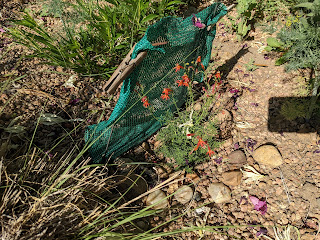
The process we now use is simple, take a small piece of shade cloth (in our case it was a piece of the large sailcloth shades that go over decks and the like), prop it up to provide afternoon and evening protection. We left the shades up for about a month to ensure establishment. We do also practice root washing to the best of our ability (especially for plants with larger root systems, for those with less roots we knock as much potting soil off as possible). These systems prove remarkably resilient in wind and rainstorms so no real adjustment is necessary until it comes time to take the covers away. 

For smaller plants we used old plant stakes that had lost their tags with clothespins to hold the cloth onto the stakes. For larger plants such as the wax currant (below) we planted this year we used a tomato cage as a support for the shade cloth. Since this plant came with some scorch already happening, we surrounded it completely with shade cloth. Many of those original leaves have dropped but new ones have replaced them.

Wax currant came with scorch so
we took extra precautions. 

One side advantage of shading the plants as they establish has been that the soil stays a little moist for longer, particularly beneficial in our xeric garden that typically only gets watered once a week. That said, we do also provide supplemental water a few times a week in the first few months for our newly establishing plants. This is also a great way to mark new plants so that volunteers don't accidentally weed them out, and it's easier to find them for watering. 

Hopefully you can enact similar successes in your own landscapes! 

Monday, August 5, 2019

Peppers have it made in the shade

Posted by Carol O'Meara, CSU Extension Boulder County

If you look forward to perfect peppers but are disappointed when they get sunburn, there aren’t as many as you thought, or they aren’t as big as you’d like, chances are that you have sunlight to blame.  High solar intensity and temperatures work against getting the most of our pepper crops.
Research on shading peppers is casting light on the benefits of cooling things off a bit on leaves and the root zone.  Heat stress reduces plant’s ability to photosynthesize and cool itself efficiently, which in turn limits root development.  Increasingly higher temperatures in summer limits root growth and damages fruit.

Colorado’s research into solving this problem is led by Dr. Mike Bartolo, Senior Research Scientist and manager of the Arkansas Valley Research Center in Rocky Ford.  He’s been researching the development of chili peppers since 1992.
Bartolo’s research into preventing sunscald on the fruit of peppers led him to using 30-percent
Shade barrier over peppers
shade barrier over some plants to protect the fruit from harmful rays.  But now that shade is proving effective in shielding plants from high temperatures as well – the transplants he covered with shade in early June aren’t showing the stress the exposed peppers are.


Globally, researchers concerned with the effects climate change could have on crop production are exploring ways to buffer hotter temperatures.  Growing under shade cloth has garnered interest, and researchers are working to find the type of shade cloth that gives the most benefit.  University of Georgia has shown that the color of the shade netting doesn’t make much difference; however, leaf surface temperature remained higher under white shade cloth.
In our gardens, peppers covered with shade cloth or floating row covers are also in much better shape.  Popping a tent of 30-percent cloth over your crop might help get things growing again, Bartolo said.  “As long as the stem is ok and not injured by sunscald, things should get moving again once things cool down or you shade the plant.”

A bit of shade is helpful to other plants as well, such as basil or tomatoes during fruit production.  Mulching also helps keep the plant cool since it protects roots from water loss and soil cracking.
Shade cloth is available at garden centers in various lengths.  It’s a durable fabric that can be used for several years.  When covering your plants, remember that this is to be suspended above them, unlike floating row covers that can sit right on the plants.  Create a frame for holding the shade barrier two to four feet above the plants, taking care that it’s secure for wind.

Floating row covers provide about 15 to 19-percent shade, which might not be enough at this time to break the grip of heat.  Early in the season it would help for root development, so keep it handy for next year.