CO-Horts

CO-Horts Blog

Showing posts with label tools. Show all posts

Friday, December 6, 2019

Gifts for the Gardener in Your Life

Post by Mike McNulty, Broomfield Master Gardener

Winter officially begins December 21st, but procrastinating gardeners are not yet thinking about presents. They’re still frantically attacking last-minute chores like clean-up, or wrapping young trees (especially redbuds, maples and fruit trees!). Through the cold and snow, the die-hard gardener will be thinking about the upcoming growing season via seed catalogs and PlantSelect® brochures. If you’re looking for a thoughtful gift for the gardener in your life, consider these garden essentials:

Gardeners are almost universally in need of another pair of gardening gloves by season’s end.  Most gardeners also spend a fair amount of time kneeling in the garden, so a set of knee pads or a kneeling board would be deeply appreciated.
As gardening tools go, pruners may be the most essential.  Look for ergonomic designs, and make sure to choose the right tool for the job. The best pruners for green stems are bypass pruners that act like scissors and reduce plant damage.  For precision jobs like harvesting tomatoes or deadheading flowers, use micro tip pruning snips.  A set of bypass loppers are a good bet for larger stems and limbs, and a pruning saw is useful for almost any trimming of woody plants.

Clockwise from top left:
Pruning saw, Hori Hori knife (garden knife), bypass pruners, micro-tip pruning snips.

A personal favorite with amazing versatility is the garden knife, also called a Hori Hori knife.  Hori Hori means “dig dig” in Japanese, and it’s fun to say!  The notched blade is perfect for weeding; use the serrated edge to cut sod, divide perennials or trim root balls; the smooth edge is great for opening bags of mulch or fertilizer and often has measurements for planting depth.

When in doubt, you can always leave the decision-making to the gardener with a gift certificate from their favorite garden or nursery center. Happy holidays!

Friday, May 10, 2019

It's Tool Time!!

Posted by: Deryn Davidson, Boulder County Extension

It's no secret that this spring has been slow to get going and now in my area we've had another stall-out with a week of rainy, cool weather. So, what is an eager gardener to do while they have to wait for plants to wake up and the weather to clear?? Make sure their tools are in good working order so they can spring into action when the conditions allow!!

Just like the gardener, garden tools work hard. They are left out in the elements, dragged through the dirt, hung up wet, shoved in buckets, lost under garden benches, you name it! They get abused. So, if you set aside a little time to treat them right, they will serve you well for years to come.

Now, some might say this is a task for the END of the season when you're cleaning up and putting your garden to bed. I'm sure some people do clean and sharpen everything then, but I know not everyone does. In fact, I know that a lot of people don't do this on any regular schedule at all. Well, like any craft or tradesperson, a gardener's tools are an important part of their work so it's a good practice to make sure your loppers, pruners, shovels, rakes, tiller, mower, etc. are all set and ready to go for a successful season.
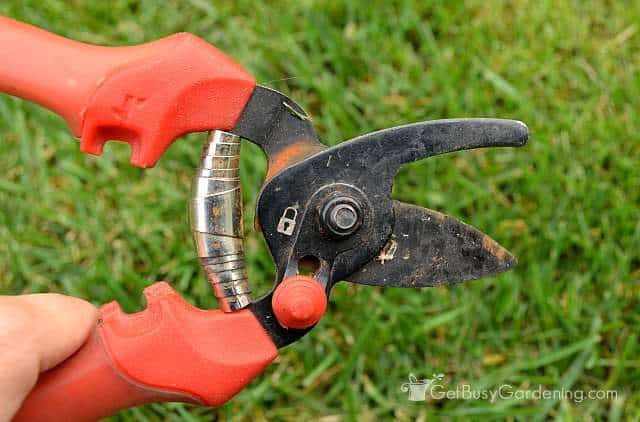
Image result for dirty prunersgarden tool maintenance, tools

Pruners and loppers:
Clean your pruners and loppers by taking them apart (if possible) and giving them a good scrub in soapy water. Steel wool will help remove any rust that might have built up. It's not a bad idea to soak them in a dilute bleach and water solution (1:10) to sanitize and then rinse and dry. Once they are thoroughly dry, rub them with boiled linseed oil to give them a protective layer from oxygen and moisture and then reassemble.

Sharpen your tools so that they are easier to use and they make clean cuts. You don't want to risk damaging branches by tearing or ripping them because your pruners didn't quite do the job. There are sharpening stones you can get for your pruners or you can take them to a local hardware store and they will often sharpen them for you. Farmer's Markets often have vendors that will sharper knives and tools so you can look for that option too.

Throughout the season, after you use your pruners and loppers, give them a quick clean. Get the sap, dirt and grime off and store them inside and they will stay in good shape throughout the season.

Shovels, rakes and hoes:
Give these a good clean by knocking, brushing or rinsing off any dirt that might still be stuck on them from the previous year. Shovels can be sharpened so that they are easier to dig with. You're not looking for razor sharp with shovels, but having them "just sharp enough" will make digging those new garden beds and transplanting and dividing much easier. They will also benefit from boiled linseed oil once they've been cleaned and dried thoroughly. 

If your shovels, rakes and hoes have wooden handles it's a good idea to check on those too. Over time they may start to crack, splinter and even break in two. If this happens, you can buy replacement handles and attach them to the head of the tool, rather than buying a whole new tool. For general care and maintenance you again want to give handles a clean, let them dry and rub them with linseed oil.

Tools with motors (mowers, tillers, etc.)
For these tools, you can certainly take them to a small engine shop and get a tune up, or you can check out the operator's manual for details on how to do it yourself. This will generally include changing out the oil, filling with fresh gasoline, changing an air filter, change spark plugs, and sharpen the blades.

Horizontal shot of dirty lawnmower in overgrown grass Stock Photo - 12887206
               
Now that you have everything in tiptop shape and are ready for the season to really start, remember that it is best to clean as you go. That way, many months from now when the leaves start to change and there is a chill in the air, your tool maintenance won't be such a big job and you can knock it out at the end of the season!! I should say, big kudos to those of you who do your tool maintenance early and often!!! To the rest of us, now is a great time too tackle it. Happy gardening!!!

Monday, June 12, 2017

The Tool Shed

Posted by: Darrin Parmenter, La Plata County Extension

We all have our favorites – favorite pet, favorite car, and heck even your favorite child (don’t worry Elena and Asher I love you both the same. Sort of…). In the kitchen, I would hard-pressed to think of utensil I use more of than my Spyderco paring knife. Or in the garage, I’m not sure what I haven’t tried to cut with a circular saw. The thing must be 20 years old - rusty and heavy - but I feel pretty confident that I can cut almost any angle without severing a finger. Heck, even as a baseball coach for my son’s travelling team, I can put my faith in a tee and a bag of Wiffle balls and know that I can probably teach somebody something.

But in the garden…that’s where one can find all sorts of tools for all sorts of chores: tilling, planting, weeding, harvesting, and the ever-increasing list for the endless number of tasks. Just take a look at the back of a seed catalog, or walk down the aisles at your local nursery and you will find tools that are probably so specific that you could have an entire quiver of metal and wood to just kill weeds. And if you ask any gardener what their favorite tool is, you could probably get as varied responses as you would if you asked them their favorite tomato variety.

My three favorites:
    photo courtesy of Gardener's Supply
    (NEVER take a photo of yourself
    with a hori hori in hand. And notice that is probably
    not my garden beverage of choice.)
  • The hori hori knife. Loosely translated as ‘dig dig’ in Japanese, this tool has the ability to do almost anything (including popping the cap off of a beer at the end of a hot day in the garden) that you could ask of it. I first learned of this tool when working at the Montana State University teaching farm and I haven’t been without one since. If you keep it sharp, it can cut through almost anything; if you use the other side, the serrated blade can rip through roots or small branches, or even a tin can. Many have a ruler for planting bulbs and all should come in a sturdy sheath.

  • A dibble board. Now, there’s an off-chance that the dibble board is way too big and way too unruly to fit in your garden’s toolbox. But if you are a relatively organized gardener like me, it is the calming force when trying to seed carrots or lettuce every spring. I made a couple boards about 10 years ago and use them every year. I even loan them out to the school gardens because nothing says uneasiness like watching 1st graders try to sow small seeds (ok, I’m a bit OCD in the veggie garden. I like order.). Mine are 12” x 12”, have a handle, and have 2” dowels equally spaced at either 2” or 3”. One of the best benefits of the tool is that it has greatly decreased my least favorite gardening chore: thinning. I feel much more confident when I can where the seeds are going so the need to place multiple seeds in each hole has been virtually eliminated.
  • The hula (or stirrup) hoe. Think of it as Crossfit for the garden – just plug in the headphones and start shaking! With these types of hoes – those that are essentially oscillating back and forth, rather than chopping and lifting like the traditional garden hoe – you can really get your heartbeat up as you hustle your way through the plants or in the row middles. If you have decent tilth in your garden, the semi-sharp blade can easily move right below the soil surface, cutting weeds below the soil line. You’re not digging them up, but you are also not disturbing the soil surface like you would with other weeding implements.
    photo courtesy of leafandgrain.com 


What are your favorites???