CO-Horts

CO-Horts Blog

Showing posts sorted by relevance for query save seeds. Sort by date Show all posts

Monday, September 13, 2021

Posted by:  Patti O'Neal, Urban Food Systems Coordinator, Jefferson County
Fall is the Time for Seed Saving 
“Oh that is the best tomato I have ever eaten!”
 “Look at the blooms on that hyssop, and the color!” 
“Could those cucumbers be any more sweet or crunchy? I want those again next year” 
 How many times have you said something similar and wondered how to get that exact flavor, texture and color every year? You can always buy more seed – especially if you have journaled the scientific name of the seed of the plant you so love; along with the company name that produced or marketed the seed. But another way is to learn to save seeds from your favorite plants to plant again the following year and actually adapt them to your garden. It is one of my favorite fall gardening activities. 
 Can all seeds be saved?
 No. In order to produce a plant that is exactly true to the parent plant that you love and to exactly duplicate the flavor, texture and color you were hoping for, you must save seeds that are open pollinated/heirloom. Hybrid seeds, those with an F1 or F2 designation on their package or label, are created 2 distinctive parents (usually of same species) cross pollinated by hand to produce offspring with a predetermined set of characteristics. Those characteristics could be flavor, skin texture, number and color of petals, plant height and so on. What happens when you try to save those seeds and plant them is that the plant begins to un-cross and does not produce true to the parent plant. If you love a hybrid plant, (example, one of the yummiest tomatoes on the planet is the Sun Gold cherry tomato which is a hybrid) be sure to plant new seed every year. 

 What are the advantages of saving seed? 
You can promote and protect the rich diversity that open pollinated/heirloom seeds represent to our history. Seeds are most rich in their ability to produce diverse plant material and a richness in diversity so wide that the plants reflect the environment they are produced and grown in. 

 They have the ability to adapt to certain terroir and to retain the changes in their DNA – to remember and to display the changes. So, by saving and planting seeds from the best representatives of each species in our own gardens, 
 • we play a part in preserving genetic variety and biodiversity 
• we can preserve varietal characteristics we value 
 we can preserve varieties specifically adapted to your particular microclimate and soils.
 According to Diane Ott Wheatley, co-founder of Seed Savers Exchange, “Growing seed in the same geographic area allows the seed to adapt to local pests and climate challenges and requires less chemical pesticides and fertilizers.” 

What are the best seeds to save if you are a beginner? 
The seeds that will provide the best chance for success to save are:

  Beans 
 Peppers
  Lettuce 
 Peas 
 Tomatoes
 These plants produce seed in the same season as they were planted in. They are mostly self-pollinators so you do not have to worry about cross-pollination. 

 What are some basic tips for seed saving? 
Remember: Growing a plant to save seed is different from growing it to eat. Most plants will grow past the stage in which they are good to eat to the stage where they will stretch and produce flowers and from there, seed (i.e., lettuce, spinach)

or they will need to dry “on the vine” (beans). Plants like tomatoes, squashes, peppers will yield their seeds up during preparation to eat them. They can be dried out in various ways at that time. 
 Save seed from the very best of your plants. Those plants with no pest and disease issues, the best fruit producers, the best blooms, the best color; the best of the best of each species in your garden. 
Seeds aren’t viable until they are fully ripe. Watch the weather carefully and protect plants that are not fully ready and keep them dry. Keep plants healthy to the very end until ready to collect. This can be tedious but is necessary to keep the seed viable. 
 Cut seed heads or take plants from the garden and further dry out by hanging in a cool, dry, dark place until completely dry. 
 Separate the seeds from the chaff of the plants and store in glass jars or paper to keep dry and safe until ready to plant. Label carefully and make journal notes about the plant and it’s origin.

 What can you do to promote seed saving to others? 
• Share the seeds you save with neighbors and friends 
  Learn about Seed Libraries 
 Learn about Seed Vaults and where they are located 
 Learn about and visit a Seed Bank 
 Host a Seed Swap


 Saving Seed is a learned experience. It is sometimes frustrating and challenging. Yet, it has shaped the history of the food we eat. There is a small learning curve. As a home gardener, Don’t be so concerned with distances or number of plants at first. As your garden expands this will become relevant. It is more important to try saving seeds and to experiment, enjoy and value the process. Learning the basics and knowing when you can and cannot successfully save seed to produce the plant you so love will set you up for second round success and beyond.

Monday, May 1, 2017

Saving Seed


Written by Yvette Henson
CSU Extension San Miguel and West Montrose Counties

When our ancestors came to the U.S., the often brought seeds with them, seeds from home.  These seeds were important because they were a source of food—often the seeds they brought were of plants that were a culturally important food, a medicine or a favorite door yard flower.  These seeds planted something from the homeland into the new land and they might have preserved a long time heirloom.  Many indigenous cultures have and still preserve their own regionally adapted plant varieties by saving the seed.  In the early days of our country the USDA had a seed giveaway program.  It was often the local Extension Agent who was responsible to distribute these seeds to local people.  Around this same time, there were many seed companies who sold many varieties of seeds.  In the early to mid-1900’s things began to change -- less people lived on small family farms, less people gardened at home and hybrid seeds were developed.  There were fewer regional seed companies and many varieties were lost.  (See the following diagram.)


Preventing further loss of genetic diversity in our seed source is just one reason to make the extra effort it takes to properly save seeds.  Here are a few more reasons to consider:
  • To preserve a cultural or heritage seed
  • To develop or maintain regional, farm or garden adapted varieties
  • To be more resilient or self sufficient
  • To ensure you have a source of your favorite varieties
  • To share!
  • Save money (the labor and space needed may not always result in savings)
  • For a fun challenge
  • To be in partnership with nature
  • It’s really ‘local’


Following are some basic terms that one needs to understand in order to save seed successfully. 


Open Pollinated (OP) varieties can produce stable offspring that breed true to type if properly managed.  “Stable” means there will be consistent uniformity between individuals in the plant population grown from the seeds saved.   OP varieties are allowed to cross pollinate in the field.  Open pollinated varieties can be just as vigorous as F1 hybrids, depending on selection.  OP varieties are not hybrids and they are not always heirlooms.
Definitions differ for what an heirloom plant variety is.  The most common definition of an heirloom is a variety that has been grown, seeds saved and regrown for at least 50 years.  But to others a variety that is being maintained by a family or in a region and passed down, even if it hasn’t been done for as long as 50 years is an heirloom.  Usually an heirloom is an OP variety but not always.  For instance, a noteworthy hybrid developed by a famous plant breeder in the past might be considered an heirloom by some.

Hybrid varieties result from natural or unnatural pollination between genetically distinct parents of a species.  Commercially, the parents used to produce hybrids (F1) are usually inbred for specific characteristics.  Hybrids can have increased uniformity and sometimes increased vigor and disease resistance, than either of the parent plants.  Seed saved from hybrids will not grow true-to-type and sometimes it’s sterile.


GMO’s (Genetically Modified Organism) varieties have had genes have inserted into their DNA.  The genes that are inserted are often from different species, genera, or even kingdoms.  Most, if not all, GMO varieties are hybrids but not all hybrids are GMO’s.  


The basic steps to save seed successfully are:
  • Start with an open pollinated variety so you can get plants true to type.
  • Learn about the characteristics and needs of the species of plant that you are growing so you can grow it to be as healthy and productive as possible. 
  • Knowledge about your plant species will give you the information you need to protect your variety from cross pollination with related plants.  This can be done by planting a single variety, by covering and/or hand pollinating or by separating similar varieties by enough distance to prevent cross pollination. 
  • Plant a large enough population size to get adequate pollination among your plants to maintain genetic vigor of your seed.  Save seeds from the healthiest plants that have the traits that you want and get rid of the plants that don’t.
  • Harvest at the correct time to get good seed.  This may mean you don’t get to eat all of the fruit of your labor—some plants might need to be saved for seed. 
  • Process your seed for the type of plant it is. 
  • Store your seed properly to ensure it remains viable.   Generally, keep seeds dry, cool and dark.  Replant and repeat!   Over time, you will get a more locally adapted variety with the characteristics you want and that will perform well in your area.
Things are coming back around.  More people are gardening at home, there are an increasing number of small farms, plant breeders, seed companies and non-profits dedicated to finding, developing and preserving seed varieties and genetics.  Community seed libraries and seed banks are sprouting up everywhere! 


If you want to know more about Saving Seeds see the following resources:
CSU Extension Fact Sheets: 
Organic Seed Alliance      www.seedalliance.org
Rocky Mountain Seed Alliance    www.rockymountainseeds.org
Seed to Seed: Seed Saving and Growing Techniques for Vegetable Gardeners by Suzanne Ashworth and Kent Whealy, Seed Saver Exchange, 2nd Edition, 2002.
The Seed Garden: The Art and Practice of Seed Saving, Butalla, Lee and Siegel, Shanyn, Seed Savers Exchange.  2015.
Breed Your Own Vegetable Varieties by Carol Deppe.  Chelsea Green, 2nd Edition, 2010.


Monday, December 11, 2023

A Few New Vegetable and Flower Varieties for 2024

by Yvette Henson, CSU Extension, San Miguel Basin

It’s that time of year again!  That time when garden seed catalogues are arriving in our mailboxes, either in our post office boxes or in our email inboxes.  Most seed companies highlight new introductions for the year.  I recently attended a webinar hosted by a well-known seed company all about their veggie introductions for 2024 and so I thought it would be fun to write about some of the new varieties I have seen in catalogs that I am thinking about growing in 2024.  As a CSU Extension employee, I want to say that I am not recommending certain seed companies or varieties over others.  There are too many seed companies and too many new listings for me to cover in this blog.  Do your own research with your own growing goals, your own specific growing conditions, and your favorite seed companies in mind.  Try something new.

A local seed company that I get a lot of seeds from is High Desert Seeds.  Their seeds are all grown regionally.  I have grown a couple of seed crops for her myself.  This year, I want to try her ‘Blue Star’ mustard. I want to use it like a southern stewing green (my hubby’s request) but it can also be used young in salad mixes.  In the south, they grow mustard greens in the winter months, but I will have to grow mine in spring and fall.

Photo credit High Desert Seed

Johnny’s Seeds are popular with small farmers and gardeners.  They have many talented breeders on staff.  Each year, I like to grow something I haven’t grown before and this year I am planning on growing a variety of Asian greens.  I would like to grow two of their new introductions in the Asian green category: ‘Haku’(F1) Chinese cabbage and  ‘Green River’(F1) komatsuna green.  They are also offering what they claim is the first white Romanesco cauliflower called ‘Whitaker’(F1).  Baker Creek also offers a white spiraled cauliflower that is open pollinated called ‘De Jesi’.  The standard Romanesco has the equally beautiful and tasty chartreuse green spirals.  White is more unique. While I will give one of the white ones and a green one another try, I have found cauliflowers difficult to grow, especially the beautifully fractalled Romanesco varieties. 

'Haku' Chinese cabbage
Photo credit Johnny's Seeds


'Green River' Asian green
photo credit Johnny's Seeds

'Whitaker' romanesco cauliflower
photo credit Johnny's Seeds

There is a cost for the Whole Seed Catalog from Baker Creek but it may be worth it to you because it contains interesting articles with history, growing conditions and recipes for a select number of crops.  The regular printed catalog is free, and they have a website where you can find all they offer.  Most of their seeds are open pollinated so it makes it easier to save your own seeds!  In this year’s Whole Seed catalog, one of the featured plants is Couve Fronchuda, a Portuguese semi-heading kale, Brassica oleraceae var. viridis.  It is more closely related to sea kale than to the kale we generally think of.  It is traditionally used in soup.

photo credit Baker Creek Seeds (Rare Seeds)

When we go visit our grandsons in California, I often go to a local health food store.  There they have a seed rack for Redwood Seed Company.  I usually buy 1 or two packs of seeds and have had success with them.  This year they are offering Japanese indigo, Persicaria tinctoria, a dye plant.  I live at 8,200’ with cool nights but I think it is worth a try since it is the leaves that produce the dye, and it is supposed to mature in 80 days.  It can also be started early indoors and planted out when it’s warm enough.  This may give it a jump on the season.

Photo credit Redwood Seeds

Floret Flowers is a cut flower/seed business that has gotten into breeding some lovely flowers in atypical colors.  They have their own lines of celosias, dahlias, and zinnias.  I want to try growing their ‘Limonata’ celosia.  It is another warm season variety that may be a bit difficult to mature in my garden.  I will start them early and grow them outdoors as well as in my high tunnel greenhouse. 

photo credit Floret Flowers

Check out this beautiful ‘Mission Giant Orange’ marigold introduced for 2024, exclusively by Burpee Seed company!

Photo credit Burpee Seeds

I would be curious to know what you are planning on growing in the coming season.  Be sure to check out all the new introductions in the catalogs, both in print and online!

Monday, November 14, 2022

A Comparison of Two Broccolis and their Side-shoot Production

 By Yvette Henson, San Miguel Basin CSU Extension

Since 2011, San Miguel Basin CSU Extension Colorado Master Gardeners have grown different crops under different covers in our High Altitude Season Extension (HASE) research trials.  We want to know which covers, if any, extend the season and improve yield and quality for whatever crop we are growing that year.  Another goal of the HASE research beds is to find varieties that perform well in our short and cool summer growing season. 

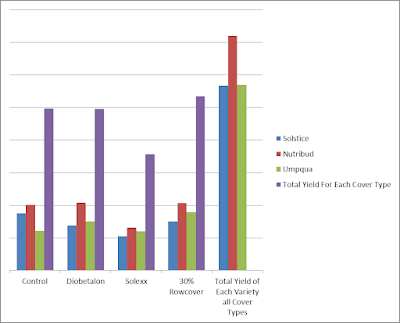
In 2016, we grew 3 varieties of broccoli under 3 different season extension covers and a ‘control’ (no cover).  We chose varieties that would continue to produce side shoots after the main head had been harvested.  Out of the 3 varieties we chose, ‘Solstice’, ‘Umpqua’ and ‘Nutribud’, ‘Nutribud was our favorite because it had the best yield, flavor and nutrition.

Yield of Broccoli
2016 HASE Broccoli Trials
This year, I grew broccoli in my home garden.  When I was planning my garden, I didn’t know if I still had seeds for ‘Nutribud’, so just in case, I bought some seeds at the garden center of the variety ‘Belstar’, an F1 hybrid. (For this blog what matters is to know that seeds from hybrids usually don’t produce plants that are ‘true to type’)  The seed packet said that ‘Belstar’ would continue to produce side shoots after the main head was harvested.  That is what I wanted- I care more about getting an extended harvest through the season than a single harvest of large heads.  After all, I cut them up to prepare them to eat, don’t you?   And since broccoli is a relatively big plant, I wanted to get as much food out of the space they take up as possible. 

‘Nutribud’ broccoli is an open pollinated variety.  (If you save seeds from an open pollinated variety grown correctly, the next generation of plants from those seeds will come ‘true to type’.)  Dr. Alan Kapuler de-hybridized a hybrid variety called ‘Pacman’ and named it ‘Nutribud’ because in a UC Davis test on nutrition in different broccoli varieties, 'Nutribud' came out highest in free glutamine, a building block of protein: good for the brain and healing for the body!

'Nutribud' broccoli head, 2016 HASE Trials, early August 2016.
Turns out, I did have seeds for ‘Nutribud’ at home so I decided to plant 4 plants of each variety.  3 of the ‘Nutribud’ plants produced full-sized heads at the end of July.  The 'Belstar' broccoli produced full-sized heads by mid-August and both varieties continued to produce side shoots until killing temperatures at the beginning of November. 

First 3 heads of 'Belstar' broccoli
and the second side shoots of 'Nutribud' broccoli, etc.
August 15, 2022.
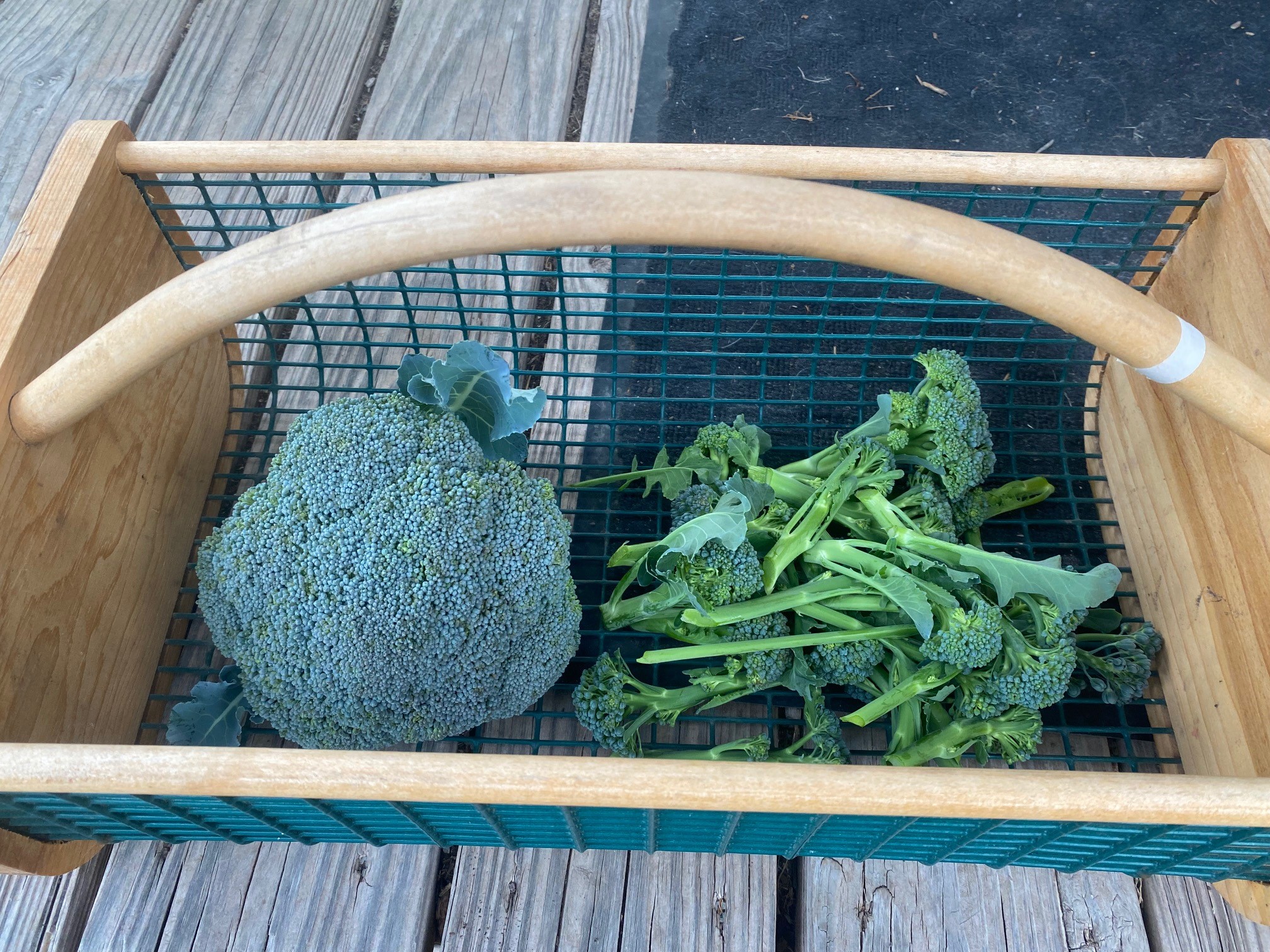
What blew my mind was the difference in size between the side shoots of the 2 varieties.  ‘Nutribud’ continuously grew bite-sized side shoots from the axils in the leaves after the heads were cut.  However, the ‘Belstar’ plants produced head-sized side shoots from large side branches!  I was amazed because none of the other varieties that we grew in 2016, produced side-shoots the size of broccoli heads!  They all produced smaller shoots, like the ‘Nutribud”. 

'Belstar' side shoot (left) & 'Nutribud' side shoots (right)
September 13, 2022
I didn’t do a thorough job weighing each harvest, especially at the beginning, so I don’t have data to show which variety actually produced the most edible broccoli, but it was close.  I could harvest many 'Nutribud' side shoots weekly but it took several weeks for the 'Belstar' side-shoots to grow to their larger size.  

Last harvest of 'Belstar' side-shoots (bottom)
and next-to-last harvest of 'Nutribud' side shoots (top)
October 21, 2022
An advantage of the ‘Belstar’ would be for gardeners or farmers who want to produce 'heads' over a longer period of time.  The advantage of 'Nutribud' would be nutrition.  I personally love the flavor of 'Nutribud' plus the shoots are very tender.


Monday, April 20, 2020

Seed Libraries

by Yvette Henson

Seed Libraries are fun and they also serve important roles in our communities!  The most important role, in my opinion, is to support a more resilient local food system.  You may ask, ‘How does a seed library do that’?  The ideal of a seed library is not only to provide seed and make gardening more accessible but to educate and grow seed-savers who will grow their favorite varieties in their gardens, allowing some of their best plants go to seed.  Then they will have seeds for themselves and to share with their local seed library for other people to grow in their gardens.

Plant genetics work so that when carefully done, saving seed, will result in plants that are better adapted to the local growing conditions they are grown in.

A reliable local seed source is an often-overlooked, but vital part of a local food system.  In addition to the benefits of having seeds for plants adapted to local growing conditions, it is important to have a reliable source of seed.  Consider our current situation with COVID-19. Many seed racks are emptied of their seeds and seed companies are running out of seed and/or having a hard time filling orders.   This is good for the seed companies and an encouraging sign that more people want to grow food.   A Seed Library with local seeds is an important source of seeds. 

carrots gone to seed
I was listening to a podcast the other day.  The guest was Ken Greene, owner of Hudson Valley Seed Company.  He is a huge proponent of seed libraries and seed savers.  In the podcast, he said something that inspired me: “We can look at this increase in seed buying as that people are worried or are ‘freaking out’ but part of it is also that seeds are hopeful and embody this sense of potential…”. 

perpetual spinach (chard) seed
I have been blessed to work with our local Lone Cone Library and Master Gardeners to develop the San Miguel Basin Regional Seed Library.  A few of our goals are to maintain and provide a collection of pure, healthy seeds for community use, to educate our community how to grow and save seed successfully and to develop a source of regionally adapted seeds. You can find more information about our seed library on our website (Agriculture/Local Food page):  https://sanmiguel.extension.colostate.edu/

San Miguel Basin Regional Seed Library 
Many Extension Offices around our state work with their local seed libraries in similar ways. At the moment most libraries and other locations that house seed libraries are not open to the public and yet they may have found creative ways to distribute seeds.

Rocky Mountain Seed Alliance has a list of seed libraries in Colorado:  https://rockymountainseeds.org/resources/seed-libraries
A few other seed libraries in our state that I am aware of are:
Larimer County: Old Town Fort Collins Library has a seed library and Loveland Library will soon have one.  https://blog.poudrelibraries.org/2019/03/growing-community-with-the-new-seed-library/ 

Lettuce Going to Seed (photo credit Laura Parker, High Desert Seed & Garden)
If you don’t see one listed in your area, reach out to your local CSU Extension Office and/or your local library. 


Monday, February 22, 2021

Five helpful tips for planning a vegetable garden

By John Stolzle, Jefferson County Extension 

If 2020 was any indication, this will be another busy year for gardening. A recent Co-Horts blog post presented some information from two seed suppliers; the gears are turning and companies are stocking up. With the upcoming year in mind, I have laid out five topic areas and include relevant resources from CSU Extension to help gardeners prep for a successful year
 
1) It’s never too early to plan. 

Having a plan in place for a garden can prevent many problems from ever occurring. Before starting a new garden, it is important to give some time and thought towards site selection and ask questions such as: will this area receive full sun, how was the land previously used, how much produce do I want? The layout and form of a garden (for example, in-ground or raised bed) can also play a significant role in its productivity. Raised beds with a block style layout can save space, drain faster, heat up earlier in the spring, and save water by keeping it where the plants are grown. 

More information to help you select a site and layout can be found in the following links: 

In our dry climate, it is especially important to consider whether a source of water is near to where you are planning to garden. Irrigation systems and mulch are two tools that we can use to help conserve water. On the topic of mulch, it is important to note that mulching too early in the season can actually reduce a garden’s productivity!

Here is some additional information on the topics of irrigation and mulch for vegetables gardens: 

3) Soil matters

One common question I often receive is about best practices for amending soil. From my perspective, it can sometimes be a challenge to make suggestions for fertilizing or adding amendments without first knowing more about a soil’s composition. A soil test can provide baseline information from which recommendations can be made. The CSU soil testing lab in Fort Collins can receive soil samples through the mail. They will analyze a sample’s composition and provide recommendations if they discover any deficiencies. At the time of posting this, the lab is expecting a 2-3 week turnaround time.

Additional information:

 4) Take care when determining your start time to avoid starting seeds too early.

Starting seeds indoors, before the weather warms allows us to get a jump start on the growing season. One challenge that comes with starting seeds early is that larger plants are often more sensitive to the stress that comes with transplanting. For this reason, it can be important to not start seeds too early and to have an idea for when you might plant them in the ground. Frost dates are often used to help determine when to plant outside and when to start seeds; these dates differ between elevations and regions in Colorado. Certain cool season crops do better in cooler temperatures and can resist a light frost (for example, Spinach, lettuce, and broccoli), whereas other warm season crops do much better in the heat of summer after the threat of frosts and freezes has passed (for example, tomatoes, squash, and watermelon). 

5) Plan with a full year in mind

One of the most important tips I can provide is to plan your garden with a full year in mind. Are you interested in donating extra produce to neighbors, or friends, or family? If so, consider planting a few extra vegetables. To receive more information about growing produce and sharing the harvest, you can sign up for the Grow&Give newsletter on the Grow&Give website: https://cmg.extension.colostate.edu/grow-give/

Lastly, I want to include a few additional links to more information which you may find helpful:

As always,
Best of luck in your gardening endeavors! 


Thursday, August 30, 2018

The Joy of Gardening With Kids!


Posted by: Yvette Henson, CSU Extension, San Miguel Basin

Most people with grandchildren will tell you how much joy their grandkids bring into their lives and how much fun it is to experience life anew with their littles.  I have realized over the last few years the positive impact grandparents can make in the lives of their grandchildren.  I can’t count the times I have heard someone attribute their love of gardening or nature or whatever to a grandparent.  And yes, I garden with my grandkids.  I have 4!  Adelle is almost 12 now!  Maddox is almost 5!  Coen and Micah, fraternal twin brothers to Maddox, are 19 months old!   


I understand that not everyone is a grandparent and not all grandparents garden or are completely positive influences.  However, what I am writing about today applies to anyone who loves to garden and loves children.  A little later in this article, I will give you some tips, resources and opportunities for gardening with children, but first I want to tell you about some of my experiences gardening with my grandkids and how I have been blessed by it even more than them! 

Adelle was my first grandchild and I was fortunate to get to spend a lot of time with her.  She would help me in my personal gardens and go with me to care for CSU Extension Gardens that I oversee.  She would eat anything right out a garden, as long as I washed it first.  Because of that she loves fresh vegetables and fruit more than any other foods.  Together, we experienced fava beans for the first time—we planted them, cared for them, harvested them and cooked them.  Together, we discovered with delight the soft, fuzzy interior of a fava bean shell and that when you cook the fava bean that grew nestled inside that blanket, it splits open to reveal a bright green, delicious bean!  When the seeds of the particular variety that we grow and save seed from, ‘Extra Precoce A Grano Violetto’ (early purple), mature they are a beautiful dark purple.  I sometimes carry one in my pocket.  Each year when I ask Adelle what we should plant in the garden she says ‘fava beans!’  


This past year, Maddox and his twin brothers and parents all lived with us!  We had, at times, 8 people living in our house!  We planted a ‘big’ garden-- as big as we could grow in the space we have.  

Maddox was the most consistent help I had.  He helped me plant every seed.  He helped me water but at times I would have to relieve him of watering duty, since like most children, he has a tendency to ‘water’ other things than just the garden.  (Sheesh!  We are in a drought after all!  And my own grandmother who grew up in western Colorado had taught me to NEVER waste water.)

Maddox got to harvest some of the veggies we planted together before they moved to California last month.  This boy who won’t eat salad at dinner, would eat the perpetual spinach we grew right out of the garden, saying “Mmmm… I love this stuff!”  Once, when his dad went with him to harvest some of it for dinner, his dad harvested some beet leaves too.  Maddox said, "Daddy, don't do that because the beets need their leaves to grow big"! 

Coen and Micah helped plant beans, plucked leaves to munch and pulled carrots and beets.  Their favorite garden duty was pulling the legs off grasshoppers.  I would then finish them off-- out of their sight of course!

I could tell you so many more stories of funny experiences and things we've learned together in the garden but I promised to give you some tips.  I’ve picked just a few.

  • I recommend that, as much as possible ,you garden from start to finish with the kids you are blessed to garden with.  Doing the work together is the most effective way to teach and to learn.  Explain the how and the why as you go; Experience the wonder and beauty all along the way!  Plan, look at seed catalogs, prep the soil, plant, water, feed, do organic pest control, harvest, clean, cook and eat!   Don’t forget to allow some plants to go to seed for next year!  

  • Let kids plant the big bean seeds AND let them plant tiny carrot seeds and kale seeds too.  There is so much variety!

  • Mistakes teach the best lessons—like when Madds spilled a bunch of carrot seeds he was trying to put back into the package. When they sprouted in a clump, he could see right where he spilled them (and this excited him for some reason).  He could see how they grew too close and learned they had to be thinned and that a lot of seeds were ‘lost’.

  • If you can, let them play in the water—just a little.  And then, lay back and enjoy the fruits of your labor together with them!

If you love to garden and you love kids, whether you have grandkids or not, there are many books and YouTube videos to inspire you and give you some fun ideas for activities in the garden.  A few of our personal favorite books are:  Sunflower Houses: Inspiration From the Garden--A Book for Children and Their Grown-Ups by Sharon Lovejoy, Miss Maple's Seeds by Eliza Wheeler and A Seed Is Sleepy by Dianna Hutts Aston.  A VLOG I really enjoy is Roots and Refuge Farm.  Jess’s videos often show footage of her 4 sons helping her on their homestead and in the garden. 

Your local CSU Extension Office most likely has volunteer opportunities for you to garden with children, such as Junior Master Gardener and/or becoming a leader of a 4-H gardening club!