CO-Horts

CO-Horts Blog

Showing posts with label Tri River Area. Show all posts

Monday, November 15, 2021

Healthy Soil- Too much of a good thing?

Recently I attended our annual forum where all the Extension staff across the state come together and we learn and share.  The sharing of programs, county issues and among us plant folk, plant and soil issues are the most telling.  There seems to be a common theme this year, gardens being over amended and a misunderstanding of organics and fertilizer versus compost is evident.  Both compost and fertilizer can be organic, but they are not the same thing. 

Compost image, Colorado State

I want to point out before I go further, that Extension and Extension staff have conventional and organic options on all our factsheets and that we all care about our environment, it’s why we have the jobs we do because we are passionate about our world.  I think it is very important understand and get the facts about your soil prior to adding amendment or fertilizer.  This is very similar to practicing IPM- Integrated pest management where you observe / monitor, proper id, learn more about the issue (or system), determine action, choose tactic(s), evaluate.  IPM is monitoring the situation, gathering the facts and doing something when needed.  https://cmg.extension.colostate.edu/wp-content/uploads/sites/59/2020/01/GN-100-Integrated-Pest-Management.pdf  So think of these similar steps in your landscape and how to improve your soil.  Get the facts before applying anything and to improve when you need to improve, plant the right plant in the right place and you will be successful.  If you have never done a soil test, this is the foundation of the garden and a good place to start.  The CSU lab is currently moving so not testing currently, other great laboratories that understand our Western soils are Ward Laboratories https://www.wardlab.com/, Servitech https://servitech.com/crop-consulting/soil-sampling and American Agricultural Laboratory Inc. https://www.amaglab.com/

Once you pick a lab, stick with them as their procedures might be slightly different.  You want to be able to compare apples to apples down the road.  Please read how to take an appropriate sample and tell them exactly what you are planting (your crop): buffalo grass, tomatoes, plum tree- the more specific you are, the better the recommendation they can give you.

University of Hawaii Soil Management


Let’s go back to the word organic.  It was first used to describe the organic matter (basically plant material: leaves, roots, stems, & microorganisms) that is in the soil.  We still use it this way, but it has also morphed into products that are naturally based.  Here I am sticking to the original definition.  Our native soils in Western Colorado are naturally 1-2% organic matter.  This is why our native plants do not prefer high amounts of compost being added to our soil, it’s not what they are acclimated to.  Then somewhere along the way organic morphed into meaning using naturally sourced fertilizers and pesticides.  We know from experience and as shown in the soil pie chart that we want up to 5% organic matter in the soil for the general typical landscape plants and vegetable and flower gardens.  When soil test results get closer to this 5% organic matter, the need for nutrients like nitrogen will drop because it is being released of some nutrients from the organic matter (plant based and microorganisms).  This article from Minnesota gives a good explanation of other reasons too much organic matter is not good.  https://extension.umn.edu/yard-and-garden-news/compost-and-soil-organic-matter-more-merrier Of course our soil is going to be different, but the having too much organic matter is the same.  We general have good minerals (phosphorus, potassium, sulfur) in our soils.  Occasionally we will see a micronutrient low due to the pH of the soil, high pH affects the accessibility of certain nutrients to specific plants.  Example: Silver maples have trouble accessing iron in high pH soils resulting in chlorosis.  Adding more iron to the soil doesn’t work unless it is chelated. 

Microbes in the soil, invisible to the naked eye-
                                                                    Colorado State
Example 2: Someone was having trouble growing vegetables, since the pH was high they continued to add sulfur, which was already at a good level.  This caused a toxicity of sulfur in the soil which causes a reduced rate of growth and necrosis.  Since we have high amounts of calcium carbonate in our soils and there already is enough sulfur, our soils are buffered which means it is very hard to change the pH so we focus on what we can change and improve.  So please do a soil sample, talk to Extension if you need more explanation, pick the right plants for your soil and you will be successful. 

Lastly, pick the right soil amendment if your organic matter is below 5%.  This includes using compost and it is ok to ask for a sample of compost and have it tested before you buy or use it.  Compost is a soil amendment, though it may help with nutrients down the road, it is not considered fertilizer or a major source of nutrients. https://extension.colostate.edu/topic-areas/yard-garden/choosing-a-soil-amendment/

If your plants are needing fertilizer, than use the appropriate fertilizer. Here is understanding fertilizer.

https://cmg.extension.colostate.edu/Gardennotes/232.pdf

Hopefully that helps in understanding that you can have TOO MUCH of a good thing.  It is like finding out that watermelon is good for you and you eat the whole watermelon, you might not feel so good afterwards.  It is important to keep things in balance.  By adding too much of one thing, other things have to become out of balance.  Look back at the soil pie chart, if there is too much water, there would be less air.  If too much organic matter, there would be less mineral particles, water or oxygen.  ALL are important. 

So hopefully if nothing else, you will do a soil sample and think about what your soil needs before you add something.

Susan Carter, Tri River Area Horticulture and Natural Resource Agent


Tuesday, March 3, 2020

Control of Grasshoppers


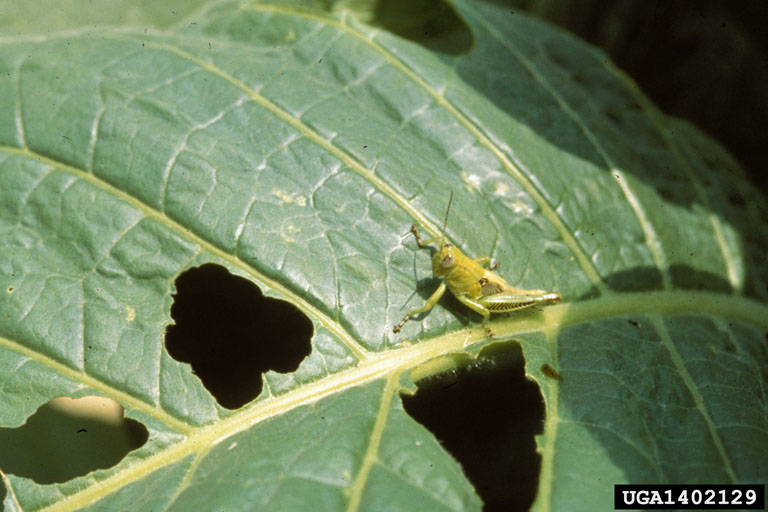
1402129 Grasshopper damage - by R J Reynolds Tobacco Company
If you are seeing holes and gnarly places chewed in your plants, it could be the result of hungry grasshoppers. Sometimes we do not really think much about grasshoppers until they become large and begin showing up everywhere. By then, it might be too late to control them.

If you live in the country, you may experience more grasshoppers than your friends in town. This is because grasshoppers prefer to lay their eggs in the fall, in dry undisturbed areas such as fields, pastures, roadsides, or empty lots. Depending on the weather, the eggs will begin to hatch in mid to late spring. 

After the nymphs are born, they begin feeding on lush green vegetation in the immediate area. As plants begin to dry up with the summer’s heat, and moisture becomes less available, food sources grow scarce and the hoppers begin moving to more desirable locations, namely your lush yard. 
Two striped Grasshopper, Linda Corwine
A female grasshopper can lay up to 400 eggs, found about ½ inch under the soil. Many of the nymphs will die before they become adults, but with that many eggs being laid it doesn’t take long for their populations to become extensive. Fortunately, there are many natural predators such as birds, nematodes, blister beetles, robber flies, skunks, and occasionally coyotes and wolf spiders to help control their populations.


While a few grasshoppers in the garden are expected, and cause no real damage, populations can become quite large taking its toll on your plants. Within 16 hours, a grasshopper can eat its own weight in green food. This is not bad if you only have a small population to deal with. It is said that if you have 7 grasshoppers per square yard over a 10-acre field, they will eat the same amount as a cow! I am not sure how much a cow eats, but I have seen plants severely damaged in a very short period.

The good news is, there’s a great organic pesticide that can help solve the problem. Nosema locustae, a fungi called Microsporidia, is mixed with wheat bran, which is a favorite treat of grasshoppers. As the unsuspecting grasshopper eats the bait, the fungus infects the hopper’s stomach, producing a chronic disease. Because this takes a while to act, patience is required. In fact, the populations may not decrease until the following season. The bait can also control earwigs (which can be considered either a beneficial or troublesome insect), cutworms, crickets, and sowbugs. It’s not harmful to mammals or beneficial insects such as bees!
Nolo Bait, Linda Corwine Photo

The Microsporidia is sold under various trade names such as Nolo Bait or Semaspore. It i commercialized by mass production in laboratories. You may have had a hard time finding Nolo Bait in previous years because there was a fire at the factory in Durango in 2018. The supplier of Semaspore put the business up for sale. However, it should be in good supply again this season. Because this is a living organism, it only has a one-year shelf life and must be stored carefully.  Homemade baits can be made, but are not safe around children and pets.

Baits will work much more effectively on young grasshoppers when applied in the evening hours, and when it’s cooler. Some grasshoppers actually prefer to feed at night, rather than during the day. Most grasshoppers will stop feeding when temperatures become too hot.

Treating the areas where the grasshoppers are hatching will give the best results, but this isn’t always possible. A barrier strip of grass, weeds, or flowers, around your property can be a good place to treat grasshoppers if chemicals are required. Just make sure that your barrier does not consist of weeds that are invasive varieties. Carbaryl, permethrin, and acephate are all effective products.

Grasshopper control is not a one-time shot with a pesticide. In spite of your best attempts, some hoppers inevitably manage to find their way to their favorite foods. Crops such as lettuce, rhubarb, tomatoes, and corn are always on the menu. Because they feed on such a large variety of plants, take time to inspect your garden and observe who’s having a hopping good time.

For additional information refer to Fact sheets 5.535 and 5.536

Linda Corwine McIntosh
Colorado Master Gardener Tri River Area, ISA Certified Arborist, Commercial Pesticide Applicator


Monday, November 12, 2018

Veteran's Day

                          United States Flag                                                  Today is the day for all of us to say THANK YOU to all that have served to protect us and to keep us free.  And to tell them that we will not forget their service.  Several years ago, I had a Veteran, Steve, take our Master Gardener class.  Though he has many health issues from serving in Vietnam, he manages to work at our Master Gardener desk answering many gardening questions.  The year after he took our class, he started sponsoring other veterans to take the class.  Some have completed the course and volunteer hours, other did not.  This year we had 3 women veterans take the class.  They all carry some "scares" from serving.  But this year I realized that with a gentle tug and words of encouragement and pointing out the positives was enough to help them forge ahead to finish their 50 hours.  I am hopeful that they will continue to volunteer and learn more about gardening.


One of these strong bright women actually works for the VA Hospital.  She asked me if I would be a collaborator to help her receive a grant that would allow her, and our program, to help teach more veterans and to put in a therapy garden.  The hope is to provide a space of healing and that some learn enough skills to acquire a job in the Green Industry.  Steve and I had discussed this idea for several years but just needed the right person and the grant to come along.  The ball is now rolling to fulfill the dream of helping our Veterans through gardening.

We all know that staying more active keeps us healthy longer.  I recently read a report about how just getting people out of the office at lunch and out into the landscape was enough to improve their mood and productivity, in fact even more then someone meditating for the same amount of time.  Gardening provides exercise, mental clarity, healthy food and a sense of community.  Hopefully we will have a way to track how gardening improves Veterans lives and the lives of others.  If this program does well in Grand Junction, imagine the potential at all VAs across our nation.

So today I challenge you to not only thank a Veteran but think about how your love of gardening could help someone, Veteran or not in your community.  Most CSU Extension offices are currently accepting applications for the Master Gardener / Colorado Certified Gardener class.  Here are the benfits of being a Master Gardener: http://www.cmg.colostate.edu/about.shtml

And again, thank you to all that have served.
Susan Carter, Horticulture and Natural Resource Agent, Tri River Area.

Thursday, August 31, 2017

Chickens in the Backyard

About six years ago, the tiny city I live in Western Colorado approved chickens within the Community Residential Zoning district.  They allowed 6 hens per dwelling unit or up to 12 per lot if more than one dwelling unit.  So my family decided we would get some chickens the following spring.  

Some of the benefits of having chickens in the garden include providing green fertilizer, insect control, compost materials, eggs and food, and psychological benefits of calming and helping with special needs such as anxiety and depression. 1  Maybe that answers why I sit on the back step and visit with the chickens after work J


Here is my daughter with our Cochins-Picture by SLC
My family did our research and wanted chickens that were good layers but docile and didn’t fly.  I remember having various breeds growing up and remembering having to clip a wing so they didn’t fly into trees or off our property.  So I ended up with 6 Blue Cochin hens.  Make sure you get your chicks from a reputable company.  http://articles.extension.org/pages/68696/selecting-birds-for-a-small-or-backyard-poultry-flock

We started them out in the garage with a heat lamp until they were old enough to move outside.  We introduced our Borador dog, that’s a Border Collie Labrador mix, to them every day so she knew they belonged.  So it came time to let them out of the coop to roam the yard.  Well, Izzy the Borador thought that she needed to herd them back into the coop.  So with a little training, she realized we just do that at night.  http://articles.extension.org/pages/68697/housing-for-small-and-backyard-poultry-flocks
Izzy the Chicken Herder
By this time, we were planting our vegetable garden.  Since we have a moderated sized town lot, our garden borders our yard.  So I planted my cold crops or cabbage, broccoli and cauliflower.  My husband and I left for work with the girls wandering around our fenced in yard.  That evening I came home to find nubs where plants had been.  My girls apparently really enjoyed the veggies.  Chickens, like humans, are omnivores, so they need a well-balanced diet.  My scraps from dinner go to the girls.  They are my replacement compost pile.  http://articles.extension.org/pages/68178/basic-poultry-nutrition

So up went some chicken fencing so they can get close to the garden but not into the garden.  The chickens seemed to do a good job eating different insects although they are a little wimpy about new things like when I threw a tomato hornworm at them.  They first ran away, and then finally realized it was food.  The one thing I noticed the first year after the City passed the ordinance was the amount of flies seem to greatly increase.  So we hung a few fly traps near the coop and clean the coop weekly.  Not sure if the food web caught up to the increasing fly population or if other people took steps like us to decrease them.  But they now seem to be under control.  Lime is also another way to control the flies within the coop and helps with others things like disease and ammonia.  http://articles.extension.org/pages/66918/use-of-lime-in-poultry-houses

Having cochins has been great in the sense that they are so docile that there is very little pecking from establishing a pecking order.  However, my sister has several different breeds of chickens and one ended up wanting to be queen of the chickens and picked on everyone else.  My sister also lives in a city that allowed chickens but unfortunately had an uninformed code enforcement officer and city employee.  Apparently someone complained about the egg laying noises and the officer came to take the chickens.  Well, my very large personal fitness trainer brother-in-law said “no you are not taking my wife's chickens”.  The gal at the city said “well you have a rooster”.  “No”, he said “I don’t”.  Her response was: “well, how do you get eggs?”  Lesson here is YES, hens lay without the presence of a rooster.   So, to not deal with the city, the chickens were moved to Dad’s house.  But the mean hen continued to pick on the other two hens and my dad threatened to throw her in a pot.  My sister said no, let me figure something out.  Well, she found chicken goggles that made it hard for her chicken to focus on the other hens.  And it worked so no stew pot for her.  I then had a Master Gardener with the same pecking order issue with her chickens and I told her about the googles.  And they worked for her. 
Here is a picture of Big Bertha with her goggles on.
There are certainly challenges to having chickens.  When we go away, we have someone open and close the coop, give them treats beyond what is in the basic feeder and fresh water 1-2 times a day.  Egg layers need a lot of water available to them.  Of course now and then they get in the garden and do some damage.  And they eggs are not cheaper but wow do they taste good.  We do let them get into the garden in late fall for cleanup.  They enjoy eating the leftover vegetation and any insects left in the garden.
My sister's Chicken, Picture by Linda Gular

Do your homework before you get chickens.  Select the right breed for your purposes and situation or support a local egg farmer.   Practice good research based techniques.  Chickens can pass on some illnesses like Salmonella so wash and read this link. https://source.colostate.edu/dont-kiss-chickens-commonsense-tips-poultry-owners/

By Susan L. Carter, Horticulture Agent and Chicken Momma
CSUE Tri River Area

1 information from Rutgers, M. Brimat, Green Chicken Lady, 2016

Oh, by the way, peach season is wrapping up so go buy some Colorado Peaches today!