CO-Horts

CO-Horts Blog

Showing posts with label damage. Show all posts

Tuesday, October 27, 2020

Farewell, stressful summer

 Posted by: Todd Hagenbuch, Routt County CSU Extension

2020 has been a challenging year, for sure. And while one of the biggest challenges of the year (yes, I’m talking about you, COVID!) led to increased interest in gardening, mother nature made it a hard year to grow the plants we had time to tend to. If you were a first-year or novice gardener in 2020 and felt like you had a lot to overcome, you weren’t alone.

Besides being somewhat off due to the pandemic, this summer in Northwest Colorado was also:

Hot and dry: plants that had a good start with our warm spring were shocked to have to survive the blistering heat that July and August brought. In fact, August was the hottest and driest on record in Routt county according to state climatologist Russ Schumacher. Our typical cool-season plants bolted early, wilted often, and suffered from the heat.

Not a banner year, but we did get some production.

But summer was also cold: my garden suffered a set-back on July 1st when an unexpected and unwelcomed frost hit my garden hard. Our zucchini, yellow squash, and cucumbers never really recovered. The hot days we had were juxtapositioned with many cold evenings, which plants struggled with, too.

Late summer and this fall were also smoky: that thick haze can create a diffused light pattern which can help plants, but it can also keep the gardener out of the garden which can lead to increased weed competition, less water, etc.

The chickens love grasshoppers, and really love
that they've now been given run of the garden
.
This summer was great for grasshoppers: lack of regular moisture in the late spring meant that grasshoppers had no real natural control early in their life-cycle this year, so we saw big numbers in late summer. They also had a voracious appetite. Many flowers and vegetables fell victim to their gnawing.

This summer was tough on trees: many trees in yards budded early when we got the first wave of hot weather, only to be damaged as more seasonable temps came back and froze the new, early growth. This can cause long-term damage to trees, so it will be interesting to see how they look in spring 2021. And who can think about the wackiness of this summer and not discuss the amazing wind that struck the day after labor day? Many mature, beautiful trees broke limbs and branches, snapped in half, or were just uprooted by hurricane force winds. Again, a lot of long-term damage due to this storm will manifest over the next few years, so we don’t yet know what the total damage will be.

And finally, a cold snap now that is seeing well-below-zero temps early: I saw -19 on my way into town today. Most of our trees and perennials have gone into dormancy, but there isn’t much insulating snow around plants. Will our more-sensitive plants that are Zone 4 or 5 suffer as a result? We can often grow things here that can’t survive cold temps because we cover them well with snow before getting below zero. Yet again, we’ll have wait until next year to see what the damage may be.

Yes, this growing season is one we won’t be sorry to see go from a plant-health perspective, but it is one we hate to see go for so many other reasons, mostly because we know a long winter is ahead of us. Stay warm this winter and stay well, and take advantage of this time to plan for the warmer days to come.

Tuesday, March 3, 2020

Control of Grasshoppers


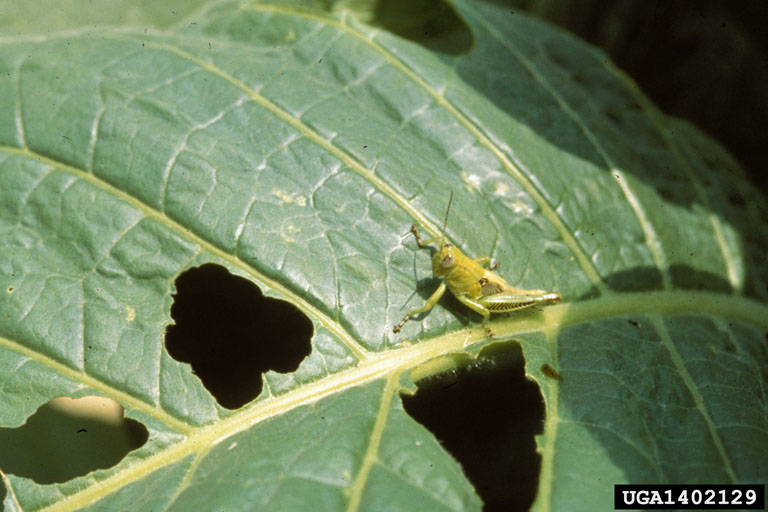
1402129 Grasshopper damage - by R J Reynolds Tobacco Company
If you are seeing holes and gnarly places chewed in your plants, it could be the result of hungry grasshoppers. Sometimes we do not really think much about grasshoppers until they become large and begin showing up everywhere. By then, it might be too late to control them.

If you live in the country, you may experience more grasshoppers than your friends in town. This is because grasshoppers prefer to lay their eggs in the fall, in dry undisturbed areas such as fields, pastures, roadsides, or empty lots. Depending on the weather, the eggs will begin to hatch in mid to late spring. 

After the nymphs are born, they begin feeding on lush green vegetation in the immediate area. As plants begin to dry up with the summer’s heat, and moisture becomes less available, food sources grow scarce and the hoppers begin moving to more desirable locations, namely your lush yard. 
Two striped Grasshopper, Linda Corwine
A female grasshopper can lay up to 400 eggs, found about ½ inch under the soil. Many of the nymphs will die before they become adults, but with that many eggs being laid it doesn’t take long for their populations to become extensive. Fortunately, there are many natural predators such as birds, nematodes, blister beetles, robber flies, skunks, and occasionally coyotes and wolf spiders to help control their populations.


While a few grasshoppers in the garden are expected, and cause no real damage, populations can become quite large taking its toll on your plants. Within 16 hours, a grasshopper can eat its own weight in green food. This is not bad if you only have a small population to deal with. It is said that if you have 7 grasshoppers per square yard over a 10-acre field, they will eat the same amount as a cow! I am not sure how much a cow eats, but I have seen plants severely damaged in a very short period.

The good news is, there’s a great organic pesticide that can help solve the problem. Nosema locustae, a fungi called Microsporidia, is mixed with wheat bran, which is a favorite treat of grasshoppers. As the unsuspecting grasshopper eats the bait, the fungus infects the hopper’s stomach, producing a chronic disease. Because this takes a while to act, patience is required. In fact, the populations may not decrease until the following season. The bait can also control earwigs (which can be considered either a beneficial or troublesome insect), cutworms, crickets, and sowbugs. It’s not harmful to mammals or beneficial insects such as bees!
Nolo Bait, Linda Corwine Photo

The Microsporidia is sold under various trade names such as Nolo Bait or Semaspore. It i commercialized by mass production in laboratories. You may have had a hard time finding Nolo Bait in previous years because there was a fire at the factory in Durango in 2018. The supplier of Semaspore put the business up for sale. However, it should be in good supply again this season. Because this is a living organism, it only has a one-year shelf life and must be stored carefully.  Homemade baits can be made, but are not safe around children and pets.

Baits will work much more effectively on young grasshoppers when applied in the evening hours, and when it’s cooler. Some grasshoppers actually prefer to feed at night, rather than during the day. Most grasshoppers will stop feeding when temperatures become too hot.

Treating the areas where the grasshoppers are hatching will give the best results, but this isn’t always possible. A barrier strip of grass, weeds, or flowers, around your property can be a good place to treat grasshoppers if chemicals are required. Just make sure that your barrier does not consist of weeds that are invasive varieties. Carbaryl, permethrin, and acephate are all effective products.

Grasshopper control is not a one-time shot with a pesticide. In spite of your best attempts, some hoppers inevitably manage to find their way to their favorite foods. Crops such as lettuce, rhubarb, tomatoes, and corn are always on the menu. Because they feed on such a large variety of plants, take time to inspect your garden and observe who’s having a hopping good time.

For additional information refer to Fact sheets 5.535 and 5.536

Linda Corwine McIntosh
Colorado Master Gardener Tri River Area, ISA Certified Arborist, Commercial Pesticide Applicator


Monday, July 6, 2015

Who dunnit? Voles or Pocket Gophers?


By Irene Shonle, CSU Extension in Gilpin County

There are many burrowing animals in Colorado that can cause damage to lawns, gardens, and pastures. The first step to resolving the problem is to figure out which animal (or animals) caused the damage.
The main four types of burrowing animals are voles (8 species), pocket gophers (4 species), prairie dogs, and Wyoming ground squirrel.   Moles are rarely found in Colorado, and only in the very eastern plains.  If you are outside that area, the species causing damage is one of the other four.
  In this post, I'll just be discussing the difference between voles and pocket gophers, since these are the critters I most often deal with in the mountains.


Voles
This year has been a very bad year for voles.
Voles cause several types of damage.  They gnaw on bark of trees and shrubs, sometimes girdling it entirely and causing the death of trees. Most damage occurs in the winter when voles move through their grass runways under the protection of snow. The greatest damage seems to coincide with years of heavy snowfall.
Vole damage to trees and shrubs is characterized by girdling and patches of irregular patterns of gnaw marks about 1/16 to 1/8-inch wide. Gnawed stems may have a pointed tip.
Other signs of damage by voles include: 1- to 2-inch-wide runways through matted grass with open 1-2 inch holes and spongy soil from burrowing activity. 
It is common to see voles, as they are active all year round, and are frequently above ground.

Vole damage on lilac. Notice small, irregular tooth marks, all under what was the snow line.


Vole trails in lawn after snow melted in spring
Add caption

Vole hole and trail in clay soil

Vole hole and trail in snow.  Note the oval-shaped OPEN hole

Examples of vole holes.  
They will often burrow near a rock, but not always.


Pocket gophers
Pocket gophers rarely appear above ground, spending most of their lives in burrows.  Prairie dogs and Wyoming ground squirrels, on the other hand, are frequently seen above ground.
The mounds that pocket gophers create are fan-shaped to round and usually have closed entrances, unlike prairie dogs and Wyoming ground squirrels. 
The main signs of damage from pocket gophers include mounds of soil (with no apparent hole), eskers (solid tubes of soil) above ground when the snow melts in the spring, and suddenly wilting plants (due to root damage).   If you walk across an area inhabited by pocket gophers, your foot will frequently break through into their tunnels.  The tunnels are usually 2.5-3.5” in diameter, and are usually found in the top 4-18” of soil.

An example of an esker - these solid soil tubes are only seen as the snow melts, and are a result of burrowing activity in the snow.


Fan-shaped mound with closed hole is typical of pocket gophers in the summer


 Now that you have a good idea of who dunnit, please refer to the following fact sheets for help with dealing with them:  6.507 Managing Voles in Colorado, 6.515 Managing Pocket Gophers.