CO-Horts

CO-Horts Blog

Showing posts with label cottonwoods. Show all posts

Thursday, May 11, 2017

April Frost brings May concerns

Mother’s Day is fast approaching and away should go the chance for frost and freezes in the Grand Valley and other low lying areas of Colorado.  Unfortunately the last weekend of April and three weeks prior we had some late cold temperatures.  Many plants were a good month ahead on growing because our February and March had been so warm.  The first of the frost/freeze wasn’t too bad.  Most of our fruit crop just had a good thinning and some just the lower limbs were affected.  Areas that were lower, like my residence in Fruita, got much colder.  I lost all my peaches and plum fruit for this year and my apples were thinned heavily.  We tend to forget that cold settles.  I had tried covering my smaller trees, but when you get down to 21 degrees F, a cover doesn’t do it.  

The Palisade area was much warmer (29 plus) and with orchard fans running were able to avoid great damage; then came the second frost April 29th and 30th.  I didn’t see much more fruit damage; it is dependent on the bud or fruit stage and how cold it gets for several hours or more.  But I did see many large ornamental trees get hit hard by the cold.  They were just at the right point of expansion of the leaves. I have noticed cold damaged foliage on cottonwoods, sycamores, elm, honey-locust and oak.  
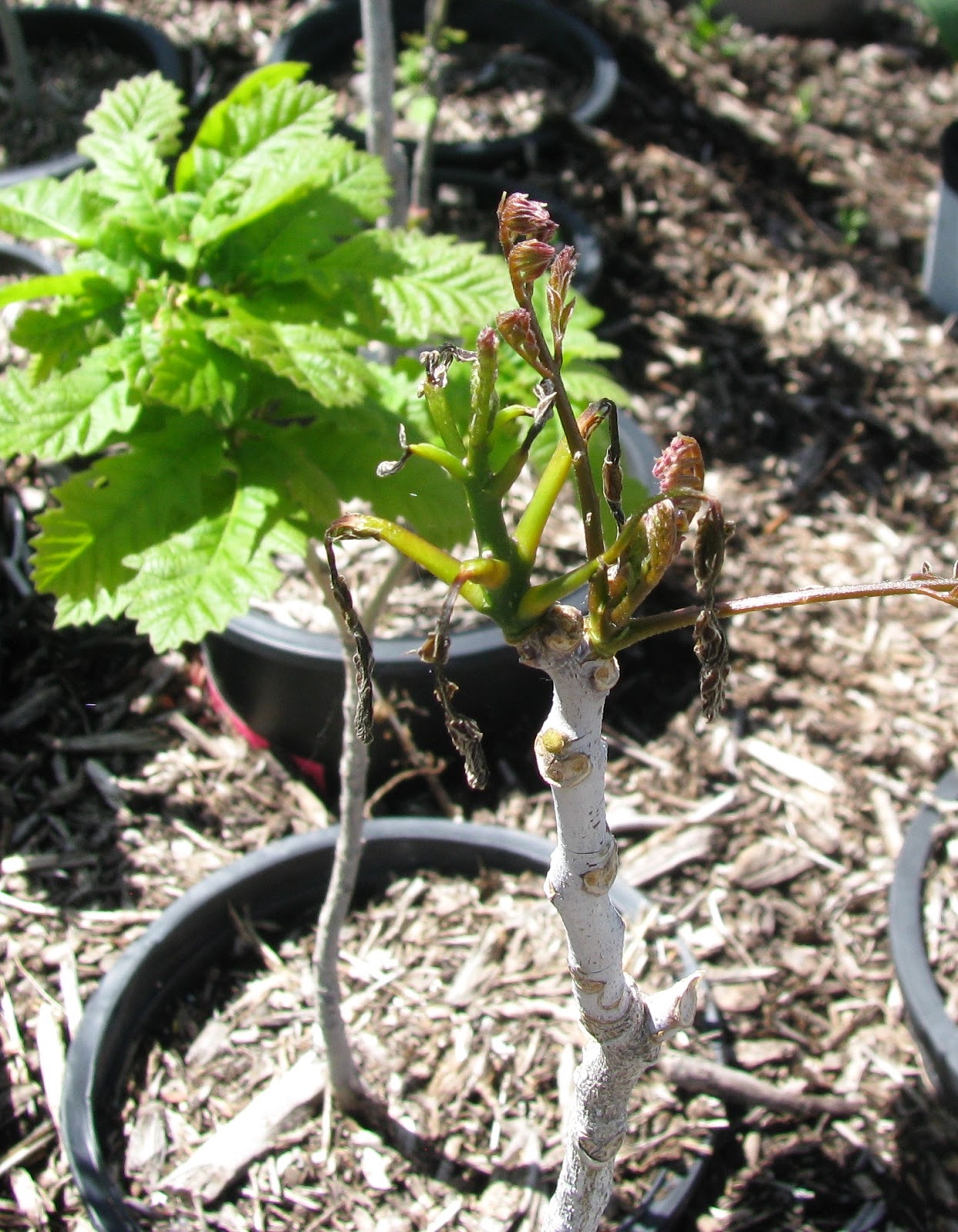
Cold damage on a baby Kentucky Coffeetree in our Nursery area- SLC

Even Siberian Elms showed some cold damage- notice the larger leaves on the tips-
New foliage is now emerging- SLC

My potatoes had damage to the edges of the top leaves and we have had some shrub samples come in with cold damage.  I found a good handout for preventing frost damage from Arizona Extension.  https://extension.arizona.edu/sites/extension.arizona.edu/files/pubs/az1002.pdf

SO what do you do if you had cold damage?  Many people at first want to cut off some of the damage or fertilize.  If the tree was in good health, a second set of leaves should emerge.  Give it time.  Patience has its virtue.  Don’t prune until new shoots have emerged; then remove the dead.   And don’t fertilize.  This plant is under stress from the frost damage.  We don’t want to try to force it to grow and cause more stress.  


Susan's potato plant with frost damage

Here is a link to how and when to fertilize: http://planttalk.colostate.edu/topics/trees-shrubs-vines/1720-when-to-fertilize/ Keep the tree watered but don’t overdue.  http://www.ext.colostate.edu/mg/gardennotes/635.pdf With some patience and good basic care, your tree and other damaged plants can come back as long as they had some reserved energy and the temperature didn’t get too cold for the particular plant.  So now that we have gotten the freezing temperatures out of the way, it’s time to plant our tomatoes in Grand Junction and wish mom Happy Mothers Day!
Plant Select plant: Scutellaria resinosa 'Smoky Hills'
Didn't see any cold damage on it.
Happy Mother's Day

By Susan L Carter, Horticulture Agent, CSU Extension, Tri River Area

Tuesday, September 29, 2015

More From the Cottonwood Front

Posted by Mary Small, CSU Extension in Jefferson County
  
Dropped branches 
A few blog articles ago, I wrote that many cottonwoods were shedding leaves early. This was due in part to foliar diseases resulting from a wet spring. Now, it seems, they are shedding small branches and causing a second round of worry from their owners. (Is it winter yet?!)

This phenomenon is known as “cladoptosis”, one of those “osis” words that strikes fear into the hearts of many.  Fortunately, cladoptosis is a naturally occurring twig drop common to many tree species, including cottonwood. And, wouldn’t you know, it happens in the fall alongside leaf drop.
"Ball" of dropped branches
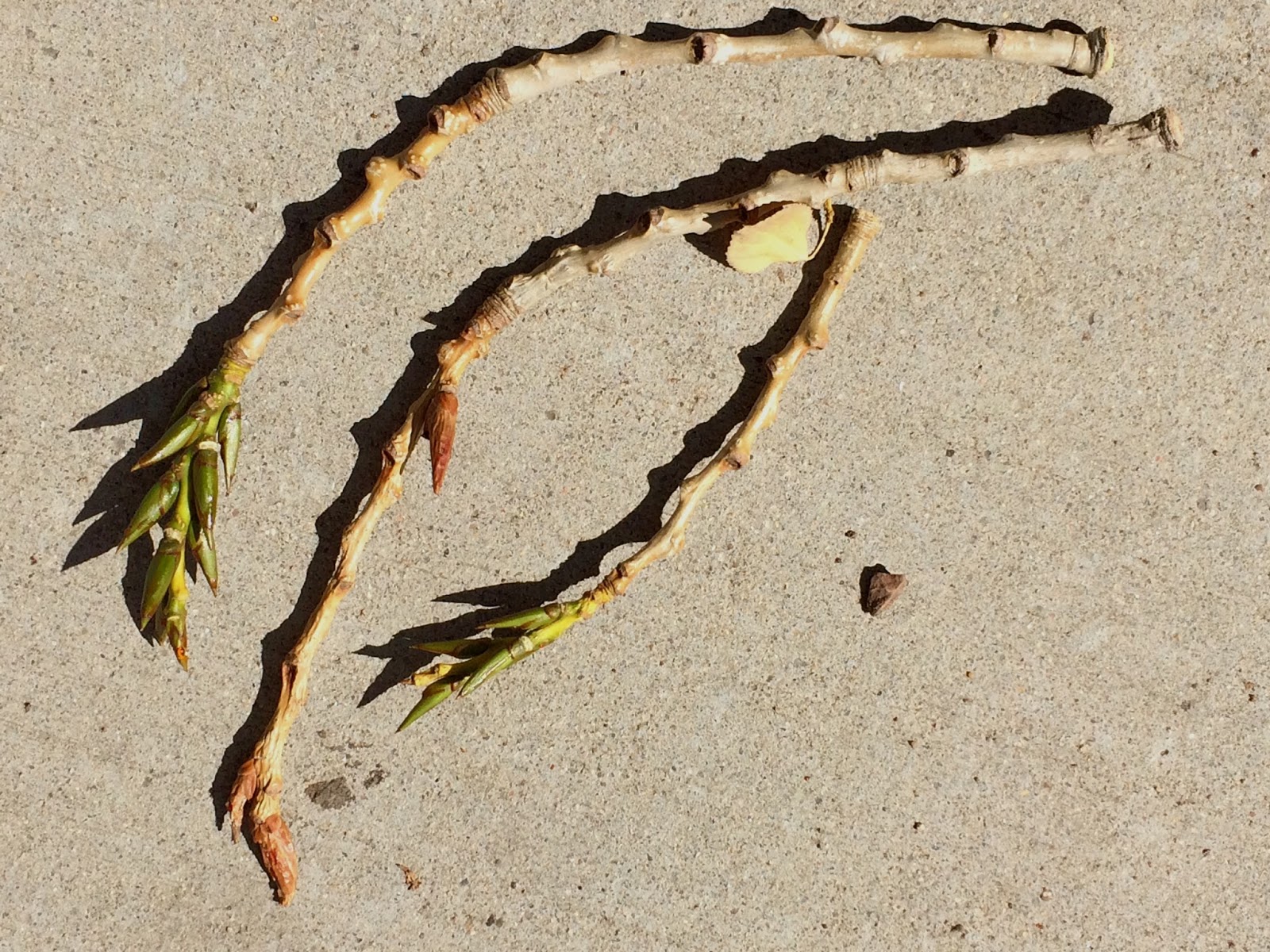
Take a look at the bottom of the fallen, pencil sized branches underneath the tree. You’ll see nice, clean cut with a rounded, raised center. If you tried to reattach the dropped branch to where it was originally connected, you’ll see the two pieces make up a ball and socket arrangement. This is a big clue that the tree was an active player and the branch drop wasn’t caused by squirrels chewing or storm breakage or something else.

"Socket" on tree branch
Before the branch fell from the tree, specialized cells created a separation layer where a break occurs. The cells also created a protective layer covering the opening in the branch remaining on the tree. This helps protect against moisture loss.  

Researchers are unclear why cladoptosis occurs. It's thought to be stress related. Affected trees may be suffering from problems such as soil compaction issues or drought.  The tree is stressed, so it “cuts its losses” by shedding less vigorous plant material, enabling it to better support more vigorous portions. Cladoptosis may also function like leaf drop, a sort of “planned senescence”.  


Bottom line: don’t worry about this type of branch drop, the tree is not dying. Try to improve water applications and reduce compaction in the tree’s root zone to improve its overall health. Don’t be surprised if cladoptosis pays a visit next year, though!

Saturday, August 22, 2015

The Leaves They Are A’Fallin’

Posted by: Mary Small, Colorado State Master Gardener Coordinator and Jefferson County Extension Office
Time to get out the rake....
Okay, can I just say I am sick of aspen and cottonwood dropping their leaves already?!
We’ve received numerous leaf samples from these trees and nearly all of them have been infected with either Marssonina or Septoria leaf spot diseases. It’s so severe in some places that some trees are already defoliated or darn near. It’s causing a lot of concern and unfortunately we can’t do much for the trees or their owners!

Caused by fungi, these diseases develop readily in cool, wet weather (like we had this spring).  Fungal spores are released from last year’s infected leaves.  Spores (the “seeds” of the fungus) are then blown or carried by splashing water to susceptible new tissue, causing infections. 
Septoria leaf spot on cottonwood
Although leaves are infected in the spring, symptoms usually don’t appear until mid to late summer. Leaves will drop prematurely.  Trees can be stressed during severe outbreaks due to reduction of photosynthesis and food production.

Symptoms vary between these two diseases. Marssonina leaf spots are dark brown dots with yellow halos.  In prolonged wet weather (which we’ve also had), smaller spots may fuse to form larger black patches. Septoria spots form under similar conditions and often occur alongside Marssonina. Septoria start out as dark sunken flecks that may enlarge and form larger dead areas or spots are tan and circular with dark margins. 
Marssonina leaf spot on aspen
One of the best times to manage the diseases is now, from late summer into fall. Where it is practical (such as in a landscape, rather than a forested setting), rake up fallen leaves and dispose of them in the trash. The diseases over-winter in the dropped leaves and raking and disposing removes that inoculum from the site for next year. (Unless of course, infected leaves/spores blow in from somewhere else!)

In the landscape, space plants according to recommendations for the species.  Trees planted too closely increase the humidity within the canopy, creating conditions ideal for infection. Keep sprinkler water out of leaves, so they stay dry.  Splashing water from sprinklers can also spread spores between leaves, causing secondary infections.  Prune to thin trees. This increases air circulation, keeping leaf surfaces dry. 

I could say we might hope for a drier year in 2016, but I won’t. Sorry, aspen and poplar.