CO-Horts

CO-Horts Blog

Showing posts with label fall harvest. Show all posts

Wednesday, October 25, 2023

Ripening Tomatoes Indoors

by Denyse Schrenker, CSU Extension, Eagle County

The temperatures are consistently below freezing at my house and I am ready to put my gardening tools up for the season. Now I need to decide what to do with all of my unripe tomatoes that have been stuck in purgatory for most of October; not progressing under their frost blankets but also not dying. I can only handle so many fried green tomatoes and green tomato relish and salsa so I sort my tomatoes into those that will ripen off the vine and those that will not.
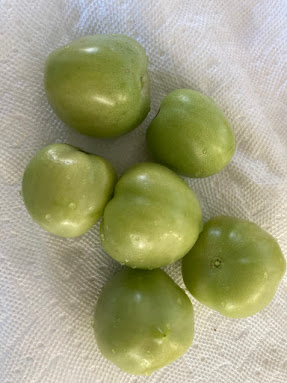

Some of the green tomatoes I separated for relish.

Tomatoes that are starting to develop a pink blush will ripen off the vine without any loss of flavor; this is called the breaker stage. Tomatoes that are a shiny green and have a white to light green star shape on the blossom end of the fruit have reached the mature green stage. These fruits will ripen off the vine but their flavor will not fully develop - a small sacrifice I am willing to make to eat fresh garden tomatoes well into November. Tomatoes that are a more matte green have not reached the mature green stage and will not ripen off the vine, these tomatoes can be used for green tomato recipes.
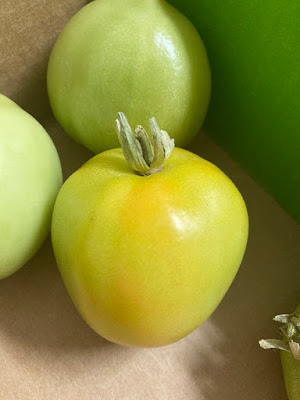

Tomato starting to develop blush color.

Once I have separated out the tomatoes I want to ripen, I remove any stems and wash and air dry the fruit on a clean paper towel out of direct sunlight. The dry tomatoes are then placed in layers 1-2 tomatoes deep in a covered box or a container with newspaper or cardboard covering them. I keep them in a dark cool location out of direct sunlight to ripen. Store the tomatoes at a temperature between 70°F and 55°F. Tomatoes stored closer to 70°F will ripen in a couple of weeks and tomatoes stored closer to 55°F will ripen in about a month. Tomatoes ripened below 50°F will be bland.
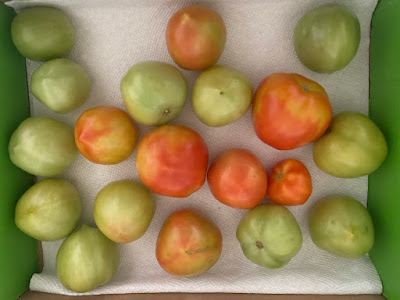

Washed, dried and ready to store for ripening.

Humidity can cause issues when ripening tomatoes indoors. Too much humidity causes the fruit to mold and too little humidity causes the fruit to shrivel. I typically have more trouble with too little humidity. To help increase the humidity, the tomatoes can be placed in a strainer or blanching pan and then placed in a covered container with water at the bottom. Make sure the tomatoes are not touching the water though. I check the tomatoes every couple of days and remove tomatoes that are ripe or nearly ripe. If I want the tomatoes to ripen more quickly I will add a banana or one or two red tomatoes to the green tomatoes.

Ripening tomatoes indoors does not need to be reserved for last ditch end of the season efforts! I try to pick most of my tomatoes when they develop that light blush color. I find that I get better yields harvesting them at this stage and then ripening indoors because I do not lose as many tomatoes to sunscald, critters, or simply missing them before they become over ripe. It may be the end of the gardening season but I am looking forward to having tomatoes all through the fall!

PlantTalk: Ripening Tomatoes Indoors

Friday, August 3, 2018

Time for planting late season crops

Can you believe August is here already?  Summer always seems to fly by.  I’ll admit this summer has not been a good year for my vegetable garden.  I first got a late start.  At my Fruita home we have had 16 days over 100 just in July compiled the extreme drought and now days that appear so cloudy but it is actually smoke from all the wildfires from the east and west of us.  Rain always perks up the garden and there has just been none.  Many warm season vegetables do best when nights are above 50 and days are 90 are less, so the high 90s and 100s are rough on these plants. They can actually abort their buds in these conditions.  I frequently see clients with greenhouses that have plants do this due to the greenhouse being too warm.  Cooling systems are important to keep temperatures under 90 degrees F.
CSU Greenhouses

Then add in my husband that tends to do frequent light watering with the veggies, definitely not the best thing to do.  Even Agents husbands' sometimes don't listen.  Watering frequently develops shallow rooted plants as plants need oxygen as well as water.  So now that days are starting to get shorter, even though our temperatures are in the 90s, it is for a shorter period of the day.  So my point is even the best of us sometimes have rough garden years.  Luckily my fruit trees are doing well.  They get infrequent deep watering and hubby has done a great job of treating for codling moth and other insects so there are very few worms in the apples and my red haven peaches look perfect.  http://extension.colostate.edu/topic-areas/insects/codling-moth-control-in-home-plantings-5-613/  I shortly will start my annual preserving.
Apple Cobbler-2017- Susan Carter


So, I am starting over with the vegetable garden.  Right now is a great time to start the cool season vegetables with plenty of time for fall picking.  A little later in the season, you can also plant garlic and seeds like spinach and lettuce for early spring picking, but still a little early for that.  Some of the cool season plants germinate readily such as lettuce which is usually 7-10 days and can be picked from 28 days to 55 depending on the type of lettuce.  http://planttalk.colostate.edu/topics/vegetables/1820-cultural-tips-leafy-vegetables/

Note: Soil Temperature, NOT air temp.  From Johnny's Seed

Lettuce Mix- Johnny's Seed- 28 days
 Below is the soil temperature chart obtained from CoAgMet captured at the Fruita Research Station that is just a few miles from my house.  Note that temperatures peaked in July and are starting to slowly decrease due to shorter day length.  Forecasts predict air temperatures will drop into the 80s for the later half of August.  Soil temperatures deeper than a  few inches will cool off slower.

CoAgmet is a site by Colorado State University that uses weather stations across the state to track all kinds of meterological data.  Check it out.  Maybe a futute blog just about CoAgMet and how to use should be on the horizon.  https://coagmet.colostate.edu/


CoAgMet Soil Temperatures from Fruita Research Station

Cool season vegetable information.  http://planttalk.colostate.edu/topics/vegetables/1806-growing-cool-season-vegetables/ 
Within the above link to vegetable is a document that contains a chart to help you decide which crops you can plant now.  Look for short season and that can tolerate cooler soil and air temperatures.  You may not have enough time to grow a beet, but you could grow the greens.  You could also use methods to extend your season from as simple as frost covers to a cold frame to a low tunnel.  Using mulch and straw to insulate the soil to hold in the warmth can extend your growing season as well.

Season Extension -CSU Extension San Miquel County

As I finish writing this blog, we finally had about 5-10 minutes of rain.  Not a lot, but at least something.  Check with your local Master Gardeners or Agents in your county to find out what you can plant in your area for fall harvest.  Hopefully we will have a long autumn with some moisture for our dry areas of the state. And if you cannot grow it, support your local farmers.

By Susan Carter, CSU Extension Tri River Area Horticulture Agent