CO-Horts

CO-Horts Blog

Showing posts with label rootstock. Show all posts

Thursday, March 2, 2017

After Care of Your Grafted Apple Tree

Posted by: Curtis Utley, Jefferson County Extension

If you are planning on attending my annual Apple Grafting Workshop April 5, 6, 7, or 8 you will produce an apple tree that you can then take home and plant. You may be very nervous about how best to care for the tree you have invested so much time and (possibly) blood into grafting.
If you have not registered yet do so at http://jeffcohort.eventbrite.com

Bench grafted trees are produced in the dormant season so for the tree to survive it will need to break dormancy, reorganize the vascular tissue at the graft union and begin producing leaves to manufacture carbohydrates to perpetuate life. Deciduous trees store carbohydrates in root and stem tissue in the autumn to provide the required energy to break bud and re-leaf the following spring; liken this to fat reserves for the winter survival of a hibernating bear. Dwarfing rootstocks used for grafting ironically do not necessarily have copious amounts of roots and to add insult to injury much of the stem tissue storing carbohydrates is removed when the cuts are made for the graft union. What is left is a tree that has just enough stored energy to break bud and repair the vascular tissues at the graft union once. With this in mind what care should you provide to your new tree?
Marrying scion to rootstock in a whip graft. The ties that bind; rubber.

1.    Plant the grafted tree as soon as possible either in the ground or in a container, size #5 or larger.
A planting hole

a.    If you plant your tree in the ground be sure to set an 8-foot-tall permanent post next to the tree before backfilling the planting hole; making sure not to damage the tree’s roots.
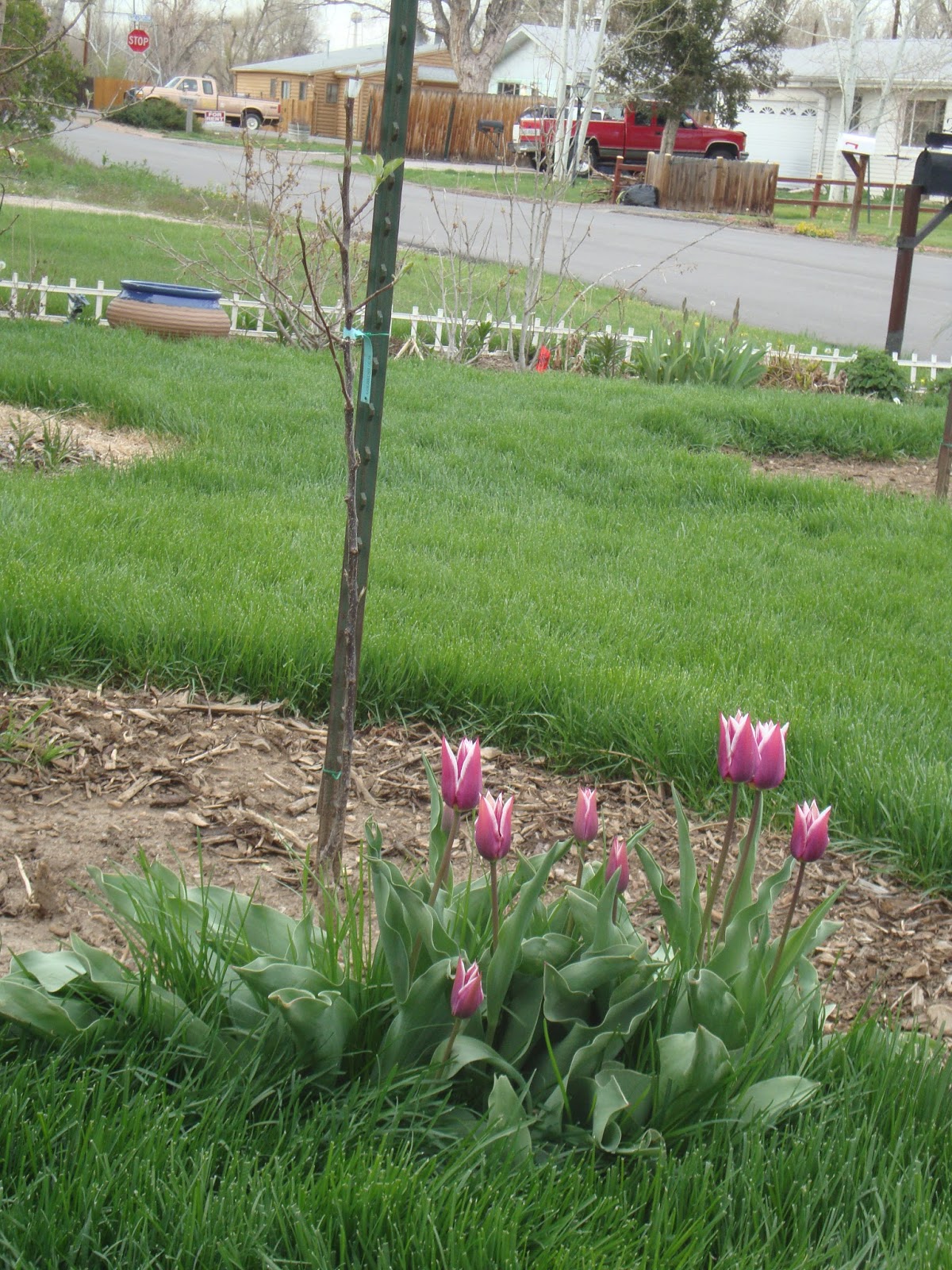
A permanent stake should be set the day of planting

2.    Water the tree well to allow the soil to settle around the frail root system and force out large air pockets.
3.    As the leaves emerge, begin foliar feeding the grafted tree with a diluted water-soluble liquid fertilizer once per week until August first . Take note, leaves from the rootstock will emerge before any signs of life occur from the (scion) grafted wood.
Bud break of grafted apple tree

4.    Never allow the rootstock’s leafy side branches to grow taller than the grafted scion wood. If these lower shoots threaten the dominance of the grafted wood, pinch them back one inch. The rootstock leaves are temporary and will provide carbohydrates to promote root growth and callus growth at the graft union.
5.    If you have not seen life from the grafted wood 8 weeks after grafting, the graft union did not take and the scion wood has died.
6.    July first carefully remove the rubber band and wax wraps from the graft union to prevent compression injury of the graft union tissue.
Remove rubber ties by July 1

Successful graft union of a whip graft
7.    The following March prune back the scion to 2 buds. This forces all the stored energy from the roots to be channeled to a single bud that will quickly grow into a strong trunk. The second (lower) bud is your insurance policy in case the top bud is damaged.
8.    When the top bud begins growing rub out the lower "insurance policy" bud.

9.    Success! Begin training your tree into the growing system of your choice.
Apple tree trained as an Espalier, Denver Botanic Gardens

Thursday, March 5, 2015

Learn How to Graft Apple Trees

Posted by: Curtis Utley, Jefferson County Extension

One of the most fantastic horticultural tools discovered by man has to be the art of grafting. The ability to attach a piece of one tree to the branch of another is nothing short of magic. Detached scion grafting was discovered sometime during the first millennium B.C. and contributed to the movement of woody tree fruits out of Asia and into Europe along the silk road (Mudge, K. et al 2009). For Centuries now mankind has been able to perpetuate superior clones of tree fruits by removing a twig or bud from a superior mother plant and attach that twig or bud to a seedling of the same tree species. The result is a replicate of the mother tree growing on the root system of a seedling tree of unknown fruit quality.
Macintosh branch grafted onto Crabapple 
 The practice of grafting is not reserved for fruit trees alone however; many horticultural plants are also reproduced by grafting the most common example is the production of hybrid tea roses. Before the development of tissue culture, the fastest way for a horticulturist to rapidly build up the inventory of a newly discovered rose or other woody plant was by bud grafting. The bud grafting technique is great because the grafter can produce a new plant from a single vegetative bud. If the bud is attached to a large and vigorous rootstock, the plant will often be ready for sale following one season of growth. Grafting is not the only way to produce clones, many plants including roses can be cloned by rooting a cutting. The advantage of grafting is the horticulturist can produce much larger clones and many more of them in a shorter length of time.
Hybrid Tea Rose
Chip bud grafting

Other advantages of grafting include size manipulation, avoidance of juvenility, disease and abiotic stress resistance, damage repair, and the creation of unnatural growth forms. Orchardists and home hobbyists alike have found dwarf fruit trees advantageous. Producing full size fruit on a small tree allows an orchardist the opportunity to plant multiple varieties in the same space it would take to grow one full size fruit tree.  Dwarf fruit trees are also much easier to manage and pick than full size trees. Many fruit bearing trees grown from a seed will not begin bearing fruit until they are mature this is called juvenility. Grafting mature wood onto a seedling tree overcomes this natural habit and allows for fruit production a few years after grafting instead of 15 or more years for a seedling tree to come into bearing.
Production orchard dwarf apple

 Starting in the Twentieth Century research scientists began actively selecting under stalk of horticulturally important crops for resistance against, disease, insect pests, drought, and soil issues allowing these crops to be grown more widely. Even annual crops such as tomatoes and watermelons have been grafted onto hearty rootstocks that have been selected for resistance against soil borne pathogens and greater production. 

Dwarf  limber pine
Grafting also allows horticulturists to produce unique unnatural ornamental growth forms, think of weeping mulberries, weeping cherries, tree form roses, and bonsai conifers.  The last reason for grafting I’ll mention is a technique called inarching. Inarching is a rescue operation orchardists use to save trees that have been girdled by rodents or attacked by a root fungus. New resistant root stock trees are planted directly beside the suffering orchard tree the top of the small rootstock tree is cut off, whittled into a chisel point and inserted (by bending the stem) into a slot cut into the trunk of the suffering tree. When the graft union takes the new rootstock serves as a bridge across the damaged lower trunk or disease ridden root system.
Whip graft

Whip graft budding strip
Successful whip graft union
If you are interested in learning how to graft woody plants I will be teaching a hands-on grafting workshop open to the public on March 31. The workshop will be held at the Jefferson County Extension office located at the Jefferson County Fairgrounds. Participants will be producing their own grafted apple tree to take home and plant. Dwarfing rootstock and a variety of apple cultivars to select from will be provided to participants. This workshop will be repeated April 1 and again on April 2. This workshop costs $20.00 per person, space is limited and reservations are required. 


The Jefferson County fairgrounds are located at: 15200 West 6th Ave., Golden, CO 80401


Citation: Mudge, K. et al. 2009; A History of Grafting. Horticultural Reviews, Vol. 35; John Wiley &Sons, Inc.