CO-Horts

CO-Horts Blog

Showing posts with label apple. Show all posts

Thursday, May 4, 2023

Rabbits, voles, and gophers...OH MY!

Posted by: Todd Hagenbuch, CSU Extension, Routt County
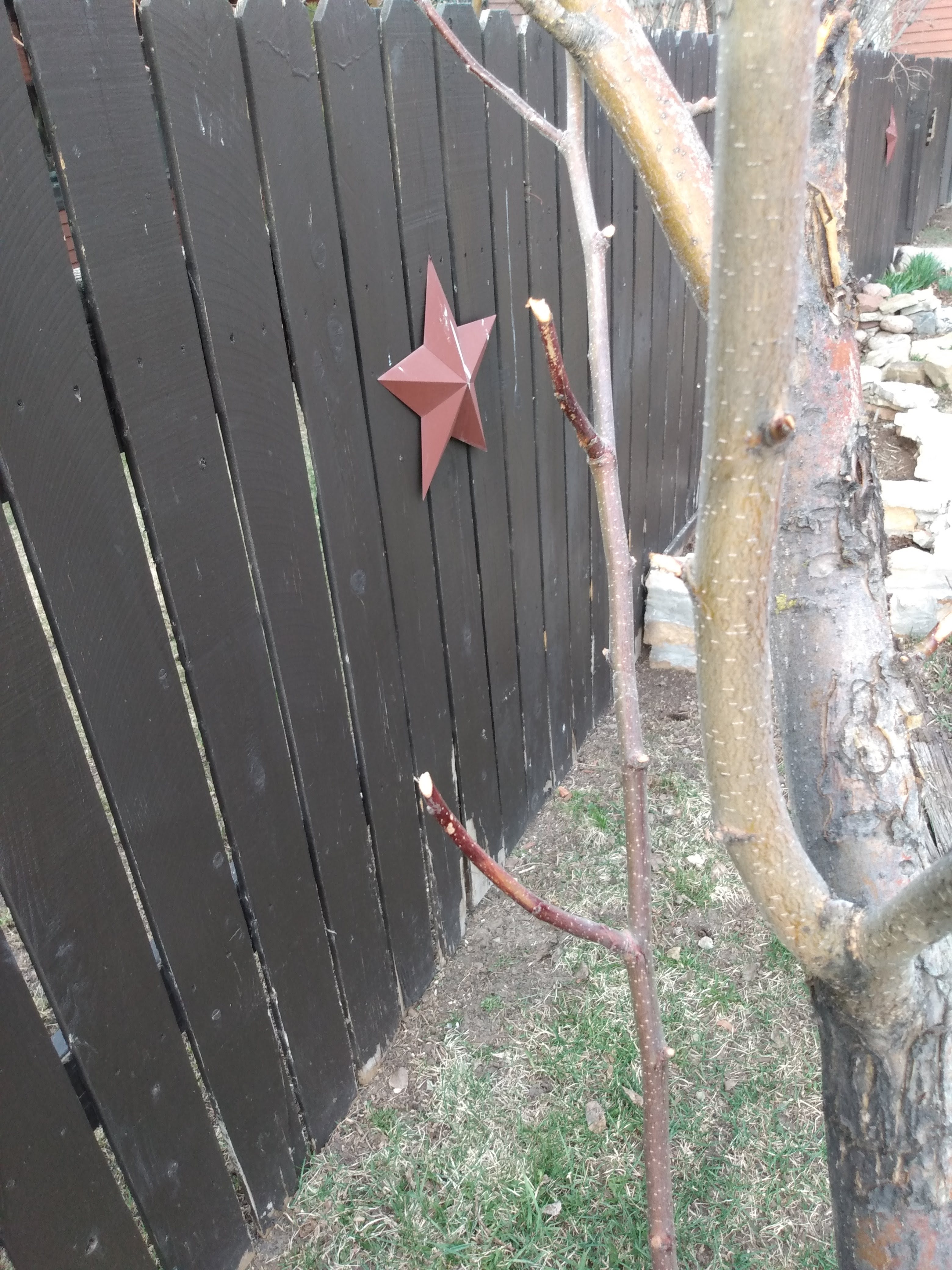
Classic rabbit 'trimming'
of smaller branches

While many of you reading this blog have been watching the daffodils and crocuses bloom for a few weeks, those of us in the higher elevations are just seeing the ground as it becomes uncovered by rapidly melting snow. As the snow recedes, what’s becoming evident is that, at least in Routt County, several types of varmints had a hay-day under the snow and treated our yards as an all-you-can-eat buffet. I’ve gotten many calls in the past two weeks with folks wondering what creature has caused the damage they’re seeing in their yards, pastures, and hay meadows. I also find that people often blame the wrong critter, or have had multiple species wreaking havoc.

Vole damage at the bottom,
rabbit damage above

The first thing we’ve seen as the snow levels dropped is that rabbits dined on several things, especially fruit trees. Lots of folks talked this winter about the number of jackrabbits in the area this year, and mentioned the damage they were seeing to local haystacks. We see now that they were taking advantage of town plants, too, with branches being trimmed and trunks being scalped at varying levels according to the snow level when they came by. I’ve seen several crabapple and apple trees that look to be a total loss due to the rabbit damage they’ve sustained.

As the snow pulled away from the bases of trees, shrubs, and herbaceous perennials, vole damage has come into full view. Have you seen girdling around the bottom of trees, along the soil line? Vole damage. Gnawing marks on the stems of small bushes? Vole damage. Perennial plants that had unexplained chewing at the base? Yep, probably voles!  

Vole damage on lilacs
I had the pleasure of visiting a home that had vole damage on their lilacs and also their fruit trees (see
photos). They still had some small piles of snow near the trees which looked like Swiss cheese, with holes into and out, right in-line with the classic vole ‘runways’ that appeared around the lawn. In fact, as we sat and were looking at the bushes, the little beasties popped their heads out and ran from pile to pile! Little tufts of grass where they’ve disturbed the surface and small holes are other telltale signs that voles enjoyed the warmth and protection of a blanket of snow while feasting on our plants.
Vole damage on apple

The other varmint that had a regular rager under the snow was the pocket gopher. While they live under the soil and dine on roots, the soil they dig out for their subterranean feasts was neatly packed away in tunnels under the snow in long, curing, snake-like piles that are called eskers. People expect to kick at the eskers and find holes or tunnels underneath, but what they don’t realize is that the hole the pocket gopher actually took the soil from is near one end or the other of the esker.

Vole runways in a pasture
Wondering what critter has been decimating your garden? If the explanations here don’t help, check out CSU Fact Sheet 6.521, Burrowing Animals: Determining species by burrows and damage. If you do know which one is to blame and want to know what you can do about it, check out Fact Sheet 6.507 Managing Voles in Colorado, or Fact Sheet 6.515 Managing Pocket Gophers. And don’t forget this next fall to prepare your plants for more damage by protecting them before it snows, too, because these little buggers are looking forward to eating at your place again next winter.
Pocket gopher eskers
in a pasture; courtesy of
Millie Delaney

Wednesday, April 6, 2022

Spring Frosts and Fruit Tree Buds


By Amy Lentz, Boulder County CSU Extension

One can grow several different types of fruit trees in Colorado with some performing better than others depending on where and at what elevation you live. Along the Front Range, apples and cherries used to be staple industries prior to the 1950’s. A few rough weather years along with changing market forces moved the industries to other states, but these types of fruit trees along with pears and plums can be quite fruitful (pardon the pun) along the Front Range. Other types of fruit trees will struggle in this region to produce a crop, whereas if you are on the Western Slope, several different types of fruit trees will give you a dependable fruit crop due to the benefit of warmer winds…perfect for growing those coveted peaches.

A lot of the potential to get a decent harvest from a fruit tree in Colorado boils down to phenology. What’s that, you ask? Phenology is a branch of science dealing with the relationship between climate and periodic biological phenomena (definition from Merriam-Webster) such as bird migrations and, in this case, flowering patterns of plants. In more simple terms, this is often referred to as bloom stage or growth stage. Fruit trees will go through various bloom stages as they wake up each spring. For example, apple trees have nine stages of blooms from dormant to fruit set as seen in this pictorial chart from Cornell University:

Apple Phenology Chart - Cornell University

Back to why it’s not easy to have a productive fruit tree in Colorado…springtime frosts! It’s safe to say that you never know when that last spring frost will come in Colorado. And when it does, how low will it go? This is the key to whether or not you will get a decent fruit crop from year to year – it’s the combination of the low temperatures experienced in the spring and the stage of bloom at that time. For example, if your leaves and/or flowers are just starting to emerge (at the ‘green tip’ stage of development), your tree’s flower buds can take some pretty low temperatures and can easily survive a light frost. However, if you tree is in full bloom, you will lose many of those flowers if the temperatures dip a just a few degrees below freezing. The following chart shows the various bloom stages for tart and sweet cherry and peaches:

% Bloom Loss vs. Temperature vs. Bloom Stage - Utah State University

Notice for tart cherries that even at temperatures down to 15° F, only 10% of the blooms will be damaged or killed if they are just swollen and have not broken through yet. Conversely, with that same tree in full bloom, you will see around 90% of the blooms (and future fruit) damaged or killed if the temperature gets down to just 25° F. The relationship is similar for peaches and other fruit trees, as well. Simply put, the further along in bloom, the more susceptible the buds are to being killed by a spring frost.

Undamaged peach flower bud compared to damaged bud after exposure to very low temperatures (-15°F). Photos: Amy Lentz

Throw in crazy Colorado weather and it’s a fool’s bet! The timing of these stages will vary from year to year, making it hard to predict when your tree will be in full bloom. The following photos were taken in the Fort Collins area in 2017 for an apple tree. The dates of each stage of flower are marked above each picture taken of the same branch over time. Just one year later in 2018, the same tree was more than two weeks later in its timing for each bloom stage.


Pink Stage occurred on April 12, 2017. In 2018, the same stage occurred about 16 days later, showing up on April 28th. Photos: Amy Lentz

There are not many options to outsmart Mother Nature and prevent your fruit tree from receiving some damage during a spring frost and some trees will fare better than others. Apricots are usually the first to bloom, followed by peaches, cherries, plums, pears and apples will usually be last. Here is one tip if you haven’t yet planted your tree…place it on the north or northeast side of a structure or house; close enough that it’s shaded in the winter and far enough that it’s in full sun later in the summer when the sun is higher in the sky. This can provide more consistent winter temperatures, hopefully keeping the tree dormant for just a bit longer and delaying flower development. Even a week of two can make all the difference!


Wednesday, March 11, 2020

The Basics of Fruit Tree Pruning

By Amy Lentz – Weld County CSU Extension

The season for pruning fruit trees has been in full swing lately. My colleagues and I have been busy teaching classes, talking with the public and helping growers “get their fruit tree pruning on”. It can be an intimidating task for some - "What if I prune out too much?" or "What types of cuts should I make?" With a little extra patience, basic research and confidence, you can do it...I promise.


Weld CMG's helping teach residents of a community.
Larimer CMG's learning to prune.


Here are some questions and answers that might help you get started (or finished) with your pruning needs.


1. Are fruit trees different than shade trees?

Yes! Fruit trees are pruned differently than shade trees. With fruit trees, you are growing a crop, maybe even for monetary gain. Therefore, you will be manipulating the tree’s growth more than you would when pruning shade trees. The three D’s (disease, damage and dead wood) still apply, but you will also be making cuts for other reasons, such as to increase fruit production or to fill an empty space with more branches. When trying to decide what to prune and what to not prune, look for strong branches with wide branch angles, which are more capable of holding a heavy load. You want to keep those! It's better to remove branches that have a very narrow, or weak, branch angle. Also, you would not be pruning your shade trees as often or as heavily as you would fruit tree! 

2. How should I prune a young tree vs. an older tree?

Young  fruit trees are much more forgiving than older fruit trees, so go lightly if you are pruning an older tree that needs a good deal of thinning. Spread out your pruning cuts to open up the canopy by pruning it lightly over several years. You can prune your young trees (say up to 5 years old or so) a little harder - and they are easier to train when they are young. So start with young trees if possible. Here is an example of how to train a tree over 5 growing seasons from a one year old whip (spreaders were added after the 4th spring):


3.  How do I know where the fruit will be?

Most fruit trees often bloom on old wood. Apples and pears, for example, grow on spurs which can begin developing after 2 years and last a long time, up to 20 years. Plums and cherries also have fruiting buds that occur on old wood, at least 2 years old, either on spurs or along the stems. Peaches, on the other hand, are developing fruit buds on last years growth, so annual pruning to encourage new growth is important for peaches. It's important to know the difference between fruiting buds and vegetative buds. You will be removing some fruiting wood during the regular pruning process, but you don’t want to inadvertently prune off all those little spurs, which will lead to fruit during the upcoming season.

Photos from University of Maine Cooperative Extension: https://extension.umaine.edu/fruit/growing-fruit-trees-in-maine/pruning/
4.. When is the best time to prune my fruit trees?

With the warmth of spring happening more often lately, it’s time to get outside and finish up those pruning jobs if you haven’t already. The best time to prune is in late winter or early spring when the trees are still dormant (which is hard to judge in Colorado!). Either way, you want to stop pruning when the buds first begin to swell and break. It’s best to prune older trees first to make sure they have enough time to heal before spring and leave the younger trees until later in the pruning season. 

Another reason we prune when the trees are dormant is to reduce the spread of diseases like fire blight, that affects those fruit trees in the Rose Family, such as apples and pears. This particular disease can easily be identified and pruned out in the winter. 

For more information on Fireblight, see the following fact sheet from CSU: https://extension.colostate.edu/topic-areas/yard-garden/fire-blight-2-907/
Another good source of information on fireblight, more for the commercial orchard, can be found here from Washington State University: http://treefruit.wsu.edu/crop-protection/disease-management/fire-blight/

5. What are my goals and objectives when pruning fruit trees? 

Approx. 5 year old cherry trees after pruning to thin the canopy.
Your main goal when pruning fruit trees is to open up the canopy of the tree to allow increased light penetration and increased air movement in the center of the canopy, where fruit spurs are located. 

You want to encourage outward growth on the tree to get branches to grow into open space. This is done by pruning to an outward facing branch or bud. Along with the three D’s (diseased, dead or damaged), look for crossing branches, branches that are shading or crowding one another and branches pointing back toward the tree. Don’t remove more than 25% a single pruning season, less for older trees so you don’t stress the tree too much. This will help with fruit development, as well as, decreasing the prevalence of insects and disease. 

To do this, remove crowded branches by making reduction or thinning cuts back to branches that are facing outward, away from the trunk. Reserve heading cuts (where you cut back to a small bud) for only those branches where you want to encourage new growth, such as lower branches or young branches. As you remove some of the twigs and branches to allow for more space in the tree, you will also, in effect, be reducing the number of fruit buds on the tree as you remove wood, so you will also be increasing the energy allotted to the fruit buds that remain – creating larger fruits that have ample sun and lots of space around them. This is the goal of growing fruit trees!

Finally...How can I build my confidence to prune my fruit tree?

Pruning fruit trees takes time, patience and a little critical thinking. A hands-on approach helps a great deal to make these concepts sink in. Definitely look beyond this blog because there is a lot more information than what I could provide here. When doing your research, be sure to look toward education- or research-based information and watch videos to help you make sound decisions when pruning. You can always remove a branch…but you can’t put it back on! Take your time, think about the branches you want to remove and what you want to keep. You can do it!

For more information on pruning fruit trees, check out the following sources from Colorado State and other universities:

Cornell Cooperative Extension - Pruning Apple Trees
http://chemung.cce.cornell.edu/resources/pruning-apple-trees

CSU Fact Sheet - Training and Pruning Fruit Trees 

Utah State - Pruning Fruit Trees: Clip with Confidence!

Educational Video Series from Montana State 

Monday, March 5, 2018

What’s That Bug: Brown Marmorated Stink Bug

Posted by: Jessica Wong, Master Gardener Coordinator, Broomfield County Extension

When people find out that I’m an entomologist they sometimes ask one of two questions: “So you study where words come from?” Or they pull out their phones to show me a blurry photo and ask, “What’s that bug?” I can’t tell you the origin of the word ‘bug’, but I can tell you a little bit about bug biology.

The latest blurry photo shared with me was of a brown marmorated stink bug (BMSB), Halyomorpha halys, inside a house. This insect is originally from Asia and it was accidentally brought to the mid-Atlantic in the late 1990s. Since then BMSB have spread to other parts of North America where they are nuisances and pests to homeowners, gardeners, and farmers.


Map of brown marmorated stink bug distribution from stopbmsb.org
There are a number of stink bug species found in Colorado, but BMSB can be identified by a few key characteristics. The adults are about 0.5 to 0.6-inch long and are brown mottled with black and tan. Their antennae have black and white bands, and the sides of their abdomens also have an alternating black and white pattern.
Key characteristics of BMSB from ipm.msu.edu/invasive_species/brown_marmorated_stink_bug
These bugs are common home invaders in the fall and winter, and in the spring and summer they can be pests of a large variety of plant species. Their hosts range from ornamentals such as tree of heaven and eastern redbud to crops including beans, tomatoes and apples. Feeding of BMSB on crops can result in fruit deformities and internal damage that compromise quality.
BMSB feeding on raspberries from stopbmsb.org by Cesar Rodriguez-Saona and Doug Pfeiffer
Necrotic spots on an apple from stopbmsb.org by Tracy Leskey and Torri Hancock

For now BMSB are not a serious problem in Colorado, but having seen the damage they cause in other parts of the country I plan to keep a watchful eye out for this one. If you want to learn more about BMSB you can visit the StopBMSB website. You can also report a sighting on the StopBMSB website if you find one.

One final thought in case you’re curious about what brown marmorated stink bugs smell like: they kind of smell like cilantro, so I guess they stink if you aren’t a fan of cilantro.

Thursday, January 11, 2018

Dormant Oil and Pruning Fruit Trees

This is a tough year.  With dry, warm weather some of our trees are confused.  Many of our fruit trees never really hardened off as reported by our local research station in Grand Junction.  And now many of the buds are swelling on trees in the Grand Valley.   I always tell homeowners to wait to prune their fruit trees later than the commercial orchards so they are closer to spring for the trees to heal.  Growers have to start early due to the sheer volume of pruning they need to do.  And I prefer to spray dormant oil after pruning but this may be one year I decide to do the opposite on my own trees.
Colostate photo-Our goal-Fruit!

I think everyone that growers fruit trees should spray with dormant oil.  This product used to be made from petroleum products but is now usually made from cotton meal seed so it can even be used on organic trees.  Yes, organic trees are sprayed, but that is a whole other article.  This oil is very thick and is only used in winter versus horticulture or summer oils that can be used during the season.  The reason we spray this is to suffocate any insect eggs or overwintering insect adults on the trees to limit pest pressure on the fruit tree in the coming season.  It is an especially good control of aphids.  Make sure the weather is warm enough to spray and that your buds have not broken (not showing any color).  The oil can burn the contents of the bud if open.  Always read the label, it’s the law.  And be sure to cover as much as the tree as possible.  Here is our fact sheet on dormant oil.  It can also be a good control for some insects on ornamental trees as well.  http://extension.colostate.edu/topic-areas/insects/insect-control-horticultural-oils-5-569/

So why do we even prune fruit trees?  Well of course to get better fruit.  Pruning a fruit tree is vastly different than pruning an ornamental or shade tree.  Many of those rules go out the window because with fruit trees you are actually trying to stress them to induce fruiting.  So our goal is to capture enough sun in the fruit tree canopy without sun burning the fruit.  The best shape to do that would be an upside down umbrella.  Now if you do not want to have a tree that looks like an upside down umbrella in your landscape, you can prune to have a central leader with spaced side limbs.  This is an older method of pruning apple trees and cherries also do well with this system of pruning.
Before pruning different types of fruit trees it is important to understand what year wood gives you the fruit.  With peaches the fruit occurs on one year old wood, the new growth from last year.  On apples, it is typically 2nd to 4th year wood but some depends on variety.

With pruning these trees we want to remove 50-60% of the tree if it is young and used to being pruned that way.  Don’t take an old tree and do this, it will stress too much.  Talk to your local agent if you have an older tree.  Here is a link: http://planttalk.colostate.edu/topics/fruits/1210-pruning-mature-fruit-trees/

Open Center Peach Pruning- Photo by Susan Carter
So young trees have their central leader removed when they have established root systems.  Here is a a diagram from UMN. 


Now back to in their prime trees; when pruning you want to think of the side shoots of the limb together looking like a feather.  So there are very few branches going up or down.  Branches underneath tend not to get enough light and too many branches going in or up can shade other branches and leaves.  But you want a few interior and upright branches to produce future growth and to provide some shade for your trunk and main branches or they may develop sunscald.  http://planttalk.colostate.edu/topics/weeds-cultural-problems/2111-sunscald-trees/
There are different types of cuts used to prune fruit trees.  My favorite to help keep the limbs going out instead of up is called a bench cut.  This cut removes the tip of the upward growing branch and brings is back to an outward facing side branch.  This side branch will then become your growing tip and will help keep the height of the tree down and to create that upside down umbrella shape.  Dutch  cuts are vertical cuts that are made on side limbs of mainly apples to induce dormant bud break below.  Something you would never do on an ornamental tree. 
Apple tree with dutch cut- photo by Susan Carter

So to summarize, start pruning and training your fruit trees when young;  Spray with dormant oil prior to bud break;  Don’t  be afraid to remove half the tree yearly;  Know the age of the wood that produces fruit so you don’t remove too much of it. 


Lastly, look for a local training on fruit trees thru Extension.  The Tri River Area offers a fruit tree class as part of their Master Gardener training.  I promise a future article on picking which fruit tree is right for you or should you support the orchards and let them do the labor.  By Susan L. Carter, Horticulture Agent, Tri River Area

Thursday, March 2, 2017

After Care of Your Grafted Apple Tree

Posted by: Curtis Utley, Jefferson County Extension

If you are planning on attending my annual Apple Grafting Workshop April 5, 6, 7, or 8 you will produce an apple tree that you can then take home and plant. You may be very nervous about how best to care for the tree you have invested so much time and (possibly) blood into grafting.
If you have not registered yet do so at http://jeffcohort.eventbrite.com

Bench grafted trees are produced in the dormant season so for the tree to survive it will need to break dormancy, reorganize the vascular tissue at the graft union and begin producing leaves to manufacture carbohydrates to perpetuate life. Deciduous trees store carbohydrates in root and stem tissue in the autumn to provide the required energy to break bud and re-leaf the following spring; liken this to fat reserves for the winter survival of a hibernating bear. Dwarfing rootstocks used for grafting ironically do not necessarily have copious amounts of roots and to add insult to injury much of the stem tissue storing carbohydrates is removed when the cuts are made for the graft union. What is left is a tree that has just enough stored energy to break bud and repair the vascular tissues at the graft union once. With this in mind what care should you provide to your new tree?
Marrying scion to rootstock in a whip graft. The ties that bind; rubber.

1.    Plant the grafted tree as soon as possible either in the ground or in a container, size #5 or larger.
A planting hole

a.    If you plant your tree in the ground be sure to set an 8-foot-tall permanent post next to the tree before backfilling the planting hole; making sure not to damage the tree’s roots.
A permanent stake should be set the day of planting

2.    Water the tree well to allow the soil to settle around the frail root system and force out large air pockets.
3.    As the leaves emerge, begin foliar feeding the grafted tree with a diluted water-soluble liquid fertilizer once per week until August first . Take note, leaves from the rootstock will emerge before any signs of life occur from the (scion) grafted wood.
Bud break of grafted apple tree

4.    Never allow the rootstock’s leafy side branches to grow taller than the grafted scion wood. If these lower shoots threaten the dominance of the grafted wood, pinch them back one inch. The rootstock leaves are temporary and will provide carbohydrates to promote root growth and callus growth at the graft union.
5.    If you have not seen life from the grafted wood 8 weeks after grafting, the graft union did not take and the scion wood has died.
6.    July first carefully remove the rubber band and wax wraps from the graft union to prevent compression injury of the graft union tissue.
Remove rubber ties by July 1

Successful graft union of a whip graft
7.    The following March prune back the scion to 2 buds. This forces all the stored energy from the roots to be channeled to a single bud that will quickly grow into a strong trunk. The second (lower) bud is your insurance policy in case the top bud is damaged.
8.    When the top bud begins growing rub out the lower "insurance policy" bud.

9.    Success! Begin training your tree into the growing system of your choice.
Apple tree trained as an Espalier, Denver Botanic Gardens

Tuesday, September 20, 2016

Delicious Jams and Jellies?

By Curtis Utley

Like Gru, I too have failed at producing a palatable product. This past weekend I attended my friends’ fall harvest party where all attendees are encouraged to bring a sample of their garden tomato bounty to enter into a grand taste test.  Each person votes for his or her favorite tomato. My friends also roll out their cider press and attendees are welcome to bring apples to crush and press into juice. I love apples and this year I had a bumper crop of Honeycrisp apples that I brought to the party for pressing.
My goal was to produce enough juice to try my hand at making Apple jelly. Apples are loaded will pectin, the gelling agent used to create a soft spreadable fruit preserve, so the recipe for apple jelly consists of two ingredients: 4 cups apple juice and 3 cups sugar. Other than dried fruit, very few things in the processed food realm are that simple.
Hard apple candy on waxed paper, Not apple jelly in a jar 

Unfortunately, getting these two ingredients to magically turn into a soft spreadable jelly takes some kitchen wizardry I have yet to master. The goal is to heat the simple mixture to a rapid boil for a period of time long enough to activate the pectin – to the gelling point. At this point, the jelly is processed in a water bath canner and the cooled product firms up. In my first attempt I produced apple flavored hard candy. In my second attempt I produced a VERY sweet shelf-stable apple juice.  Oh well, better luck next year, and maybe I’ll add in the optional third ingredient, lemon juice.