CO-Horts

CO-Horts Blog

Showing posts with label Hail. Show all posts

Thursday, July 15, 2021

The Benefits of Hail Cloth

Guest Blog by: John Weiss, Master Gardener in Larimer County
Hailstorms are every gardener's fear...and nemesis!

According to the Colorado Climate Center at CSU, hail season runs from April 15 through September 15. Using hail cloth offers the gardener at least two benefits. The first benefit is obvious - to protect your vegetables from unwanted hailstorms and the potential damage they can produce. The second benefit is shade for your vegetables. Studies suggest that a small amount of shade reduces the intensity of the sunlight. Plants appreciate the shade and responses with enhanced performance.

The hail cloth I selected provides 13-15% shade and can be obtained from greenhousemegastore.com (but there are other businesses that sell it).  The hail cloth has a somewhat open weave that allows air movement and rain to penetrate it while keeping even small hail out. 

Close-up of the hail cloth available from greenhousemegastore.com; this cloth provides 13-15% shade and protects plants from small hailstones

It can be easily cut with scissors and comes in any length.  Keep in mind that the cloth will shrink over the first season so cut large enough in anticipation of the shrinkage.

Jon's raised bed with hail cloth in place.

Above is my large, raised bed with a frame to hold the hail cloth about 4’ above the center of the bed.  The frame is PVC and each vertical piece fits over rebar imbedded in the raised bed.  A wood strip on each side was added for strength.  To keep the hail cloth from blowing off the frame, PVC pipe (lying on the ground) with a 3-4’ piece of rebar (for weight) sits on the raised bed frame.  Two vertical pieces of wood (on each end) was added to keep the PVC pipe from falling off the frame (see below).


PVC, rebar, and wood hold the hail cloth in place

Hail cloth can be draped over any sort of structure, even tomato cages and will last multiple seasons. If you haven’t tried hail cloth, give it a try as it’s great insurance against unexpected hailstorms.

Don't let this happen to your tomatoes! Get some hail cloth.

Monday, April 12, 2021

Protecting your plants from wild weather this spring

Posted by: John Stolzle, Jefferson County Extension
Spring weather in Colorado can be temperamental, it can sometimes feel like we experience all of the seasons in a single day. This past weekend, if your garden was located around the Front Range, it likely experienced warm springtime weather ripe for growing; but later this week, forecasts predict cooler temperatures and even a possibility for snow! These erratic fluctuations provide challenges for our gardens, but CSU Extension has put together some techniques which can help gardeners to extend the growing season and to protect plants against some these drastic weather patterns.
In this post, I have highlighted some techniques and provided references with more information for managing your garden with our spring weather in mind.
Seedlings purchased from a garden nursery may need to be hardened off before they are planted in your garden [click here for more information on this topic]. 

One of the most important factors to consider in vegetable gardening is when to plant your garden, and the length of your garden’s growing season. If planted too early, some vegetables can encounter challenges with frosts which can kill tender plants; but if planted too late, crops may not mature by the time fall comes around. By planting the right plants at the right time you can help to cultivate a successful crop.
Planting Guides can help you decide
when to plant certain things.

Cool, hardy season crops can often tolerate minor frosts and thrive in cooler weather conditions which dip as low at 40°F, some examples are broccoli, spinach, and onions. Warm season crop are much more sensitive to frost and should not be planted until all danger of frost has past. These plants do better in temperatures ranging from 70°F - 95°F, some examples are tomatoes, peppers, and watermelon. A longer list for these plants, and more details on this topic can be found in the following link to CSU Extension's vegetable planting Guide:  https://cmg.extension.colostate.edu/Gardennotes/720.pdf
There are a range of techniques which can be used to extend our growing season. These include things such as planting gardens on south-facing slopes, providing windbreaks, mulching, and even covering plants when frosts are suspected. Sheets and blankets can be used to trap heat from the soil around young vegetables at night; these covering should be placed low to the ground and secured. In the morning after using sheets, if this fabric has become damp it should be dried before being used for this purpose again.

Simple hoops over a garden can provide great
fastening points for hail cloth and shade cloth.

More techniques and helpful tricks to extend the growing season can be found in the following link to a factsheet on this topic:
 https://cmg.extension.colostate.edu/Gardennotes/722.pdf

Frosts and cold snaps are one challenge, but hail can be one of the greatest risks to our gardens.  Hoop houses or high tunnels can both extend the growing season and offer protection from hail. Hoops can also provide structures to which tightly woven ‘hail cloth’ can be fastened for added protection; hail cloth can also be placed over tomato cages or other structures available in your garden.

Walls of water and gallon milk cartons (with the bottoms cut off) can be used to protect new seedlings. If you leave the cap off of these cartons, they can even be left over seedlings until the plant outgrows this structure. Your imagination is the limit! Before a hailstorm, cardboard boxes, plastic buckets, and even sheets can help prevent some of the most extreme damage from occurring; however, you should never risk personal safety to protect your garden and should only implement these methods if you are able to get out far enough ahead of a storm for it to be safe.

A seven minute video on Hail Mitigation and cleanup can be found in the following link to more information provided by CSU Extension staff: https://www.youtube.com/watch?v=hQ9G6S4ODtA

A factsheet on this topic can be found on the following link: https://elpaso.extension.colostate.edu/wp-content/uploads/sites/44/2017/05/May-27-2017-Hail-mitigation.pdf

Sometimes it isn't possible to protect our gardens from a rapidly developing hailstorm. If you don’t find yourself with enough notice that a potential storm is coming or perhaps find yourself away from your garden when this weather occurs, you should know that our plants can recover! They want to grow.  To include a direct quote from our Plant Talk page on this topic:

For perennials with foliage intact but stripped, remove flower stalks and cut them back leaving as many intact leaves as possible. Lightly cultivate the soil, and apply a light dressing of low-nitrogen fertilizer.­  

Flowering annuals with no remaining foliage probably won’t recover after a hailstorm. Petunias usually survive if there is at least some foliage still on the plant. Clean the plants of ruined foliage and apply a light application of fertilizer to help them recover.  

Early vegetable root crops with no remaining foliage will not recover. They need the green leafy foliage to produce energy for the roots to grow. Leafy vegetable crops may recover; replant if you see no signs of new growth after a week or so.


The reality is that Colorado's climate and weather patterns are challenging for gardens. But, CSU Extension is here with specialized knowledge to help you grow successful gardens of abundance. To get started, check out the following two links to the Colorado Vegetable Guide: 

en EspaƱol

and In English

For a wealth of information on gardening, I would also highly encourage you to check out our 'Growing' resources at http://growandgivecolorado.org/ 

Tuesday, July 31, 2018

Is there hope for the landscape after hail?

by Amy Lentz

If you live along the Front Range in Colorado and have not had your yard ravaged by hail this year, you should count yourself lucky! I've been in the vicinity of four hailstorms around Weld and Larimer counties this year...and that's four too many! Hail can wreak havoc on one's landscape and garden. After hail, you might be wondering if your garden is toast or if there is something you can do to save the landscape. Depending on the time of year and the severity of the storm, there may be hope...

Hail forms within strong updrafts of some thunderstorms. As the air in the storm rises, it cools due to drops in pressure and temperature creating a colder air mass at the top of the storm. Ice particles can move upward due to the updraft and collect water as they rise, causing them to grow in size. The newly formed hail stones will swirl around in the upper layers of the storm. However, eventually the storm cannot hold onto the heavy hailstone, gravity takes over and it falls to the ground.

https://climate.ncsu.edu/edu/SevereHazards

The organization Community Collaborative Rain, Hail & Snow Network (CoCoRaHS for short) has a list of hail facts on their website along with a ton of other great weather information. Here are a few interesting facts about Colorado's affinity for these falling ice balls (you can find the complete list here):
  • Colorado is one of the most hail-prone states in the U.S.
  • The Colorado hail season is April 15 to September 15.
  • Hail occurs more frequently in the lee of the Rockies than anywhere else in North America.
  • Hail also occurs very frequently in the high Colorado mountains during the summer. These stones, however, tend to be small and soft and rarely do damage.
CoCoRaHS also has a database to track the number of hail storms in your area, including the size and location of hail reports. For example, both Larimer and Weld counties have had hail reported on 13 separate dates so far this year. The hail reported ranged in size from that of rice (less than 1/4 inch) to hen egg size (two inches in diameter). The most recent storm occurred just two days ago on July 29th. 

Check hail reports for your county here.

So what should you do if your garden or landscape gets hit by hail? Your trees will show the most damage toward the tops as this is where it takes the most beating. Any leaf area still on the tree will continue to photosynthesize and will likely keep the tree going through the rest of the growing season. The tree should leaf out okay the following year. if the damage was not too great. However, keep in mind that the hail can also do damage to the branches and open up the tree to disease, so hail damaged trees should be monitored for additional stress throughout the season. Similar monitoring should be done with perennials, as well.

The Weld County Extension Demonstration Garden after the June19th hail storm, up to dime-size hail.
The Weld County Extension Demonstration Garden 1 month after the hail storm, recovering nicely.

Depending on the time of year that hail hits your annual flowers, they might have enough time to recover and look nice. In early June, I had several containers of annuals damaged by a severe hail storm (up to quarter sized hail for an extended period of time). Needless to say the plants were shredded, with just a few leaf pieces hanging on for dear life. Upon further inspection, I noticed that there were a few new growth points that looked to be spared. So I waited. It's a good idea to wait a few days (up to a week or so) after hail has damaged you plants before you prune them back. This way you can see where there is hope for regrowth, allowing you to leave that growth on the plant when pruning off dead plant parts.

Quarter-size hail from the June 19th near north Fort Collins.

My lovely containers of petunias, zinnias and coleus after hail on June 19th.

Even though this coleus was shredded, a few growing points are still in tact.

After about a week, I removed the dead portions from these annuals and made sure to keep them well watered and as stress-free as possible over the next month to help them recover. After about 5 weeks, the annuals are recovering well. 


Five weeks after hail damage. If you look close, you can see that the coleus from the last picture is growing again.

Vegetables are tricky, as some will not recover at all after a hail storm, while others might be salvageable. Give it a week and see how they respond. You may need to replant if it's early enough in the season. Row covers and hoop houses can be helpful, along with hard structures to protect the plants. The University of Wyoming has an article with additional tips on how to protect the vegetable garden from hail. That article can be found here.

So don't loose all hope! If it's early enough in the season to get regrowth and if the severity of the hail left some leaf tissue in tact, the plants may be able to recover with time and a little TLC.


 Click here to find more information on how to deal with hail damage in this Planttalk Colorado™ article regarding hail.

Monday, August 17, 2015

Why I love floating row covers


Posted by Irene Shonle, CSU Extension in Gilpin County

As a mountain gardener, I believe that floating row covers are my vegetable garden’s best friend.   I wrote an “ode” to them in the Mountain gardening blog: http://coloradomountaingardener.blogspot.com/2013/06/an-ode-to-floating-row-covers-by-irene.html

This year, I have a new reason to love them: hail.   We got a spectacular hail storm in July, with about an inch of graupel and a couple inches of rain falling in less than an hour.  We still had a pile of hail under our downspout three days later.


The weight of the hail pulled the row cover off a corner of my row cover, and where the tender spinach and lettuce was exposed, it turned to mush:


The spinach underneath was untouched (which, thankfully, was most of the bed).  Hooray for floating row covers! 

I had tried an experiment this year where I planted red mustard and squash in the same bed.  I figured I’d be harvesting the mustard as the squash grew larger, so it was a good use of space. Just as the squash was starting to flower, I took the row cover off to allow for pollination.  I was planning on cooking up a mess of greens for dinner, but the hail hit before I harvested.  Bad timing!  Shredded mustard.  I tried salvaging a few of the leaves to cook, but the rain had been so intense, it was impossible to wash all of the imbedded grit off.    The squash leaves were skeletonized as well. Fortunately, almost everything recovered pretty well within a couple of weeks.  

This is probably one of the only downsides to floating row covers – the need to remove them for plants that require pollination.  Okay, and the cute factor goes down a bit, too – but I’d rather have nice greens than cute.


Monday, June 22, 2015

Mosquitoes and rainstorms and hail, oh, my!

Posted by Carol O'Meara, CSU Extension Boulder County

Just when you thought it was safe to go into the garden, Mother Nature pounds us with severe storms, hail, and tornadoes.  If that weren’t enough, the series of Seattle-like weather has given rise to the scourge of outdoor activity:  mosquitoes.
A gardener’s yard is filled with opportunities for mosquitoes to lay their eggs, since we have pots, buckets, saucers, bird baths, ponds, wheelbarrows, and other accessories stacked around the yard.  If you look at the list many of the health agencies have on common breeding areas, gardeners’ yards appear to be mother ships for these insects.

But there is something you can do to reduce the problem of mosquitoes:  change bird bath water twice per week; dump out water that collects in the dish beneath pots; turn over unused pots, saucers, trays and buckets; and use Bt doughnuts to float in your ponds or water features.  Bt, short for Bacillus thuringiensis, is a natural way to kill off the mosquito larvae in your water.
To protect yourself while working in the garden, cover up or use a mosquito repellent that’s effective against West Nile Virus-carrying mosquitoes. Check with your local health department for suggested repellents. 

Though the gardens love the wet weather, one thing they could do without is the hail that came with it.  If your plants were victims of the savage skies, take heart: it looks bad now but, depending on the plant, its maturity, and time left in the season for recovery, all may not be lost.
Vegetable root crops, such as potatoes or beets, with destroyed leaves could send up new shoots, compromising quality of the crop. In this case the produce may not be worth the growing space.  For leafy vegetables, be patient:  give them at least a week to recuperate after the storm, and if there’s no sign of life, replant.

Flowering annuals stripped of their leaves may not survive, and replanting now will ensure a good display later in summer.  Yes, it’s hard to pull up those babies, so if there are a few bits left on the stem and you’re feeling nurturing, clean them up and a give them a light application of fertilizer.  They might recover.
Severely shredded leaves on smaller perennials should be cut back to the ground, and if the leaves aren’t too damaged, leave them alone.  Bleeding hearts and other perennials with soft stems that look reasonably unharmed should be cut back part way. Generally they'll sprout new leaves along the stem at the junction between the old leaves and the stem.

Work fertilizer in around any damaged perennials that are well established to give them a boost for recovery.  Those with firm stalks should be cut partially back.  If they don't sprout new leaves on existing stems, look for new stems pushing up from their roots.  
Trees and shrubs not pushing new leaves need to be closely monitored; it’s possible they fell victim to the sudden polar plunge we had last November.  Wait until June is almost over before deciding if the plant won’t bounce back from the damage of the freeze.  Examine your woody plants for wounds in the bark or torn limbs; clean up the wound site with a sharp knife and let the plant heal itself. 

Our gardens will recover after this weather, and soon we can relax, enjoying what the dry heat brings:  scorch, blossom drop, and sunburn.

Sunday, August 11, 2013

What the Hail!? Plants that Stood Up to the Ice Bombs

Posted by: Tony Koski, Professor and Extension Turfgrass Specialist, CSU
 

Golfball and baseball-sized hail
Unfortunately, I don’t live in the idyllic area where Darrin lives…where unicorns and lemonade waterfalls co-exist together.  No, I live in northern Colorado—Wellington to be exact—and hailstorms are frequent.   And on August 3, parts of northern Colorado suffered from one of the worst hailstorms in recent history.  Pea-sized hail is laughable…the hail we got was baseball-sized (and a lot of golfball-size).  This storm paved a swath of destruction from Wellington to Windsor, dropping hail and copious amounts of rain in a short time. 
 
 
When life gives you hail,
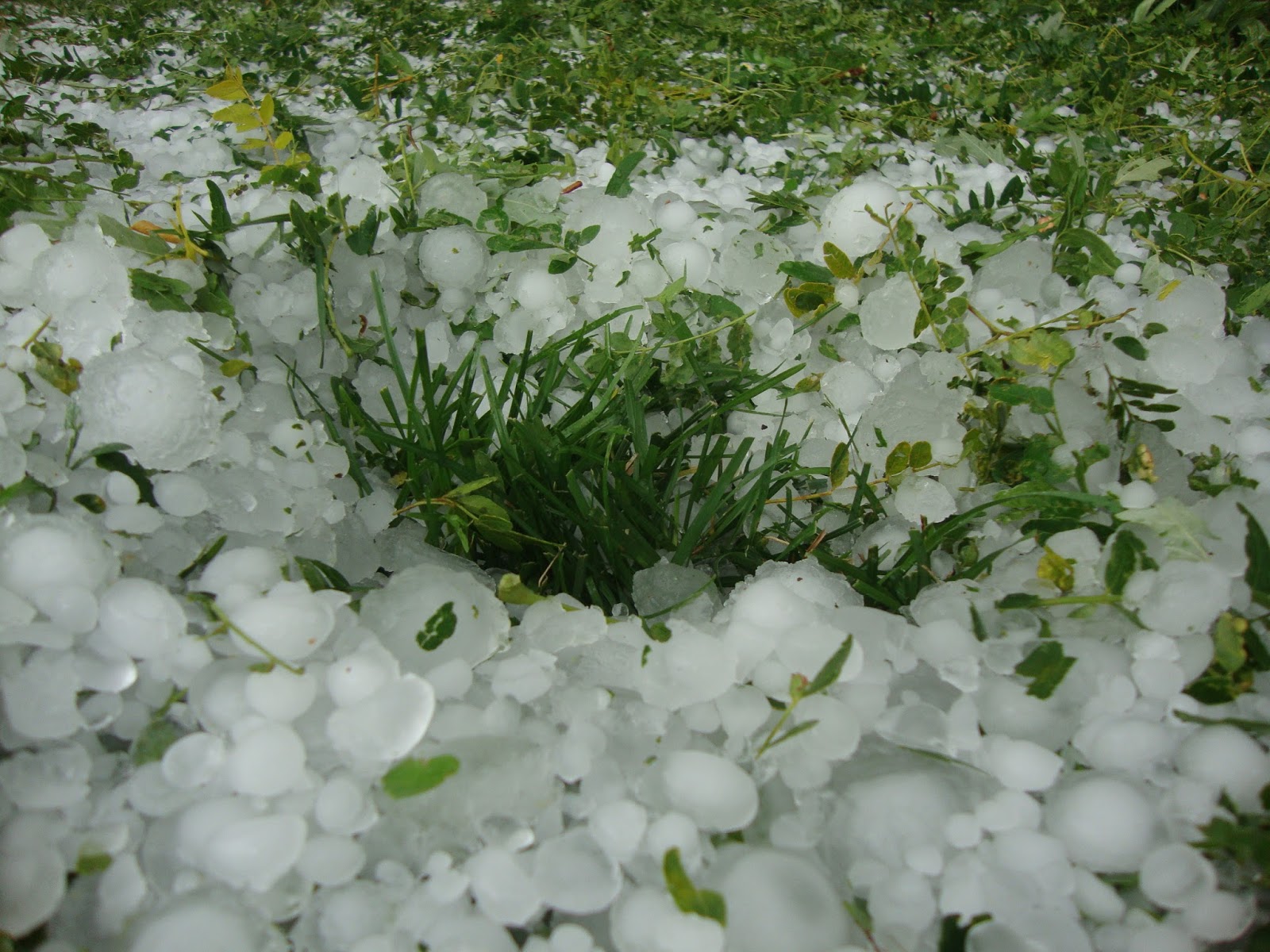
you collect it for show and tell.


While Windsor had to get out the snowplows to clear the streets, the hail in Wellington wasn’t as plentiful, but much larger.  And it got me thinking as I cleaned up my garden…are there plants that do better than others when pelted with these ice balls?  According to Wikipedia, the size of the hailstone determines the rate of speed at which it hits the earth.  A hailstone less than ½” will strike ground around 20 mph.  If you increase the size to 3”, the speed increases to 110 mph.  That means my baseball-sized hail ricocheted to the ground faster than Wyoming drivers race down I-25. 


Since Alison and I both had extensive damage to our gardens (we are seeking donations of any garden produce), here’s the list of plants that fared well and those that are now compost:


Plants that survived the hail
  • Ornamental grasses (Janey—note for your thesis!)
  • Hawthorn with hail damage;
    a little light pruning is all that's necessary
  • Lavender
  • Sage
  • Parsley
  • Rosemary
  • Groundcover thyme
  • Most small-leafed trees (honeylocust, linden, maples and crabapples/apples)
  • Broccoli
  • Kale
  • Cosmos
  • Lilacs
  • Pines (they lost a few needles, but look good)
  • Spruce (tips were pruned, but overall fared well)
  • Junipers (shocking, I know)
  • The sandcherry just laughed at the hail.
  • Lamb’s ear
  • Vines trellised to fences/structures (honeysuckle, silver lace vine)
  • Cholla cactus
  • Opuntia cactus
  • Coneflower
  • Scabiosa
  • Yarrow
  • Dogwood
  • Sandcherry
  • Agastache
  • Turfgrass (another reason to have turf!)

The turf says, "Hail?  What hail?"
Plants that bit the dust
Zucchini...I think.  Pretty sure.  Hard to tell.
  • Squash, cucumbers and other cucurbits
  • Eggplant
  • Peppers
  • Tomatoes
  • Dill
  • Beets (but may recover, since edible part grows below ground)
  • Rhubarb
  • Hops
  • Russian sage
  • Upright sedums
  • Cleome
  • Zinnias
  • Coreopsis (tickseed)
  • Fleshy-leaved sedums are a hail favorite
  • Iris
  • Daylilies
  • Peonies
  • Big-leaf trees (catalpa)
  • Heuchera (coralbells)
  • Hosta
  • Blue-mist spirea
  • Winecups
  • Jupiter’s beard
  • Shasta daisy

Sniff...there goes the beer :(
Hops vines totally denuded of leaves.

Darrin’s blog covered how to handle hail-damaged plants well, so I won’t repeat that.  And we’d love to hear from you about the plants in your garden that have prevailed after hail…anything we missed? 


Sungold cherry tomato = no likey hail
The Russian sage was in full bloom.
Now it's a hot mess.
Onward and upward to greener pastures!
Green space downtown Toronto, Canada.
These cows don't make cowpies!