CO-Horts

CO-Horts Blog

Showing posts with label Weld County. Show all posts

Tuesday, January 4, 2022

Evergreen Trees for Dry Sites

by Amy Lentz, CSU Extension Horticulture Agent- Weld County


Even with recent snowfalls, many of us are still in some sort of drought in Colorado. It’s been unseasonably dry over the past fall and winter so far and our trees could suffer if they don't get moisture during these dry winter months. We've talked before about the importance of winter watering, but I also wanted to take a moment to cover just a few evergreen trees that can better withstand drier conditions, whether you create those conditions through xeriscaping or you just want to choose the right evergreen tree for your dry location.


Pinyon pine (Pinus edulis)
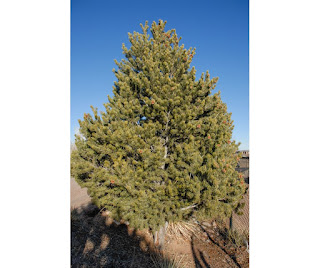
Pinyon pine tree. Photo by Colorado Springs Utilities Xeriscaping.

This is a great option for those living along the Front Range and lower elevations and if you are dealing with a steep slope where water runs off frequently. However, they don’t like to be wet, so placing a Pinyon pine in the middle of your lawn where it gets watered three times a week is not ideal and the tree will likely suffer. It’s a smaller evergreen tree with two needles per bundle and attractive smaller cones. These cones are where we get pine nuts!
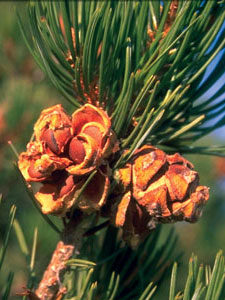
Pinyon pine cones. Photo by Colorado State Forest Service - Colorado State University.


Bristlecone pine (Pinus aristata)


Bristlecone pine tree. Photo by Oregon State University.


Bristlecone pine is a unique tree with a smaller mature height of around 20 feet tall with short, dark green needles that have tiny white resin dots on them (and often mistaken for bugs). Once you see past the dots, you will notice that this tree has a nice form and holds its needles for several years. This tree also grows very slowly, so you can even use it on your front porch in large containers until you are ready to plant it in the ground.


Bristlecone pine needles. Photo by Oregon State University.


Rocky Mountain juniper (Juniperus scopulorum)


Rocky Mountain Juniper Trees. Photos by Oregon State University.

This is one tough tree! Rocky Mountain junipers are often utilized in the worst conditions, like a windbreak on the Northern plains where the wind never stops. They are pyramidal in shape and small in mature height, reaching around 15 feet, depending on what type you choose. The overall color of these trees can range from green to blue, again depending on the cultivar. Look to your local nurseries to find specific cultivars such as 'Wichita Blue', 'Woodward' or 'Cologreen'.

The list of good evergreen trees for dry sites doesn’t stop with this blog, there are plenty from which you can choose. For a more complete list of all evergreen trees for Colorado landscapes (including those or more moist sites), check out our CSU Fact Sheet #7.403 - Evergreen Trees.


Thursday, October 15, 2020

Grow & Give: Community Garden Makes a Big Impact

 By Amy Lentz, CSU - Weld County Horticulture Agent


With the unique situation of the global pandemic that began back in March, many CSU Extension staff shifted gears to create the Grow & GiveTM program. This program took the idea of the victory garden and modernized it for 2020 by creating a comprehensive, statewide horticulture initiative focused on helping people grow a food garden and donate the produce locally to address food insecurity. The program registered almost 600 gardens across 37 counties in Colorado, with participation from individuals, Master Gardeners and community-run gardens. 


During the Grow & GiveTM program’s pilot year, there have been over 1600 reported donations across the state, totaling more than 40,000 pounds of produce! In addition to all of the amazing donations that were spurred by the program, the organizing team created several new resources for participants to help them with their ‘growing and giving’ questions and needs. To learn more about the Grow & GiveTM program, visit growandgivecolorado.org.  


One particular garden in my home county deserves some serious recognition for their past and present involvement in growing food for donations and their participation in this year's Grow & GiveTM program. The Treasure Island Demonstration Garden donated over 5,580 pounds of produce over the past few months, all donated locally! Although this wasn't their first year growing food for donation (they've been doing that for over 10 years), it was the first year they had to do it while dealing with restrictions due to the pandemic.


Treasure Island Demonstration Garden, conveniently located along the Poudre River Trail in Windsor, is visited by thousands of pedestrians and cyclists each year as they pass by the long garden area. The garden started 13 years ago as a side project for a small group of Weld County Colorado Master Gardeners. In their first year, they grew lots of pumpkins to get the garden up and running. Since then, the garden has grown to be an attractive and educational landmark of the town.


Today, Treasure Island is home to several garden sections including a very large vegetable garden, kitchen garden, dahlia garden, ornamental grass garden, memorial rose garden, a crevice garden and several mixed perennial gardens. 


The vegetable garden has really been thriving this year, with an abundance of crops such as cabbage, broccoli, zucchini, summer squash, onions, and tomatoes and peppers of all kinds! All of the fresh produce is donated to the Windsor Food Pantry for distribution throughout the area to those in need.


We are so proud of Windsor's volunteers at the Treasure Island Demonstration Garden and their continued efforts to help their local community! The Treasure Island Demonstration Garden is located at 1560 7th St. in Windsor, Colorado.


Tuesday, July 31, 2018

Is there hope for the landscape after hail?

by Amy Lentz

If you live along the Front Range in Colorado and have not had your yard ravaged by hail this year, you should count yourself lucky! I've been in the vicinity of four hailstorms around Weld and Larimer counties this year...and that's four too many! Hail can wreak havoc on one's landscape and garden. After hail, you might be wondering if your garden is toast or if there is something you can do to save the landscape. Depending on the time of year and the severity of the storm, there may be hope...

Hail forms within strong updrafts of some thunderstorms. As the air in the storm rises, it cools due to drops in pressure and temperature creating a colder air mass at the top of the storm. Ice particles can move upward due to the updraft and collect water as they rise, causing them to grow in size. The newly formed hail stones will swirl around in the upper layers of the storm. However, eventually the storm cannot hold onto the heavy hailstone, gravity takes over and it falls to the ground.

https://climate.ncsu.edu/edu/SevereHazards

The organization Community Collaborative Rain, Hail & Snow Network (CoCoRaHS for short) has a list of hail facts on their website along with a ton of other great weather information. Here are a few interesting facts about Colorado's affinity for these falling ice balls (you can find the complete list here):
  • Colorado is one of the most hail-prone states in the U.S.
  • The Colorado hail season is April 15 to September 15.
  • Hail occurs more frequently in the lee of the Rockies than anywhere else in North America.
  • Hail also occurs very frequently in the high Colorado mountains during the summer. These stones, however, tend to be small and soft and rarely do damage.
CoCoRaHS also has a database to track the number of hail storms in your area, including the size and location of hail reports. For example, both Larimer and Weld counties have had hail reported on 13 separate dates so far this year. The hail reported ranged in size from that of rice (less than 1/4 inch) to hen egg size (two inches in diameter). The most recent storm occurred just two days ago on July 29th. 

Check hail reports for your county here.

So what should you do if your garden or landscape gets hit by hail? Your trees will show the most damage toward the tops as this is where it takes the most beating. Any leaf area still on the tree will continue to photosynthesize and will likely keep the tree going through the rest of the growing season. The tree should leaf out okay the following year. if the damage was not too great. However, keep in mind that the hail can also do damage to the branches and open up the tree to disease, so hail damaged trees should be monitored for additional stress throughout the season. Similar monitoring should be done with perennials, as well.

The Weld County Extension Demonstration Garden after the June19th hail storm, up to dime-size hail.
The Weld County Extension Demonstration Garden 1 month after the hail storm, recovering nicely.

Depending on the time of year that hail hits your annual flowers, they might have enough time to recover and look nice. In early June, I had several containers of annuals damaged by a severe hail storm (up to quarter sized hail for an extended period of time). Needless to say the plants were shredded, with just a few leaf pieces hanging on for dear life. Upon further inspection, I noticed that there were a few new growth points that looked to be spared. So I waited. It's a good idea to wait a few days (up to a week or so) after hail has damaged you plants before you prune them back. This way you can see where there is hope for regrowth, allowing you to leave that growth on the plant when pruning off dead plant parts.

Quarter-size hail from the June 19th near north Fort Collins.

My lovely containers of petunias, zinnias and coleus after hail on June 19th.

Even though this coleus was shredded, a few growing points are still in tact.

After about a week, I removed the dead portions from these annuals and made sure to keep them well watered and as stress-free as possible over the next month to help them recover. After about 5 weeks, the annuals are recovering well. 


Five weeks after hail damage. If you look close, you can see that the coleus from the last picture is growing again.

Vegetables are tricky, as some will not recover at all after a hail storm, while others might be salvageable. Give it a week and see how they respond. You may need to replant if it's early enough in the season. Row covers and hoop houses can be helpful, along with hard structures to protect the plants. The University of Wyoming has an article with additional tips on how to protect the vegetable garden from hail. That article can be found here.

So don't loose all hope! If it's early enough in the season to get regrowth and if the severity of the hail left some leaf tissue in tact, the plants may be able to recover with time and a little TLC.


 Click here to find more information on how to deal with hail damage in this Planttalk Colorado™ article regarding hail.