CO-Horts

CO-Horts Blog

Showing posts with label blogging. Show all posts

Monday, October 25, 2021

CSU Extension is Here to Help!


by Amy Lentz, CSU Horticulture Extension Agent, Weld County


CSU Extension has a TON of resources to help you with a variety of needs when it comes to anything ‘horticulture’ and sometimes it can be a bit overwhelming to know where to look. I thought it would be a nice touch to our CO-Horts Blog series to have an instructional article on how to utilize these many resources that your CSU Extension experts have created for you! You can be sure that the information you get from CSU Extension is based on sound research and good practices, even if it's in a fun style like the current blog site you are visiting.

So, here you go…this is a summary of the different types of resources you might want to check out for more information on anything you can think of about gardening, landscaping, lawns, trees, flowers, vegetables, fruit and so much more! Links are embedded in each summary below in case you want to visit these sites and bookmark them for future use:
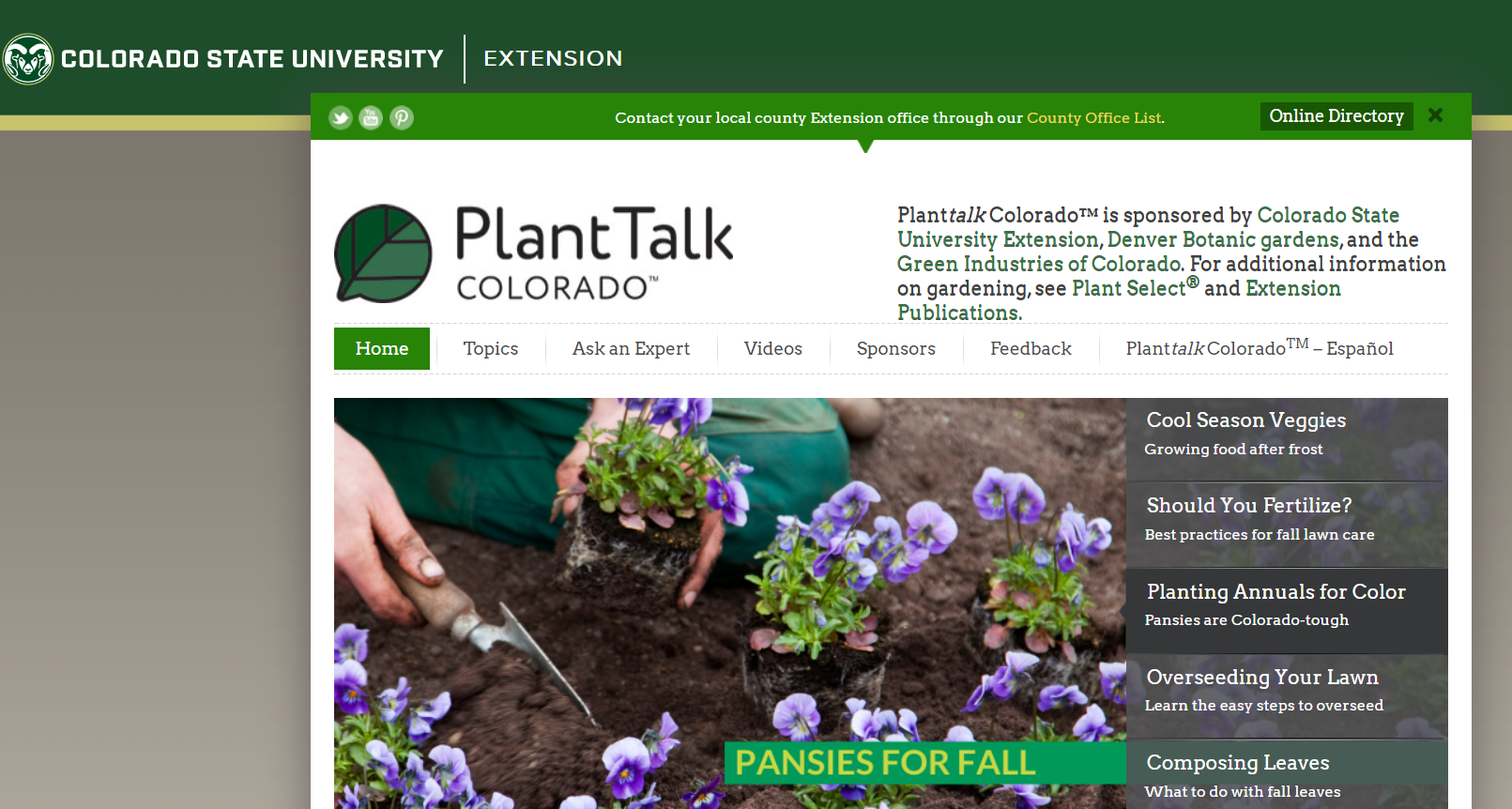

Resources from CSU’s Planttalk website are brief articles to introduce you to a wide range of gardening
topics. The subject material is focused on the beginner and offers other resources for further researching. The Planttalk website is also home to a full library of short gardening tutorial videos for those that prefer visual learning. Find these resources, along with a form to ask your question directly to Extension experts, on the Planttalk website.


CSU
 Fact Sheets are scientifically written and detailed articles that often include growing and treatment recommendations for everything from insect issues to recommended trees and shrub lists. Fact Sheets are peer reviewed and written by CSU Extension specialists, agents and other experts. These are great if you have an issue for which you need research-based advice. Fact Sheets can be found on the main CSU Extension Website under Publications.


CMG GardenNotes
 are very detailed chapter-style resources that are great for those seeking textbook style learning. These are utilized during training for Master Gardener volunteers and others at our annual Green School. You can find out more about Green School and access the complete set of CMG GardenNotes on the Colorado Master Gardener website.


Grow & Give is a program recently created by CSU Extension that teaches you how to grow fruits and vegetables and connects you with local donation centers to donate your excess bounty. Visit the vast resources on the Grow & Give website.


The CO-Horts Gardening and Colorado Mountain Gardener blog postings are more casual and fun resources where agents and Master Gardeners across Colorado write about random topics surrounding horticulture. You can subscribe to these blogs to receive the articles right into your email inbox or you can just read online. 


The CO-Horts blog website also offers a list of recorded Gardening Webinars that have been taught across the state by CSU Extension agents.  


Finally, probably the best part about CSU Extension is that you can contact your Local CSU Extension Office and Colorado Master Gardener Volunteers to get personalized help with your gardening questions! CSU Extension offices also cover many other topics that are useful to Coloradoans.


Thursday, September 19, 2019

A Pesky Invasive That Can be Managed


Posted by: Nancy Klasky, Broomfield County Extension

You may have seen common mullein (Verbascum thapsus) scattered along roadways, mountain canyons, rangelands, or in forests. The tall stalky plant has yellow blooms gathered at the top and large sage-colored leaves at the base. It grows profusely after major disturbances like fire, construction, or flooding. Common mullein is an introduced species and is present in all 50 states and Canada. Originally brought to North America for medicinal purposes, it has been designated a C List Noxious Weed by the Colorado Department of Agriculture, which means it is up to private and public entities to manage. 

I got to learn a lot about mullein after the High Park Fire west of Fort Collins. This lightning- ignited fire started in June of 2012 and due to the hot, dry spring, it burned over 87K acres and destroyed 259 homes before being contained a month later. I worked on land in this area at the time and saw first-hand both the devastating effects of the fire and the renewal of the forest that followed. After all, when occurring naturally, fire is a cleansing process that actually keeps our forests healthy. If left unmanaged, accumulated duff (forest litter) and smaller shrubs and trees can create dense, overgrown forests that can cause cataclysmic wildfires. Some regular burning keeps this in check.
Common mullein before mitigation work.
Tiny seeds find their way into crevice of rocks and form first year rosette. 

The land I worked on is a mixed forest just over 8,000 feet in elevation. It’s primarily ponderosa pine, with some Douglas fir and aspen. Ponderosa pine evolved with the wildfires. Thick bark protects them from destruction by low-intensity fires, and natural loss of lower branches reduces “ladder fuel” that allows fire to climb to the crown of the tree. Much of the surrounding land was turned into a moonscape by the High Park Fire, with 100% mortality of trees and other plants. On the managed land, many ponderosa survived, but most other vegetation was destroyed. This created the ideal environment for common mullein to grow, and boy did it grow. Where once there was an abundance of wildflowers, kinnik-kinnik, and common juniper shrubs, there was now a forest of mullein.

Mullein seeds will survive a fire and can remain viable for 100 years! They may have been in the area for decades, unable to germinate until this disturbance. Worse yet, each of these plants can produce 100,000 to 250,000 seeds per terminal spike. I had my work cut out for me, but I was determined to see this beautiful property restored to its natural state. 

Common mullein is a biennial plant, which means it takes two years to grow to its mature height and bloom. The first-year plant is a basal rosette that stays low to the ground and does not flower. If the plant lives to the next year it will bolt up and bloom. Management techniques that work with this lifecycle are important to stopping the spread of this invasive plant and not exacerbating the problem. 
Last years deadheaded stalks with no new mullein growing!

Like I mentioned mullein likes disturbed ground, so how do you get a plant out of the ground without creating more disturbance? First, you only want to remove the plant if it is a first year rosette. The roots are shallow and usually easy to pull up. It’s important to try and press down the soil as you pull the plant out. Yanking the plant out will give the seeds you know are there a better chance. If the plant has made it to the second year, which was the case with many plants by the time we got to them, you want to cut the bloom off before it starts to dry and drop its seeds. With the help of great groups of volunteers we were able to make many trips to the property to work on the mullein issue. Each year we saw less of the plant come back, and each year we worked to remove what did pop up. With persistence and determination, we saw the native wildflowers, kinnick-kinnick, and juniper shrubs take back what was theirs! The beauty of the restoration is when the native vegetation grows back, that is enough to keep the mullein from growing. There are other management options to consider, but I found the mechanical removal of this plant the best one for this area. 
The property with it's natural vegetation having taken back over.