CO-Horts

CO-Horts Blog

Showing posts with label exotic species. Show all posts

Thursday, October 29, 2020

Plants That Hunger: Green Insectivores through the Dormant Season

Posted by: John Stolzle, Jefferson County Extension 

We’re well into autumn, tilting further into the dormant season.. but this doesn’t have to be a time completely devoid of plant life, of green, of fresh produce and herbs. You can have freshly fallen foliage on your floor 365 days a year, if you like. Personally I enjoy the weirdness that comes with being surrounded by green plants while it is snowing outside, but that's just me.

But while we’re at it, why not consider raising a world of green insectivores that live on the brink? Carnivorous plants that consume other organisms on a regular basis. It sounds very much the stuff of sci-fi and imagination. In reality, quite a variety of these curiously adapted organisms exist in nature. And as fearsome and tough as they may seem or sound from reputation, carnivorous plants can be quite sensitive. They need care and particular environments to thrive.


In this blog post, I outline a little information on some of the more common carnivorous plants which you may be more likely to encounter in a garden nursery. At the end of the post I have also included links to information on less ‘fussy’ and more resilient plants that will just grow and be happy in a wide array of indoor environments, no doting required. 

Along the way, I will be providing plenty of links to further reading for a variety of these topics.

Carnivorous Plants

In the harsh reality of Colorado’s climate, many of these plants would not survive a week outdoors. It’s dry, the soil is challenging in many respects, and the temperature and weather fluctuates seemingly by the hour; however, in climate controlled home environments, these botanic curiosities can have a place right by any bedside.

But even indoors, they need a little extra care. As a kid, I always wondered why the mighty Venus Flytraps I purchased would die within a week. One problem is that I was treating them like quasi houseplant-animals rather than specialized organisms which needed time to acclimate. I wanted to see them eat bugs, but what they needed was time… and likely for me to stop poking them every 10 minutes.

Carnivorous plants have evolved to flourish in environments which are very low in accessible nutrients (low in Nitrogen and minerals salts, for example). But these plants do not primarily get their sustenance from their living meals; rather, they convert light into sugars (via chloroplasts) like all plants. They capture and 'process' their prey to compensate for their low-nutrient environments – it's like they take supplements in the form of digested insects! It’s a method to obtain a few specific things here and there but not a primary means for the plants to obtain energy. Also, don’t feed them raw meat.

Before diving in, an amazing list of detailed recommendations for the cultivation of various carnivorous plants may be found here: https://www.carnivorousplants.org/grow/guides.

Venus Flytraps (Dionaea muscipula)

Venus Flytrap - Dionaea muscipula
James Henderson, Golden Delight Honey, Bugwood.org

These little shop of horror-esque curiosities are native to a coastal region in North and South Carolina. The can consume an array of insects but in the wild their diets primarily revolve around ants, spiders, and even small beetles; the plant will clamp down when an insect brushes by two of its internal hairs. Once trapped, insects are digested in about a week (or a little more), after which the jaws reopen in preparation for another meal. If the plant's mechanism is accidentally triggered or an insect manages to escape, it will take about 8hours for a trap to reopen. A mixture of Sphagnum moss and sand is often used as a growth medium for Venus Flytraps. But it is important to note that they (and many other carnivorous plants) do not grow well in salty soils; Venus Flytraps and are so sensitive that even using “hard” mineral-heavy water can have a detrimental impact to their health. Use distilled water when possible, and try to keep them in an environment above 50% humidity. Because it is so dry here in Colorado, it might be necessary to grow one in a terrarium or other semi-sealed type of environment.

More information on the Venus Fly trap:

Sundews (Drosera spp.)

Sundew - Drosera spp.

Rob Routledge, Sault College, Bugwood.org

This genus (group of species) of plants ranges drastically in color from pinks to purples with reds in between; some have long thin tentacle leaves while others have short stubby spoon shaped leaves. The hairs on the leaves are tipped with a sticky substance that traps insects. Upon detecting a trapped insect, the leaf will roll itself up and begin digesting its meal. The Sundew then absorbs the nutrients through its leaves. Some research suggests that Sundews can obtain 20-57% of their required nitrogen from prey. A word of caution, if you decide to try growing one, do a little research on your variety. The needs of these plants can vary quite a bit between species of this genus; for example, some cannot handle dried mealworms as a food source while others can, some can tolerate a little bit of dryness while others do well in pots placed in trays of water. More detailed information for cultivating these plants can be found here: https://www.carnivorousplants.org/grow/guides.


Pitcher Plants (varied)

This group encompasses multiple genera of similar plants.

 Darlingtonia californica - California Pitcher Plant

Harlan B. Herbert, Bugwood.org

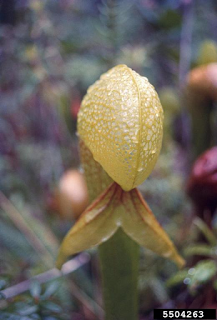
The pitcher plant Darlingtonia californica (aka. California Pitcher Plant) is native to Oregon and California. True to their namesake, these plants grow in a pitcher-like form. An insect will find itself drawn into the pitcher, fall into a small pool of water at its base, and then struggle to escape due to various possible plant adaptations (for example, some species have smooth and slick pitcher walls, others have downward pointing hairs or small spines). The water at the base of these plants is often enhanced with digestive enzymes, and nutrients are absorbed through the walls of the plant at the base of the pitcher. The California Pitcher plant has a twist in its pitcher to help retain prey, it is also somewhat unique in that it relies on bacteria and microinvertebrates to help breakdown trapped insects.
Darlingtonia californica - California Pitcher Plant
Harlan B. Herbert, Bugwood.org

I won't go into detail on the Napenthes pitcher plant (image below), other than to say it is another common variety; more information can be found in the links following the image.

Nepenthes Pitcher Plant

Rebekah D. Wallace, University of Georgia, Bugwood.org
Carnivorous plants can be challenging to grow, but the challenge can be part of the fun. And one day, all of the pieces may come together and you might find yourself with a terrarium full of curious wonders. It just takes some deliberate preparation: a semi-enclosed terrarium, growth medium (sphagnum moss and sand or other), proper lighting and watering. Alas, it seems so simple. Fortunately in-depth guides exist (previously linked). But, if you're like me then you might want some plants that just grow well indoors without a lot of fuss. 

If you’re interested in learning more about the kind you can just "give water and they’ll grow", then I highly recommend you check out the following few links:

A short Afterward

These curious carnivores are pretty cool, unfortunately many species are threatened, endangered, and some critically so, due to poaching, habitat destruction, and so forth. There do exist licensed vendors for these plants. And so if you are interested in trying to grow one of these curious terrors, do a little investigation and please make sure you are getting your exotic plants from a reputable source.


If you are interested in learning more about indoor gardening, then you might also be interested in checking out these other posts in this indoor blog series: 

And as always,
Best of luck in your gardening endeavors!

Thursday, September 19, 2019

A Pesky Invasive That Can be Managed


Posted by: Nancy Klasky, Broomfield County Extension

You may have seen common mullein (Verbascum thapsus) scattered along roadways, mountain canyons, rangelands, or in forests. The tall stalky plant has yellow blooms gathered at the top and large sage-colored leaves at the base. It grows profusely after major disturbances like fire, construction, or flooding. Common mullein is an introduced species and is present in all 50 states and Canada. Originally brought to North America for medicinal purposes, it has been designated a C List Noxious Weed by the Colorado Department of Agriculture, which means it is up to private and public entities to manage. 

I got to learn a lot about mullein after the High Park Fire west of Fort Collins. This lightning- ignited fire started in June of 2012 and due to the hot, dry spring, it burned over 87K acres and destroyed 259 homes before being contained a month later. I worked on land in this area at the time and saw first-hand both the devastating effects of the fire and the renewal of the forest that followed. After all, when occurring naturally, fire is a cleansing process that actually keeps our forests healthy. If left unmanaged, accumulated duff (forest litter) and smaller shrubs and trees can create dense, overgrown forests that can cause cataclysmic wildfires. Some regular burning keeps this in check.
Common mullein before mitigation work.
Tiny seeds find their way into crevice of rocks and form first year rosette. 

The land I worked on is a mixed forest just over 8,000 feet in elevation. It’s primarily ponderosa pine, with some Douglas fir and aspen. Ponderosa pine evolved with the wildfires. Thick bark protects them from destruction by low-intensity fires, and natural loss of lower branches reduces “ladder fuel” that allows fire to climb to the crown of the tree. Much of the surrounding land was turned into a moonscape by the High Park Fire, with 100% mortality of trees and other plants. On the managed land, many ponderosa survived, but most other vegetation was destroyed. This created the ideal environment for common mullein to grow, and boy did it grow. Where once there was an abundance of wildflowers, kinnik-kinnik, and common juniper shrubs, there was now a forest of mullein.

Mullein seeds will survive a fire and can remain viable for 100 years! They may have been in the area for decades, unable to germinate until this disturbance. Worse yet, each of these plants can produce 100,000 to 250,000 seeds per terminal spike. I had my work cut out for me, but I was determined to see this beautiful property restored to its natural state. 

Common mullein is a biennial plant, which means it takes two years to grow to its mature height and bloom. The first-year plant is a basal rosette that stays low to the ground and does not flower. If the plant lives to the next year it will bolt up and bloom. Management techniques that work with this lifecycle are important to stopping the spread of this invasive plant and not exacerbating the problem. 
Last years deadheaded stalks with no new mullein growing!

Like I mentioned mullein likes disturbed ground, so how do you get a plant out of the ground without creating more disturbance? First, you only want to remove the plant if it is a first year rosette. The roots are shallow and usually easy to pull up. It’s important to try and press down the soil as you pull the plant out. Yanking the plant out will give the seeds you know are there a better chance. If the plant has made it to the second year, which was the case with many plants by the time we got to them, you want to cut the bloom off before it starts to dry and drop its seeds. With the help of great groups of volunteers we were able to make many trips to the property to work on the mullein issue. Each year we saw less of the plant come back, and each year we worked to remove what did pop up. With persistence and determination, we saw the native wildflowers, kinnick-kinnick, and juniper shrubs take back what was theirs! The beauty of the restoration is when the native vegetation grows back, that is enough to keep the mullein from growing. There are other management options to consider, but I found the mechanical removal of this plant the best one for this area. 
The property with it's natural vegetation having taken back over.