CO-Horts

CO-Horts Blog

Showing posts with label indoor gardening. Show all posts

Monday, December 21, 2020

Caring for Popular Holiday Houseplants

 by Amy Lentz, Weld County Horticulture Extension Agent

Earlier this month, I had the pleasure of sitting in on a fantastic webinar about caring for holiday plants by one of our Larimer County Colorado Master Gardeners, Susan Bonsall. Her class was so informative that I thought I would highlight some of these holiday plants in this week’s blog post. If you want to dive deeper into Susan’s 1-hour webinar, a recording can be found HERE. (Thanks Susan!)

Many of you may be receiving a holiday themed and decorated plant as a gift this holiday season, or maybe you decide to buy yourself one to dress up your home. But don’t be fooled, even though most of these plants are sold and promoted this time of year, they are not made for outdoor temperatures or winter landscapes. Most of these are tropical in nature and are to be grown as houseplants indoors. So, let’s talk about a few of the most commonly received holiday houseplants! 

*Be sure to check out all of the linked text throughout this article for more information and growing instructions.


Poinsettias

I could go on for days about poinsettias. In fact, I’ve written a blog post in the past about the interesting history of the poinsettia and how it became the quintessential holiday plant. Poinsettias are not commonly kept very long after the holidays are over, but if you do want to keep your poinsettia going past the holidays, you can keep it indoors in a high light area until the summer then move it outside. Water it thoroughly when dry and allow the pot to drain completely. For more tips on caring for poinsettias, see the following fact sheet from CSU Extension.

Poinsettias in a Greenhouse - Photo: Amy Lentz

Christmas, Thanksgiving and Easter Cactus

That’s right, there are actually 3 main types of holiday cactus and the difference is shown in the leaves and when they each bloom. These popular holiday plants are short-day plants that require several weeks of days with less than 12 hours of light in order to bloom, with the Easter cactus requiring the most number of weeks. If you are unsure of which type you have, try comparing the leaf segments to the chart below from Iowa State UniversityExtension:

I'm guessing Thanksgiving cactus. 
Photo: Amy Lentz

For more information on how to care for your holiday cactus, visit this PlantTalk article.


Amaryllis

I LOVE the amaryllis! These popular houseplants have beautiful trumpet-shaped blooms atop a tall stalk with long, thick grass-like leaves. They are truly stunning when they bloom! They come in a variety of colors from red to pink to white - and all shades in between. 

The bulbs prefer to be planted in a container that is 1 inch larger in diameter than the bulb and deep enough to support its long root system. They also like to be planted shallow with half of the bulb above the surface of the planting medium. And, because these plants bloom better when pot-bound, you only have to repot them every 3-4 years.

My amaryllis blooms when it wants to
and surprises me every time.
Photo: Amy Lentz

 For more tips on growing Amaryllis, see the following PlantTalk article.


Paperwhites

Paperwhites (Narcissus tazetta) are an easy plant to force indoors by planting the bulbs in a container of rocks. They are a tropical bulb that take about 6 weeks to grow and bloom. They will show off their blooms for a few weeks, but then do not rebloom and can be disposed after blooming. To help keep your paperwhites on the shorter side, you can follow Cornell University’s research guidance and give them a little hard liquor mixed with water (4% solution)! 


The above video from PlantTalk and Tagawa Gardens has more tips on how to grow Paperwhites and Amaryllis.


 Norfolk Island Pine

This time of year, these popular gifted plants are adorned with lots of holiday decorations to look like a miniature live Christmas tree. And even though they are dressed up as cute little pine trees, they are not true pines at all. They are actually large tropical houseplants that would not survive out in the cold!

Photo: Costa Farms/Amazon


When caring for these tree-like houseplants, make sure to give them a large container to support the top growth that can be anywhere from 2 to 20 feet in a home setting. These plants can actually reach heights of 200 feet in their native habitat in Australia and New Zealand! They prefer a mild room temperature of 60-72 degrees and at least two hours of bright but indirect sunlight. Click on this link to CSU's PlantTalk article for more information about growing a Norfolk Island pine in your home.

Hopefully these tips and links will help you to keep your holiday plant going strong for years to come!


Thursday, October 29, 2020

Plants That Hunger: Green Insectivores through the Dormant Season

Posted by: John Stolzle, Jefferson County Extension 

We’re well into autumn, tilting further into the dormant season.. but this doesn’t have to be a time completely devoid of plant life, of green, of fresh produce and herbs. You can have freshly fallen foliage on your floor 365 days a year, if you like. Personally I enjoy the weirdness that comes with being surrounded by green plants while it is snowing outside, but that's just me.

But while we’re at it, why not consider raising a world of green insectivores that live on the brink? Carnivorous plants that consume other organisms on a regular basis. It sounds very much the stuff of sci-fi and imagination. In reality, quite a variety of these curiously adapted organisms exist in nature. And as fearsome and tough as they may seem or sound from reputation, carnivorous plants can be quite sensitive. They need care and particular environments to thrive.


In this blog post, I outline a little information on some of the more common carnivorous plants which you may be more likely to encounter in a garden nursery. At the end of the post I have also included links to information on less ‘fussy’ and more resilient plants that will just grow and be happy in a wide array of indoor environments, no doting required. 

Along the way, I will be providing plenty of links to further reading for a variety of these topics.

Carnivorous Plants

In the harsh reality of Colorado’s climate, many of these plants would not survive a week outdoors. It’s dry, the soil is challenging in many respects, and the temperature and weather fluctuates seemingly by the hour; however, in climate controlled home environments, these botanic curiosities can have a place right by any bedside.

But even indoors, they need a little extra care. As a kid, I always wondered why the mighty Venus Flytraps I purchased would die within a week. One problem is that I was treating them like quasi houseplant-animals rather than specialized organisms which needed time to acclimate. I wanted to see them eat bugs, but what they needed was time… and likely for me to stop poking them every 10 minutes.

Carnivorous plants have evolved to flourish in environments which are very low in accessible nutrients (low in Nitrogen and minerals salts, for example). But these plants do not primarily get their sustenance from their living meals; rather, they convert light into sugars (via chloroplasts) like all plants. They capture and 'process' their prey to compensate for their low-nutrient environments – it's like they take supplements in the form of digested insects! It’s a method to obtain a few specific things here and there but not a primary means for the plants to obtain energy. Also, don’t feed them raw meat.

Before diving in, an amazing list of detailed recommendations for the cultivation of various carnivorous plants may be found here: https://www.carnivorousplants.org/grow/guides.

Venus Flytraps (Dionaea muscipula)

Venus Flytrap - Dionaea muscipula
James Henderson, Golden Delight Honey, Bugwood.org

These little shop of horror-esque curiosities are native to a coastal region in North and South Carolina. The can consume an array of insects but in the wild their diets primarily revolve around ants, spiders, and even small beetles; the plant will clamp down when an insect brushes by two of its internal hairs. Once trapped, insects are digested in about a week (or a little more), after which the jaws reopen in preparation for another meal. If the plant's mechanism is accidentally triggered or an insect manages to escape, it will take about 8hours for a trap to reopen. A mixture of Sphagnum moss and sand is often used as a growth medium for Venus Flytraps. But it is important to note that they (and many other carnivorous plants) do not grow well in salty soils; Venus Flytraps and are so sensitive that even using “hard” mineral-heavy water can have a detrimental impact to their health. Use distilled water when possible, and try to keep them in an environment above 50% humidity. Because it is so dry here in Colorado, it might be necessary to grow one in a terrarium or other semi-sealed type of environment.

More information on the Venus Fly trap:

Sundews (Drosera spp.)

Sundew - Drosera spp.

Rob Routledge, Sault College, Bugwood.org

This genus (group of species) of plants ranges drastically in color from pinks to purples with reds in between; some have long thin tentacle leaves while others have short stubby spoon shaped leaves. The hairs on the leaves are tipped with a sticky substance that traps insects. Upon detecting a trapped insect, the leaf will roll itself up and begin digesting its meal. The Sundew then absorbs the nutrients through its leaves. Some research suggests that Sundews can obtain 20-57% of their required nitrogen from prey. A word of caution, if you decide to try growing one, do a little research on your variety. The needs of these plants can vary quite a bit between species of this genus; for example, some cannot handle dried mealworms as a food source while others can, some can tolerate a little bit of dryness while others do well in pots placed in trays of water. More detailed information for cultivating these plants can be found here: https://www.carnivorousplants.org/grow/guides.


Pitcher Plants (varied)

This group encompasses multiple genera of similar plants.

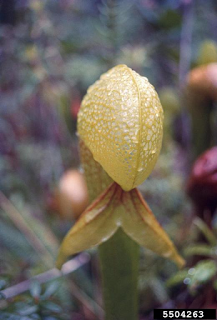
 Darlingtonia californica - California Pitcher Plant

Harlan B. Herbert, Bugwood.org

The pitcher plant Darlingtonia californica (aka. California Pitcher Plant) is native to Oregon and California. True to their namesake, these plants grow in a pitcher-like form. An insect will find itself drawn into the pitcher, fall into a small pool of water at its base, and then struggle to escape due to various possible plant adaptations (for example, some species have smooth and slick pitcher walls, others have downward pointing hairs or small spines). The water at the base of these plants is often enhanced with digestive enzymes, and nutrients are absorbed through the walls of the plant at the base of the pitcher. The California Pitcher plant has a twist in its pitcher to help retain prey, it is also somewhat unique in that it relies on bacteria and microinvertebrates to help breakdown trapped insects.

Darlingtonia californica - California Pitcher Plant
Harlan B. Herbert, Bugwood.org

I won't go into detail on the Napenthes pitcher plant (image below), other than to say it is another common variety; more information can be found in the links following the image.

Nepenthes Pitcher Plant

Rebekah D. Wallace, University of Georgia, Bugwood.org
Carnivorous plants can be challenging to grow, but the challenge can be part of the fun. And one day, all of the pieces may come together and you might find yourself with a terrarium full of curious wonders. It just takes some deliberate preparation: a semi-enclosed terrarium, growth medium (sphagnum moss and sand or other), proper lighting and watering. Alas, it seems so simple. Fortunately in-depth guides exist (previously linked). But, if you're like me then you might want some plants that just grow well indoors without a lot of fuss. 

If you’re interested in learning more about the kind you can just "give water and they’ll grow", then I highly recommend you check out the following few links:

A short Afterward

These curious carnivores are pretty cool, unfortunately many species are threatened, endangered, and some critically so, due to poaching, habitat destruction, and so forth. There do exist licensed vendors for these plants. And so if you are interested in trying to grow one of these curious terrors, do a little investigation and please make sure you are getting your exotic plants from a reputable source.


If you are interested in learning more about indoor gardening, then you might also be interested in checking out these other posts in this indoor blog series: 

And as always,
Best of luck in your gardening endeavors!