CO-Horts

CO-Horts Blog

Showing posts with label water conservation. Show all posts

Thursday, December 16, 2021

Growing the Three Sisters

 By Irene Shonle, El Paso County Extension
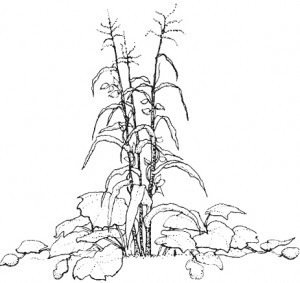
Three sisters illustration (from gardening.cals.cornell.edu)


This coming summer I have decided to try growing the traditional grouping of crops called the Three Sisters – corn, beans, and squash.   This is one of the oldest companion planting groupings, first planted by Native Americans in many different regions.  It is rich in tradition and indigenous knowledge, and can produce a lot of food. The idea is that the corn provides the trellis for the beans, the beans provide nitrogen for the hungry corn, and the squash shades the ground and reduces both water needs and weed seeds. 

I have been growing beans and squash for a while now, but had avoided corn due to the high numbers of raccoons in my area.  Supposedly, the combination of the prickly squash leaves and the raspy, tangly bean vines reduces raccoon visitation.  We shall see -- I have the perfect conditions to test this concept.

For the three sisters,  it is traditional to use a flour or popping corn with taller stalks, a pole bean, and a squash. Many sweet corn varieties don’t have sturdy enough stalks, and bush beans do not climb up the corn stalks. I decided to go with a dry bean rather than a green bean, because I don’t want to be wading into the plot on a daily basis to pick green beans.   Sometimes a fourth sister is planted, which is traditionally a sunflower or a bee plant.  I have both growing in my yard, and they will probably be on the edge of the three sisters area as well as elsewhere in the garden. These help to draw in pollinators.

It’s been fun figuring out what specific varieties I will grow. I do not have an easy way to grind flour, but I am a popcorn fan, so that’s what I decided to go with. Glass gem has irresistibly beautiful multi-hued kernels, and grows at least 6 feet tall. It’s also supposed to make yummy popcorn, and can double as a decoration.   For the beans, I want a variety that is harder to find in stores, so I am currently leaning towards the Hopi red bean, which is supposed to make wonderful chile.  I considered Gigante beans, which I would really like to try, but I have a feeling that they may be a little too exuberant.  Maybe I’ll try growing a few up some of my giant sunflowers (they were 15’ tall last summer), if I can find the seeds (they are hard to come by in this country- I may have to resort to ordering a pound of beans intended for eating).  Finally, for the squash variety,  I will likely plant a couple of summer squash varieties and perhaps either a Lakota squash (which is a cultivar derived from a landrace grown by Native Americans in Nebraska and crossed with a Hubbard: https://digitalcommons.unl.edu/cgi/viewcontent.cgi?article=1637&context=agronomyfacpub  and somewhat deceptively named: https://medium.com/@MisterOctober/the-lakota-squash-is-a-regrettable-deception-ecd549cb73a5) or a pink banana squash.


How to grow:

Test your soil first. Corn is a heavy nitrogen feeder (even with nearby beans), and squash will be more productive with fertile soil.  Adding compost before planting can be helpful to provide a little extra water-holding capacity and to improve soil structure and a add a few nutrients.
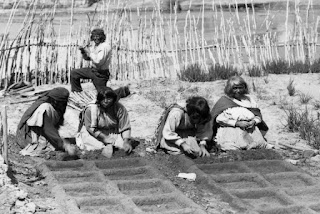
Zuni waffle garden. Photo Credit: A:shiwi A:wan Museum Photo Archives


There are many, many different suggestions for the layout for planting, with different layouts traditional to different areas of the country.  Because I live in a hot, dry area, I intend to use the traditional Zuni waffle garden design to conserve water.  The waffles are created with raised soil edges, and they are almost the opposite of raised beds.

Probably one of the biggest considerations for the planting design is to plant the corn in blocks so they can become adequately pollinated.  Also, grow only one variety of corn to avoid cross-pollination.
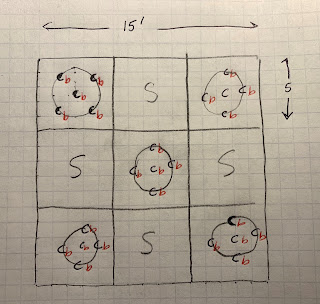
Three sisters planting diagram (c=corn, b=bean, s=squash)

I am going to plant in a 15x15’ area, with 9 ‘waffle’ squares.  In the center of every other waffle, I will plant the corn in a circle about 18’ diameter, and will plant 5 seeds of corn, with one in the middle, and the rest evenly spaced. There will be five blocks of corn, which should provide reasonable pollination. The squash will go in alternating waffle squares (so, four squares).

Once the corn is 4” high, I will plant the beans (one per corn plant).   It is a good idea to soak the corn and bean seeds before planting for at least 8 hours.


Monday, April 16, 2018

So You Want to Do Some Landscaping

Posted by: Andie Wommack, Douglas County Extension


First thing’s first. Why are you doing this landscaping? Have you moved into a new house with no landscaping? Are you redoing an old landscape? Are you adding an area of landscaping? Next. What restrictions do you have when doing this landscaping? Does your HOA have requirements on the types or amounts of plants you can put in? Do you have water use restrictions, or will you have water use restrictions at some point during the season? Are there topographical or climatic restrictions? Other things to consider are the aesthetics, water consumption, and site preparation needs. There is a lot of planning that should happen before you go to your favorite garden center to purchase plants.
  
Speaking of plants. One of the biggest things you should think about when planning a landscape is right plant, right place. Colorado is a hard place to live for most plants, even the ones who grow natively here. Most plants that grow well on the east or west coasts will not grow well in Colorado. Rethinking what constitutes a “beautiful” landscape may be one of the hardest things for transplants moving to the area. Planting an Autumn Blaze Maple because you love the beautiful fall color will become problematic at some point in its lifetime. The alkaline soils in Colorado bind iron, making it unavailable to plants. This will cause your maple to become chlorotic. Other plants that need a lot of water to do well, like azaleas, will not thrive in our climate with the amount of water you will be able to give them.
Dryland Mesa Garden
(https://www.botanicgardens.org/
york-street/gardens-west#dryland-mesa)

Water in Colorado is the biggest limiting factor for plant growth and survival. We have had a couple years of very dry winters. Looking at the drought monitor for Colorado, the percentage of the state in Extreme Drought conditions has increased three percent just in the last week. (http://droughtmonitor.unl.edu/CurrentMap/StateDroughtMonitor.aspx?CO) Roughly 50% of municipal water is used for outdoor landscaping. This will mean there will be mandatory water use restrictions during the hottest months of the year, creating stress on all the plants on your property. Maintaining a lush, green lawn in Colorado can be difficult if you do not plant the right variety of grass and take care of it properly. Landscape plants that don’t have some degree of drought tolerance will also struggle. When planning your new landscape, strongly consider planting xeric plants that will tolerate drought and native plants. Natives will grow well with little to no additional water once they are established in your landscape. They have adapted to grow in our climate so they will be able to survive, for the most part, on only the precipitation that we receive. Another great resource is Plant Select, which is a program run in partnership between Colorado State University and the Denver Botanic Gardens. These plants are tested in trial gardens to determine whether or not they can grow successfully in our climate.
Photo Credit: Jim Tolstrup, Summer
(https://conps.org/summer/)
  
A key thing to note when putting in a new landscape are the needs of the newly planted plants. If you put in a xeric garden, you will still have to water those plants. Xeric and native plants take about three years to get established after planting. If you do not provide supplemental watering during those first three years, you will lose plants. It is also important to note that you will have some plants that will not make it through the first year for a wide variety of reasons. Plan on having to replace some of your plants.


Here are a couple resources to use when choosing plants and trees.

Colorado Native Plant Society: https://conps.org/gardening-with-native-plants/
Low-Water Native Plants, Front Range & Foothills: http://extension.colostate.edu/docs/pubs/native/FrontRange.pdf

Monday, December 7, 2015

GreenCO Dives Into Colorado Water Plan


Posted By Carol O’Meara, Boulder County Extension
Colorado experienced a watershed moment in 2015, one with ripple effects on the state for generations to come.  On the surface, the Colorado Water Plan approved by Governor Hickenlooper on November 19 is an ambitious road map for managing, conserving, and protecting this vital resource.

But still waters run deep, and if you look closely, you’ll see the plan is designed to help Colorado face climate change, population boom, protect wildlife, keep agriculture vibrant, and support economic growth.  All while preserving our quality of life.  


“Our water picture has changed over the last 10 to 15 years; it’s no longer good enough to just have water law managing our water,” said James Eklund, Director of the Colorado Water Conservation Board, which wrote the plan.  “We’ve had record fires, flooding, and historic drought – the worst we’ve ever measured. We’re warmer by two-degrees; our summers are going to be hotter and our growing season extended.”
With Colorado’s population projected to grow 73-percent by 2050 and a projected shortfall of 560,000 acre-feet of water, Governor Hickenlooper in 2013 ordered the creation of the plan.  The CWCB sought input from water providers, agricultural organizations, environmental groups, the General Assembly, local governments, the business community and the public. 

Among the objectives for closing that gap is landscape water conservation.  “With water being recognized as a major factor for the state's long-term growth, now comes the tough discussions and decisions needed to implement a state water plan that works and delivers the quality of life we all treasure,” said Kristen Fefes, a GreenCO board member (GreenCO is an alliance of seven landscape related associations). 
Landscape water use accounts for 3-percent of state water, which may seem like a drop in the bucket.  But a study commissioned by GreenCO suggests that homeowners reducing over-irrigation by 10 to 20-percent can save 86,500 acre-feet of water over 40 years. 


“Because landscape water use is so visible, it is often the main target – and main solution – for saving water.  But it’s not the only solution. There’s no silver bullet; it’s going to take work on a lot of fronts to conserve water.  We believe that xeriscape and other sustainable landscape practices will continue to gain popularity with Colorado consumers. They’re already a business model for us,” said Fefes.
Education may be the biggest challenge and an area where Fefes hopes the state and local policy makers lean on the Green Industry.  “Landscape water use is complicated and how much to use depends on a variety of factors – soil, sun, slope.  There’s no one answer to ‘how much water does landscape use?’  Industry member have technical knowledge to give customized answers to homeowners.  We can be a big asset for state and local policy makers in education, outreach, and implementation.”

Eklund and Fefes agree that urban landscapes are integral to our quality of life and not expendable.  Its value to mitigating heat islands and reducing pollutant runoff is just as important to sustainability as water conservation.
“The knee-jerk reaction is that we can conserve our way out of this, but we’re looking at all the tentacles into lives that could trip us up,” said Eklund.  “The heat island effect could mean that a person keeps their air conditioning on.  If a person stops watering their lawn and it dies, when it does rain we get all that dirt and pollutants washing off and into the wastewater system where we all pay money to treat it.”

Says Eklund, “We must create a conservation culture, use efficient irrigation, teach our kids that we live in a high desert and water is limited.  People moving here need to know that too and not plan for the lush landscapes they might have had back east.”
The Green Industry is committed to being partners with the CWCB in closing the water gap, said Fefes.  Find tips for how you can conserve by signing up for the ALCC Tip of theWeek . 

Monday, April 8, 2013

Growing vegetables in a dry land takes planning

Posted by Carol O'Meara, Boulder County Extension


As another hot, dry season creeps closer, vegetable gardeners are pondering what they can do to conserve water and still get a bounty for the kitchen.  During times of drought, vegetable gardening is a challenge, but proper planning helps conserve water while still providing good quality produce.

Build your soil’s moisture holding capacity by amending the soil with organic material, such as compost. This breaks up clay, providing better growing conditions for roots during times of stress.

Make a commitment to drip or trickle irrigation.  Sure, a gently oscillating fan of water is festive to watch, but in a dry land, irrigating by throwing water through the air is wasteful.   Drip reduces water usage by about 50 percent, and soaker hoses are inexpensive and easy to use.  Known as a "leaky pipe," soaker hoses let water seep out all along its length at a slow rate.  Emitter type hoses, with small disks that seep, are good on individual plants, such as peppers, but not as efficient with leafy row crops, like lettuce, which need uniform coverage all along the row. 
Straw mulch helps conserve water

Mulching is crucial for conserving water.   Research has shown that one to three inches of organic mulch lowers water needs by reducing evaporation of moisture from the soil.  Weeds are less of a problem too, which leaves more water available for the vegetables.  Dried grass clippings or straw are ideal; wait until soil has warmed before applying the mulch, usually in mid-June.  Plastic mulch is only recommended for tomatoes, peppers, eggplants, and vining crops such as squash or cucumbers.  Place mulch over water hoses for best water conservation.

Choosing plants that withstand hot, dry conditions greatly help in getting good production.  Many varieties are available that resist bolting (when the plant stops growing edible leaves and rapidly produces non-edible flowers). 

Plant in blocks, rather than rows; you’ll increase yields five-fold.  Block planting is a compact design in which vegetables are grown in smaller, square plantings instead of stretching them out in long rows.  As the plants grow, their leaves fill in and shade roots, conserving water in the soil underneath.  Plan on blocks that are three to four feet wide and any desired length. 
Group plants with similar water needs together on the same soaker hose.  Cucumber and zucchinis, for example, require similar amounts of water.  Water is needed during the first few weeks of development, immediately after transplant, and during formation of edible plant parts. 

Apply water at low pressure for only 10 to 15 minutes. Much faster than this causes run-off, unless the soil has exceptionally good drainage.  Water during early morning, when wind is low and temperatures are cool.  Use a timer for the watering and time it to deliver only what is needed by the plants, avoiding watering during rainfall.  Watering restrictions that limit irrigation to every two or three days should not have a major impact on the vegetable garden.

Provide wind breaks and shade to reduce evaporation of moisture from soil.  Wind can wick water from the soil and from plant surfaces.  High heat and direct sun take their toll on even the most sun loving plants if water is reduced.  Tomatoes, for example, will not set fruit in high temperatures and peas, lettuces, and broccolis will bolt.  Shade can be provided with the use of shade barrier cloth that will cut sunlight by approximately 25 percent.  Gardeners should construct a shade canopy over plants before the high heat of the summer arrives and place the cloth over heat sensitive plants when temperatures soar into the upper 80's.