CO-Horts

CO-Horts Blog

Showing posts with label Landscaping. Show all posts

Tuesday, August 2, 2022

Ribbons and Livestock and Gardens, oh my!


It’s that time of year when, across the entire state, counties are gearing up for their county fairs. Event planning is being finalized, award ribbons are being made, and livestock is being meticulously groomed before show. Similarly, demonstration gardens are also being polished up before fair, but rather than being trimmed and brushed, gardens are being weeded and prepped.

Demonstration gardens are common features of extension offices, showcasing research-based practices for landscaping and/or gardening and often dedicated to a particular theme. For instance, many counties offer demonstration gardens that focus on native plants or on xeriscape gardening. Some counties have more uniquely-themed demonstration gardens, such as the Rock and Hell Strip Demonstration Garden in Boulder County or the Ute Ethno-botanical Learning Garden in the Tri-River area. So whether you’re interested in some ideas for your own landscaping or gardening project or you just want to tour some pretty gardens, make sure to check out your local demonstration gardens while you attend this year’s county fair (or anytime, really)!

Rock and Hell Strip Demonstration Garden in Boulder County

Ute Ethno-botanical Learning Garden in the Tri-River Area

Over at Jefferson County, we’ll be hosting an Open Garden Day on August 6th from 9 AM to 7 PM, located at the Jefferson County Fairgrounds in Golden. Demonstration gardens on-site include the Giving Farm Horticulture Garden, the Plant Select Garden, the Native Garden, and the Fruit Tree Orchard. Aside from having Master Gardeners available to answer any questions, we’ll be offering giveaways and garden-themed kids’ projects, so don’t miss out!

Giving Farm Horticulture Demonstration Garden in Jefferson County


Monday, August 2, 2021

Three quick steps for planning low water landscapes

 Posted by: John Stolzle, Jefferson County Extension

Note: Many vegetable gardens are in the midst of full production. If you find yourself with an abundance of excess produce, I would encourage you to look into CSU Extension’s Grow & Give program where you can learn helpful tips to grow produce and information about how you can share the harvest. More information can be found on the Grow&Give program's website: http://growandgivecolorado.org/

This blog is not going to focus on vegetables, but instead present starter tips for planning a xeric or low water landscape. Across the state, summer heat is impacting our gardens and it has resulted in many common landscape plants struggling with heat and drought. Creatively designed and carefully planned landscapes which incorporate hardy xeric, or native plants can flourish under hot and droughty conditions.

caption2
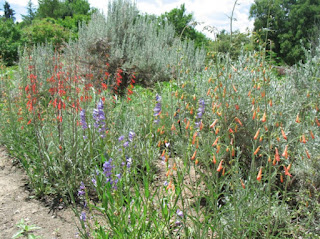
Penstemon and sagebrush, Denver Botanic Gardens. Photo by Irene Shonle
Provided in: CSU Factsheet for Low Water Native Plants - SE Colorado.
Step 1. Planning & Plant Selection

The first step is to assess your landscape and begin selecting plants and to develop a general layout and plan. You’ll want to consider the amount of sun that your landscape receives; southern and western exposures particularly near buildings or pavement (with reflected heat) will often have the greatest losses of water – to address this, consider using plants that are especially tolerant of dry conditions. In exposed locations that are particularly steep or difficult to irrigate such as terraced areas, you might consider planting a xeric groundcover which can also help to prevent erosion. Once you have selected plants for your landscape, it can be helpful to group them by water requirements.

A great list of xeric groundcover plants to help get you started can be found at this following link: https://extension.colostate.edu/docs/pubs/garden/07230.pdf

Additional resources to help start planning a xeric garden can be found towards the end of this blog post.


Heat reflected by the sides of buildings can be especially
 stressful for plants not well adapted to heat and drought.

Step 2. Soil Prep and Irrigation Planning.

Once you have a plan in place for your landscape and plants picked out, you can help ensure the successful establishment of your plants by properly amending your soil when needed. If your soil is too sandy, nutrients and water can be lost to leaching below the root zone of your plants; if the soil is thick clay, a landscape can lose water to runoff. To cultivate a soil that is just right, you can add organic matter annually to garden areas to help improve moisture retention. Additional information regarding soil amendments can be found in this following link: https://extension.colostate.edu/docs/pubs/garden/07235.pdf


Drip irrigation isn't just for vegetable gardens,
it can be very effective for other landscapes as well.
 

Native and Xeric plants can withstand very trying conditions; however, they are vulnerable and more sensitive when first becoming established. This process can take up to three years after planting, and so it is important that newly planted xeric and native plants are provided supplemental water during their initial years in a landscape. If you have an irrigation system already installed, you may wish to conduct an irrigation system self audit; if you do not have a system installed, you may be interested in setting up a drip irrigation system. Drip irrigation can be much more efficient than standard above ground sprinkler systems.

Irrigation System Self Audit: https://extension.colostate.edu/topic-areas/yard-garden/lawn-irrigation-self-audit-lisa/

Drip Irrigation: https://extension.colostate.edu/docs/pubs/garden/04702.pdf


Step 3. Just add mulch.

Mulch can greatly help to conserve soil moisture, it can reduce soil temperatures, the amount of soil exposed to wind, and help manage weeds. Wood chips and pea gravel can make a great choice for trees, shrubs, or perennials; but stone mulch should be limited to less than half and inch in diameter for weed management and water conservation. Black rolled plastic, or woven ‘weed fabric’ can interfere with the flow of oxygen and water between the soil and air and this can sometimes harm plants. These types of mulch are not recommended for many landscape situations; however, they can be effective in vegetable gardens when used very carefully. You can find a reference link with more information on using fabric mulch in vegetable gardens, below.

If you are interested in learning more about xeriscaping or hardy drought tolerant plants, I would encourage you to look through the follow links for additional information on these topics.


A view of the Jeffco Plant Select garden. Plant select is a program
run in partnership with Colorado State University and the Denver Botanic Gardens
 http://plantselect.org/plants/find-a-plant/


More information about Xeriscaping:

Retrofitting a Yard:
https://extension.colostate.edu/docs/pubs/garden/07234.pdf

Low water native plant guides for all areas of Colorado: https://cmg.extension.colostate.edu/gardening-resources/online-garden-publications/native-plants/

More detailed overview for creative xeriscaping: https://extension.colostate.edu/docs/pubs/garden/07228.pdf

Native & Xeriscaping Plant Lists:

Perennials and Annuals: https://extension.colostate.edu/docs/pubs/garden/07231.pdf

Groundcover:
https://extension.colostate.edu/docs/pubs/garden/07230.pdf

Trees & Shrubs: https://extension.colostate.edu/docs/pubs/garden/07229.pdf

Native Trees & Shrubs: https://extension.colostate.edu/docs/pubs/garden/07422.pdf

Native Herbaceous Perennials: https://extension.colostate.edu/docs/pubs/garden/07242.pdf

Mulch:

Mulches for vegetable gardens (includes information on fabric mulch): https://cmg.extension.colostate.edu/Gardennotes/715.pdf

Mulches for home grounds: https://extension.colostate.edu/docs/pubs/garden/07214.pdf

Mulching trees: https://cmg.extension.colostate.edu/Gardennotes/658.pdf

Extra:

Fall and winter watering during drought:https://planttalk.colostate.edu/topics/trees-shrubs-vines/1751-fall-winter-watering-drought/

And as always, best of luck in your gardening endeavors!


Monday, August 27, 2018

So You Did Some Landscaping


Posted by: Andie Wommack, Douglas County Extension


Earlier in the season, I gave you some things to consider when doing landscape work. One thing many people tend to do is place their plants too close together. When planning out your landscape it is important to consider the size your plants will be at maturity.

There are several websites that have landscape plans for you to use in your yard. They are all mapped out with the plants at maturity. When the landscape is first installed it will look sparse. It is important not to crowd your plants as that may cause problems down the line. While there are many tools available online to help you plan your own landscape, another option that is always good is to consult a landscape designer with help in renovating your landscape.


With any luck, the plants will be happy in their new homes and you should see nice growth as they begin to establish themselves. Some of the plants will die for a variety of reasons. One of the problems we had with the landscape we installed at our office was rabbits. Several of our new plants got eaten clear down to the ground. Some were able to recover. Others we will have to replant next spring. One thing we tried that seemed to work fairly well was to apply Liquid Fence, Deer and Rabbit Repellant granules. This seemed to help.
Another problem we had was too much water. Thankfully, we were spared the severe hail storms that plagued the rest of the front range this summer, but we did receive a lot of rain. This caused several of our plants to decline and some died. To compound this issue, one of the sprinkler heads got damaged at some point and was no longer pointed at the correct angle, causing some areas to receive too much water and others not enough.

Irrigation is more often than not the culprit in landscape issues. Too much. Too little. Inadequate coverage. Water needs fluctuate throughout the growing season and as plants grow and mature. It is important to check your system periodically to make sure all of the heads are working correctly, pointed in the right direction, and are reaching all the areas they are meant to. As a landscape matures, plants may begin to impede the stream from your sprinkler heads, lawnmowers may tilt the heads up or down, or heads may become clogged or damaged in other ways.
Gardening in Colorado can be particularly challenging so the most important thing to remember is to not give up! If you are having problems, your local Extension office is there to help! Many have Colorado Master Gardeners available to answer questions or your local horticulture agent is there as a resource as well.

Monday, April 16, 2018

So You Want to Do Some Landscaping

Posted by: Andie Wommack, Douglas County Extension


First thing’s first. Why are you doing this landscaping? Have you moved into a new house with no landscaping? Are you redoing an old landscape? Are you adding an area of landscaping? Next. What restrictions do you have when doing this landscaping? Does your HOA have requirements on the types or amounts of plants you can put in? Do you have water use restrictions, or will you have water use restrictions at some point during the season? Are there topographical or climatic restrictions? Other things to consider are the aesthetics, water consumption, and site preparation needs. There is a lot of planning that should happen before you go to your favorite garden center to purchase plants.
  
Speaking of plants. One of the biggest things you should think about when planning a landscape is right plant, right place. Colorado is a hard place to live for most plants, even the ones who grow natively here. Most plants that grow well on the east or west coasts will not grow well in Colorado. Rethinking what constitutes a “beautiful” landscape may be one of the hardest things for transplants moving to the area. Planting an Autumn Blaze Maple because you love the beautiful fall color will become problematic at some point in its lifetime. The alkaline soils in Colorado bind iron, making it unavailable to plants. This will cause your maple to become chlorotic. Other plants that need a lot of water to do well, like azaleas, will not thrive in our climate with the amount of water you will be able to give them.
Dryland Mesa Garden
(https://www.botanicgardens.org/
york-street/gardens-west#dryland-mesa)

Water in Colorado is the biggest limiting factor for plant growth and survival. We have had a couple years of very dry winters. Looking at the drought monitor for Colorado, the percentage of the state in Extreme Drought conditions has increased three percent just in the last week. (http://droughtmonitor.unl.edu/CurrentMap/StateDroughtMonitor.aspx?CO) Roughly 50% of municipal water is used for outdoor landscaping. This will mean there will be mandatory water use restrictions during the hottest months of the year, creating stress on all the plants on your property. Maintaining a lush, green lawn in Colorado can be difficult if you do not plant the right variety of grass and take care of it properly. Landscape plants that don’t have some degree of drought tolerance will also struggle. When planning your new landscape, strongly consider planting xeric plants that will tolerate drought and native plants. Natives will grow well with little to no additional water once they are established in your landscape. They have adapted to grow in our climate so they will be able to survive, for the most part, on only the precipitation that we receive. Another great resource is Plant Select, which is a program run in partnership between Colorado State University and the Denver Botanic Gardens. These plants are tested in trial gardens to determine whether or not they can grow successfully in our climate.
Photo Credit: Jim Tolstrup, Summer
(https://conps.org/summer/)
  
A key thing to note when putting in a new landscape are the needs of the newly planted plants. If you put in a xeric garden, you will still have to water those plants. Xeric and native plants take about three years to get established after planting. If you do not provide supplemental watering during those first three years, you will lose plants. It is also important to note that you will have some plants that will not make it through the first year for a wide variety of reasons. Plan on having to replace some of your plants.


Here are a couple resources to use when choosing plants and trees.

Colorado Native Plant Society: https://conps.org/gardening-with-native-plants/
Low-Water Native Plants, Front Range & Foothills: http://extension.colostate.edu/docs/pubs/native/FrontRange.pdf

Tuesday, December 5, 2017

Landscaping with Colorado Native Plants Conference


Landscaping with Colorado Native Plants Conference
February 10, 2018 at the Denver Botanic Gardens
Registration for the 3rd Annual LWCNP Conference NOW OPEN! landscapingwithcoloradonativeplants.wordpress.com.


Our keynote speaker will be Panayoti Kelaidis: Native Plants in the Garden: a Problem or Panacea?
This talk will present a few of the challenges encountered establishing native plants at Denver Botanic Gardens (and similar institutions) such as the difficulty of procuring germplasm, how hard they can be to establish and maintain and the often negative reaction to poorly designed native plantings. Panayoti will then show solutions to each of these challenges that intelligent design and proper maintenance can obviate: a successfully established native garden can be a panacea in our urban spaces—minimizing irrigation and runoff and reaffirming our connection to Nature in every sense.

Topics for the ‘New to natives’ breakout session will include planting for habitat, planting for year-round interest, adding natives to an existing landscape (including replacing your lawn), and “plant this, not that”.  Topics for the ‘Knows the natives’ breakout sessions will include maintenance,  rock/crevice gardening (including bare-root planting), soils for native plants, and water conservation through passive water harvesting.  We will end the day with panel with a grower’s perspective on natives.

We will also have many wonderful vendors to check out before and after the conference, and during breaks.

The Landscaping with Colorado Native Plants Conference promotes the inclusion of native plants in our landscaping to benefit pollinators and songbirds, save water, and restore the beauty and health of nature in the places we live, work and play. 

While we recommend the use of straight species and local ecotypes wherever possible, we support the use of varieties and cultivars of native species as long as their breeding doesn’t interfere with their ability to function in nature and maintain key relationships with pollinators and other lives.