CO-Horts

CO-Horts Blog

Showing posts with label drought. Show all posts

Wednesday, February 9, 2022

When is it no longer just a drought?


By Irene Shonle, CSU Extension El Paso County


Despite a statewide snowpack of right at 100% (as of Feb 7, 2022), most of the state is in moderate to extreme drought, especially along the Front Range.  The Western Slope, thanks to recent snows, has improved to “just” moderate drought or even abnormally dry.This is because drought conditions only improve when precipitation falls on the area in question - the mountain snowpacks will help our reservoirs and rivers, but if snow doesn't fall in your yard or open space, it will remain in drought no matter how good the mountain snowpack is (if you don't live in the mountains).

Colorado drought monitor, Feb 3 2022


Temperatures are warming, too. The statewide average temperature for this past December was 7.1°F above the monthly average -- the 2nd warmest December on record. Colorado observed its warmest Jul-Dec on record in 2021, far beating out the previous record from 1933. It also ranked as 39th driest. This year, Denver had its least snowy September through November period on record and latest first snow on record since records began in 1882.

We are used to seeing drought in Colorado, even multiyear drought. It has come and gone over the years, but good times have always followed the bad times.
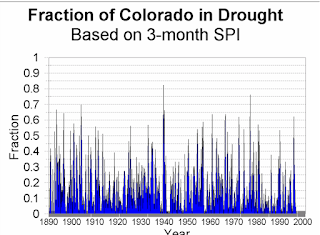


 However, there is reason to believe that things may be changing, and that the current drought may not be a situation where we can just grit our teeth and endure for a time. Some scientists are suggesting that we abandon using the word ‘drought’ altogether, because that implies that a year or two of good precipitation will put things to rights again.  Jonathan Overpeck and Brad Udall instead say that “anthropogenic climate change calls this assumption (that drought will end) into question because we now know with high confidence that continued emissions of greenhouse gases into the atmosphere guarantee continued warming and that this continued warming makes more widespread, prolonged, and severe dry spells and drought almost a sure bet.” (https://www.pnas.org/content/117/22/11856).

The reason that precipitation won’t necessarily fix things is because even if the rains come, "the hotter temperatures we are beginning to experience are a potent driver of greater aridity: hotter climate extremes; drier soil conditions; more severe drought; and the impacts of hydrologic stress on rivers, forests, agriculture, and other systems". (https://www.pnas.org/content/117/22/11856).  Warmer air holds more moisture and can basically suck more water out of soils and plants due to evaporation and evapotranspiration. So, even if climate change brings increased precipitation (which is still very unclear in the models), we will be seeing widespread aridification across the West, and even creeping eastward. Some scientists are beginning to compare the trajectory we are on to the medieval megadrought (https://www.science.org/doi/10.1126/science.aaz9600).  Edit to add that 2 days after I published this post, an article in Nature Climate Change showed that the current drought is the driest period since the 1500s! (https://www.nature.com/articles/s41558-022-01290-z)

 It does seem as though we have already hit somewhat of a tipping point with our forests. Just a decade ago, you could count on clear mountain skies for summer hikes, but now, the huge fires across the west create unhealthy air conditions and poor air quality on a yearly basis. Smoke monitoring apps are now a thing. The fire season is no longer a season, but year round – as illustrated by the unprecedented wildfire in Boulder County on December 30, 2021, shaking many. Overall, we are seeing an uptick in large wildfires and wildfire severity, which studies have tied to human-caused climate change. Sixteen of the top 20 largest wildfires on record have occurred since 2008, according to the Colorado Division of Fire Prevention and Control.  Unfortunately, there is no relief in sight – wildfires are only expected to increase in frequency and in scope (https://csfs.colostate.edu/colorados-forests-changing-climate/).

 We will also see more challenges to agriculture, as producers may experience less water for irrigation either from overtapped aquifers or overappropriated rivers with less water, and unirrigated rangeland may become less productive.

I am not intending this to be a doom and gloom post, although I know the message is grim, and one no one really wants to hear.  I am really intending it to be food for thought for gardeners.  Consider the plants you have in your yard. Are they resilient to drought? What if there are increasing water restrictions?  What if prices for water go up? If you are going to do any yard renovation this year or in the near future, you would be wise to take the long view, and plant plants that are both waterwise and heat tolerant, so your yard can stay attractive, even in a changing climate. Consider planting drought-tolerant native plants – and consider “shopping” from the palette of plants just to the south of your location – or at a slightly lower elevation. Front Range gardeners could look at these two publications: SE CO Native plants: https://extension.colostate.edu/docs/pubs/native/SESm.pdf and Western CO native plants: https://extension.colostate.edu/docs/pubs/native/WestSlopeSm.pdf.

Here are more fact sheets on native trees, shrubs, and perennials you could plant (avoid the ones that require higher water):

https://extension.colostate.edu/topic-areas/yard-garden/native-trees-for-colorado-landscapes-7-421/

https://extension.colostate.edu/topic-areas/yard-garden/native-shrubs-for-colorado-landscapes-7-422/

https://extension.colostate.edu/topic-areas/yard-garden/native-herbaceous-perennials-for-colorado-landscapes-7-242/


 And please, don’t give up altogether and replace your yard with gravel – this just leads to increasing heat and aridification!

Here are some other resources to make your garden more resilient to drought: 
https://extension.colostate.edu/disaster-web-sites/landscape-management-during-drought-and-with-limited-water-availability-in-colorado/

https://extension.colostate.edu/disaster-web-sites/woody-plant-management-during-drought-and-with-limited-water-availability-in-colorado/

https://extension.colostate.edu/topic-areas/yard-garden/xeriscaping-retrofit-your-yard-7-234/

https://extension.colostate.edu/disaster-web-sites/flower-management-during-drought-and-with-limited-water-availability-in-colorado/

 https://extension.colostate.edu/disaster-web-sites/home-vegetable-garden-management-during-a-drought-in-colorado/


Monday, August 2, 2021

Three quick steps for planning low water landscapes

 Posted by: John Stolzle, Jefferson County Extension

Note: Many vegetable gardens are in the midst of full production. If you find yourself with an abundance of excess produce, I would encourage you to look into CSU Extension’s Grow & Give program where you can learn helpful tips to grow produce and information about how you can share the harvest. More information can be found on the Grow&Give program's website: http://growandgivecolorado.org/

This blog is not going to focus on vegetables, but instead present starter tips for planning a xeric or low water landscape. Across the state, summer heat is impacting our gardens and it has resulted in many common landscape plants struggling with heat and drought. Creatively designed and carefully planned landscapes which incorporate hardy xeric, or native plants can flourish under hot and droughty conditions.


caption2
Penstemon and sagebrush, Denver Botanic Gardens. Photo by Irene Shonle
Provided in: CSU Factsheet for Low Water Native Plants - SE Colorado.
Step 1. Planning & Plant Selection

The first step is to assess your landscape and begin selecting plants and to develop a general layout and plan. You’ll want to consider the amount of sun that your landscape receives; southern and western exposures particularly near buildings or pavement (with reflected heat) will often have the greatest losses of water – to address this, consider using plants that are especially tolerant of dry conditions. In exposed locations that are particularly steep or difficult to irrigate such as terraced areas, you might consider planting a xeric groundcover which can also help to prevent erosion. Once you have selected plants for your landscape, it can be helpful to group them by water requirements.

A great list of xeric groundcover plants to help get you started can be found at this following link: https://extension.colostate.edu/docs/pubs/garden/07230.pdf

Additional resources to help start planning a xeric garden can be found towards the end of this blog post.


Heat reflected by the sides of buildings can be especially
 stressful for plants not well adapted to heat and drought.

Step 2. Soil Prep and Irrigation Planning.

Once you have a plan in place for your landscape and plants picked out, you can help ensure the successful establishment of your plants by properly amending your soil when needed. If your soil is too sandy, nutrients and water can be lost to leaching below the root zone of your plants; if the soil is thick clay, a landscape can lose water to runoff. To cultivate a soil that is just right, you can add organic matter annually to garden areas to help improve moisture retention. Additional information regarding soil amendments can be found in this following link: https://extension.colostate.edu/docs/pubs/garden/07235.pdf


Drip irrigation isn't just for vegetable gardens,
it can be very effective for other landscapes as well.
 

Native and Xeric plants can withstand very trying conditions; however, they are vulnerable and more sensitive when first becoming established. This process can take up to three years after planting, and so it is important that newly planted xeric and native plants are provided supplemental water during their initial years in a landscape. If you have an irrigation system already installed, you may wish to conduct an irrigation system self audit; if you do not have a system installed, you may be interested in setting up a drip irrigation system. Drip irrigation can be much more efficient than standard above ground sprinkler systems.

Irrigation System Self Audit: https://extension.colostate.edu/topic-areas/yard-garden/lawn-irrigation-self-audit-lisa/

Drip Irrigation: https://extension.colostate.edu/docs/pubs/garden/04702.pdf


Step 3. Just add mulch.

Mulch can greatly help to conserve soil moisture, it can reduce soil temperatures, the amount of soil exposed to wind, and help manage weeds. Wood chips and pea gravel can make a great choice for trees, shrubs, or perennials; but stone mulch should be limited to less than half and inch in diameter for weed management and water conservation. Black rolled plastic, or woven ‘weed fabric’ can interfere with the flow of oxygen and water between the soil and air and this can sometimes harm plants. These types of mulch are not recommended for many landscape situations; however, they can be effective in vegetable gardens when used very carefully. You can find a reference link with more information on using fabric mulch in vegetable gardens, below.

If you are interested in learning more about xeriscaping or hardy drought tolerant plants, I would encourage you to look through the follow links for additional information on these topics.


A view of the Jeffco Plant Select garden. Plant select is a program
run in partnership with Colorado State University and the Denver Botanic Gardens
 http://plantselect.org/plants/find-a-plant/


More information about Xeriscaping:

Retrofitting a Yard:
https://extension.colostate.edu/docs/pubs/garden/07234.pdf

Low water native plant guides for all areas of Colorado: https://cmg.extension.colostate.edu/gardening-resources/online-garden-publications/native-plants/

More detailed overview for creative xeriscaping: https://extension.colostate.edu/docs/pubs/garden/07228.pdf

Native & Xeriscaping Plant Lists:

Perennials and Annuals: https://extension.colostate.edu/docs/pubs/garden/07231.pdf

Groundcover:
https://extension.colostate.edu/docs/pubs/garden/07230.pdf

Trees & Shrubs: https://extension.colostate.edu/docs/pubs/garden/07229.pdf

Native Trees & Shrubs: https://extension.colostate.edu/docs/pubs/garden/07422.pdf

Native Herbaceous Perennials: https://extension.colostate.edu/docs/pubs/garden/07242.pdf

Mulch:

Mulches for vegetable gardens (includes information on fabric mulch): https://cmg.extension.colostate.edu/Gardennotes/715.pdf

Mulches for home grounds: https://extension.colostate.edu/docs/pubs/garden/07214.pdf

Mulching trees: https://cmg.extension.colostate.edu/Gardennotes/658.pdf

Extra:

Fall and winter watering during drought:https://planttalk.colostate.edu/topics/trees-shrubs-vines/1751-fall-winter-watering-drought/

And as always, best of luck in your gardening endeavors!


Monday, March 29, 2021

Weather can be our Friend or Foe.


Color to come, hopefully.
Last October, Colorado saw some crazy weather with cold weather come in after really warm weather.  Several days in early October were in the 80’s.  First there was a big wind event.  Then temperatures hitting below normal around Oct 13th, hitting just above freezing, followed by temperatures as cold as 11 degrees F and ended toward the end of the month with a big snow storm.  Of course the moisture was needed and appreciated, but rain would have been better.  Yearly average temperatures in mid to late October in the Grand Junction area are 67 / 41 Degrees F.

Plum Tree, pre-pruning, L. Masters
Plants, like people, do not like quick change.  Many perennial plants like trees had not had the chance to appropriately harden off, or acclimate, so they were ready for winter.  There are still trees that still have their leaves and not the normal ones like Oak trees.  This is because the trees did not have time to form the hormone that creates the abscission layer, causing leaves to drop in fall.  I predict we will see samples of tree damage from the cold for months to come.

Our fruit tree growers and the CSU Western CO Research Center in Orchard Mesa was tracking how the fruit trees were acclimating, or in this cause the lack of acclimating.  Here is what David Sterle reported in early December from the Western CO Research Center: “We are seeing between 10 and 40% dead (peach) buds after the freeze depending on variety. The bigger worry is probably the shoot tissue, and an important thing about the shoots is that from the middle of the shoot to the base there is a lot less damage. The damage in the tip 1/3 of the shoot is about 3 times as common as on the base. So from that point on I will only be looking at buds from the basal half of the shoot, where there are more live buds. We are recommending spraying Captan / Topsin / lime sulfur if possible to prevent cytospora from getting into the damage shoot tissue.”  The good news is this varied by location and peach variety and some trees did go on to acclimate as winter went on.  And of course last year we saw a late frost that impacted the number of peaches that were available.  So I predict peaches will be at a premium again this year.

Checking for life, WCRC

Many of the growers have seen twig death.  No studies have been done on the combination of the cold combined with the drought, but certainly the drought has not been helpful.  Many of the peach growers worked to prune out the dead.  Typically over 50 % of the tree is pruned to stimulate new growth for next year, so it just took some modifying to do more tip pruning to remove the obvious dead.  Pending not having any damaging spring frosts, we should still have a peach crop.  But the wine growers have not fared as well.  Many wine growers have moved to grafted Vitis vinifera varieties of grapes, native to the Mediterranean area, that are hardy against phylloxera, which is basically a root eating aphid that slowly kills the vines.  However, these grafted grape varieties are not as hard.  It is expected up to 100% of these winery hybrid grapes are gone.  And sweet cherries are a very similar story.  Several of the local sweet cherry growers had just recovered from drought damage on their fruit trees.  Drought stress can affect trees for several years.  Areas in Delta County have irrigation that is very dependent on natural precipitation levels.  Recent drought years they have seen no irrigation in late summer or fall.

drought and insect damage, S. Carter

In doing multiple orchard visits, many of the orchards have decided to wait on pruning the grapes and cherries to see if they sprout.  CSU Research specialist Horst Caspari did a session for grape growers on how to prune and what to look for the cold damage.  Many will be depending on the vines sprouting from the lower portion of the vine, or may be replanting and starting over.  Last summer the grape growers in the area had to deal with possible smoke taint from the local wildfires.  Combine that with a decrease in visits to tasting rooms, and it has been a very bad wine year.

So, appreciate your local fruit and wine producers as it has been a tough year for them beyond what the rest of us have experienced.  Colorado climate can be a challenge to grow plants in, but when we are successful nothing tastes better.

By Susan Carter, Extension Horticulture and Natural Resource Agent, Tri River Area

Monday, October 19, 2020

Fire Recovery Tips

By Susan Carter, CSU Extension Tri River Area, Horticulture and Natural Resource Agent

I live in Fruita where the Pine Gulch Fire had the title of the largest Colorado fire until the Cameron Peak Fire exceeded it.  Having to respond to the effects of fire in many ways has taught me a lot this year.  Pardon me if I go off the plant topic a little on and off in this blog, but I hope you will appreciate it.

During our fire I had many mornings where the garden covered in ash.  I learned that the ash was very high pH, coming in around 11!  Seven is neutral and in Western Colorado it is common for our alkaline soils to be a pH of 8.   So 11 is very high.  So hosing or blowing off the ash so the plants would not be harmed by a loss of photosynthesis and the ash is a good idea.  I did end up with one squash plant that suffered.  If your walkways and other hard surfaces are covered with ash, sweep them off and throw it away.  Do NOT add it to the garden.  This is especially dangerous if any structures burned as then you don’t know what might be in the ash.

During Pine Gulch fire I got a question about animals, so here is the information I got from some wonderful CSU experts.  Keep your pets and backyard chickens and other animals inside as much as possible.  Clean their water often as ash can mess up their digestive systems.  Animals don’t need to be breathing the air any more than we do.  Try to watch your local air quality and do your landscaping and gardening when the air quality is not so bad.


The drought, fire and ash got me thinking about defensible space and being ready for an emergency.  My husband is a retired firefighter EMT of 21 years and fought many wildfires.  So we have items in case of emergency in our car, etc...  Make part of your gardening and landscaping thinking and acting to prevent fires around your property.   In this time of drought, wildfires could happen ANYWHERE.  We should all be prepared. https://www.ready.gov/

So how can you be prepared in the garden and landscape?  Well, I would start by removing any dead plants.  Deadhead flowers (removing flower stalks that are no longer blooming) as often these dry out.  Plus this will put my energy back in the root system of perennials and shrubs instead of working on producing seeds.  Remove leaf litter that is close to the house or in the gutters.  It just takes one ember to land in a crook of the house where there is debris and a fire starts.  You could start a compost pile away from the house to put plant debris.  Use rock mulch or other materials like flagstone, pavers, or other non-combustible materials closest to the house.  Keep wood piles and other wood products or structures away from the house.  Ideally a zone of lower growing, high-moderate water loving plants would be closer to your house as long as it does not affect your foundation. 

To create defensible space, height should increase as you move away from the house. 


See this website for more detailed information on Defensible Space. 

https://csfs.colostate.edu/wildfire-mitigation/protect-your-home-property-forest-from-wildfire/#:~:text=Defensible%20space%20is%20the%20area,modified%20to%20reduce%20fire%20hazard.&text=Develop%20these%20zones%20around%20each,buildings%2C%20barns%20and%20other%20structures.

Did you know that there are plants that are more fire resistant?  Of course some of that depends on drought and how much moisture is in the plants.  https://extension.colostate.edu/topic-areas/natural-resources/firewise-plant-materials-6-305/ .  Choose plants that do not produce a lot of litter under them.  Aspen trees would be a good high altitude garden choice over 5000 plus feet elevation, I personally recommend even higher like 6-7000’ as aspen do not do well in the low Valley’s heat and clay soil.  

Pinyon pine with twig or bark beetle damage, picture from Tri River Area


Now let’s talk drought.  I have been getting many calls about older trees not doing well.  For those of us in town with irrigation, give your trees and landscape a really good drink before the irrigation goes off.  If you live on a large properties or up in the mountains, typically there is not a lot you can do other than depending on Mother Nature for moisture.  But could you water one or a few favorite or most important trees?  If they are mature established trees, water out twice their height or spread and give them a deep soak once a month to a depth of 12-18”.  This will keep them vigorous enough to help ward of insects like bark beetles and borers.  Some trees, like pinion pines, might need some insecticide treatments to prevent ips beetle from investing.  When there are epidemics of insects and there is prolonged drought, the trees are very susceptible to attack. https://extension.colostate.edu/topic-areas/insects/ips-beetles-5-558/

For trees with lower dead limbs, removing them can decrease fire ladder potential and helps the tree to heal.  Prune evergreens when dormant to prevent attracting insects like bark beetles and borers.  Make sure you use proper pruning techniques and cut outside the bark ridge and bark collar.  For bigger limbs use the three cut method to prevent the limb from breaking and causing trunk damage. https://static.colostate.edu/client-files/csfs/pdfs/613.pdf Turn these limbs into chips or stack in a wood pile, again away from your structures.  If the plants are diseased or insect infested follow appropriate protocol for that particular issue to dispose of or prevent any spread of issues.

I hate to say it but I am hoping for an earlier winter with lots of moisture to help with the fires and the drought.  We can only do, what we can do the rest is up to Mother Nature.

Monday, November 18, 2019

Drought hits most of Colorado Again, pray for snow!


By Susan Carter
Here we go again.  Many of you remember the drought of 2017-2018, second worst on record.  Some parts of our state where there is no irrigation did not even bother planting crops; some areas were on water restrictions and then came the snow the winter of 2018-2019.  That was a godsend.  If we would have had two years in a row of severe drought, we would have been hurting for water resources.  With the winter snow and the wet spring, sources of irrigation and domestic water filled up beyond what was expected.  For a brief period, the entire state had no, zero, nada drought.  Then the drought started creeping up from the southwest corner again.  Now ONLY the north to northeast corner of Colorado is not in drought.  Note the Water year starts in October.
So what does this mean for your garden and perennial plants including trees?  Drought stress is not something that just goes away because you watered once or because for a brief period, the state was not in drought.  Water is one of the key ingredients in photosynthesis and other plant processes that help the plant create carbohydrates and move water and nutrients throughout the plant.  When plants cannot adequately produce food, they use up their reserves.  Each plant, like people, is different due to the environment and the type of tree as well as its specific genetic makeup.  So some plants will bounce right back, where others will stumble along for a few years before they give up because they have exhausted their resources.  In addition, stressed trees attract insects that can also exhausts the tree’s resources as they cannot fight off the insects or recover from the damage done.
Old Pinon Pine with IPS Beetles- Incorrect water stress
Photo By Tom Ziola
Leaf Scorch- drought can be a cause
Photo by Susan Carter

So how do we deal with drought that seems to come more often?  Well we can properly water, winter water, direct downspouts etc… to keep what we have alive.  Then we can start by replacing plants that have died with more drought resistant plants.  Remember, if you have a tree in a lawn and you remove the lawn and install rock what have you just done?  The root system of that tree is totally under the lawn.  A tree’s root system is at least twice its width or 2-5 times the height.  Ninety percent of the roots are in the top 12-18" of soil.  That area needs water. https://extension.colostate.edu/topic-areas/yard-garden/healthy-roots-and-healthy-trees-2-926/
Watering photo from CSFS
Trees are like people in that they do NOT like change.  To change a watering zone from frequent watering of turf to watering the tree root zone, you have decrease the frequency slowly.  You have to wean it off the watering to the appropriate 10, 20 or 30 day of watering interval for the type of tree and environment. (Watering Mature Trees) https://cmg.extension.colostate.edu/Gardennotes/657.pdf  I could go on with more ways to save water, but I think that is a blog for another day, the point is think about drought affects, where you water and why you water and come up with a long term plan. 


Snow around Plum trees
Photo by Susan Carter

In addition, we can hope for more snow!  If the ground is dry and frozen when the snow arrives, it does not hydrate the parched soil.  If the soil is dry, but not frozen water so there is moisture in the soil (but not saturated) so if it thaws again there is water available to the roots.  Plants need to go into the winter with moisture available to them as they continue to respire and give off moisture even if they have dropped their leaves.  Of course evergreen plants like pine and spruce trees, evaporate due to having leaves all winter.  A dusting of snow is not very helpful either.  It can just evaporate.  Snow at least 6” deep can insulate the ground and provide enough moisture when it melts to help.  Then there are the reservoirs that need to fill so we have irrigation and domestic water.  So let it SNOW!

Susan Carter is the CSU Extension Horticulture and Natural Resource Agent for the Tri River Area.

Tuesday, May 22, 2018

Gardening for Drought Conditions

Here in Western Colorado we only got ½ of our average moisture last year and we are not doing any better this year.  Although the North and East portion of the state has gotten more moisture, since waters from Western Colorado are piped over the divide to Eastern Colorado, we all win if we can use our water sparingly.

http://droughtmonitor.unl.edu/


Drought Intensities

·               None: No Drought
·               D0: Abnormally Dry
·               D1: Moderate Drought
·               D2: Severe Drought
·               D3: Extreme Drought
·               D4: Exceptional Drought


Concerns with drought are saving trees since they are much more permanent and provide so many benefits from shade to reduction of crime and about 100 more reasons to have trees.  Water for the trees.   https://digitalcommons.usu.edu/cgi/viewcontent.cgi?referer=&httpsredir=1&article=1013&context=cwel_extension

 Often we see people retrofit their landscape to xeriscape (dry scape or low water landscapes)but they forget about the needs of the trees   http://extension.colostate.edu/topic-areas/yard-garden/xeriscaping-retrofit-your-yard-7-234/

Xeriscape does NOT have to mean cactus and succulents, but we love ours at the TRA Mesa County Extension Office, Photo by Susan L. Carter

And certainly there are certain situations where we need grass like ballfields areas for pets etc…  But we can minimize the amount of lawn and water features that are not necessary.
If starting a new landscape, use the principals of xeriscape. http://planttalk.colostate.edu/topics/water-wise-xeriscape/1901-xeriscape-basics/

Note I did not say ZERO scape, there is no such thing and rockscapes are very hot and increase cooling needs of your home and business thus using more water. Use plants that require less water like native plants suited to your elevation and area are great choices.  http://planttalk.colostate.edu/topics/trees-shrubs-vines/1710-native-plants/
Studying Plants on the Grand Mesa, Photo By Susan L. Carter
And consider that sometimes we have areas that are naturally wetter such as drainages or seeps, so install plants that like more moisture in those situations.  We call that Right Plant, Right Place. 
Here is a recent video I did for our area on ideas to save water. Water Landscape Drought Go to the Pro Tip:  https://youtu.be/GK8M4vZC9a0

And some quick bullet points of what is in the video as well as additional tips.
  •  Turn off your sprinklers before there is runoff.  Runoff lets us know the soil is a “field Capacity”, can hold no more water, and may deprive the roots of oxygen thus suffocating your plants.
  • Make sure you are not irrigating hardscapes such as patios, driveways and sidewalks.
  • Use a long skinny screwdriver or soil moisture to check moisture at 6” or deeper depth to determine if you need to water.
  • Water at night.  And don’t set it and forget it; I’m talking about your irrigation clock.  Watering needs peak in July.  Then start to reduce irrigation to slow plants down for fall.  They will acclimate better to winter and be healthier.
  • Never water everyday unless you just installed seed or sod.  Then water daily for the first month and start switching to less frequent deeper soaks to get roots deeper.  If you have to water daily to keep plants alive then something else is wrong like improper irrigation system setup or soil issues.  See our LISA, Landscape Irrigation Self Audit Website, and ask your local Agent if they have a kit you can check out.  http://extension.colostate.edu/topic-areas/yard-garden/lawn-irrigation-self-audit-lisa/
  • Turf will get a blue tinge or footprints will stay in the lawn when it needs water.
  • Group plants with similar watering needs together.  This is called Hydrozoning.
  • Watering During Drought Factsheet:


You can create beautiful landscapes using low water plants it your choices are much larger than just cactus, although they can be beautiful too. 

Yellowhorn Tree and other Xeric Plants at Mesa County CSUE TRA office
And remember when first planting, even a cactus needs water to get established.  So be a savvy water-er and check your plants and soil before you water and we will all benefit.  Enjoy where we live, it’s a drier state. 


By Susan Carter, Horticulture Agent, CSUE Tri River Area.

Friday, December 29, 2017

Lawn Winterkill: Lessons from 2016-'17

Tony Koski' Extension Turf Specialist


It’s been a dry fall and early winter throughout most of Colorado – in spite of the recent snow (that’s rapidly disappearing as I write this today). Little precipitation, combined with windy, sunny, and warm days, is a pretty good recipe for some winter turf injury (aka “winterkill”). Throw in some alternating extreme cold with the warm days and things get potentially worse for turf, trees, and shrubs in our landscapes. But not all “winterkill” is the same when it comes to turf. Here are some examples from the spring of 2017 (these were all in April/May) to illustrate that point.

Winter injury from drought – enhanced by VERY thick thatch in this bluegrass lawn. Note that the green turf is where water was supplied by a gutter downspout, runoff from the driveway (plus the concrete acts as a “mulch” for turf growing alongside it), and runoff from the neighbor’s gravel-covered plastic.


This lawn had been sodded in early 2016 and was perfectly green and healthy going into the winter of
Dead area is where home construction had been "staged",
resulting in extreme soil compaction before sodding.
2016. It had been handwatered religiously throughout 2016, was mowed the correct height, and was otherwise perfectly cared for. The problem was the soil under the sod. The dead area was where home construction was “staged”: lumber, roofing, tile, other building supplies were dropped off – along with concentrated, heavy, constant traffic. The soil was not tilled sufficiently prior to sodding, so almost no rooting occurred following sodding. The constant handwatering in 2016 kept it alive and looking perfect, but the lack of rooting during the winter resulted in winter desiccation and sod death in spring 2017.
Sod had not rooted into the compacted soil, which
lead to winter kill in spring 2017.

Winter mite injury
This lawn suffered from turfgrass mite feeding in the late winter and early spring. Mite feeding and reproduction is favored by dry conditions. Drought-stressed turf is often killed by mite feeding in the spring if numbers are high enough and no snowcover or spring rains occur – and if winter watering isn’t performed at least a few times during the winter.

The common thread here? Water! Turf, trees, shrubs, and other landscape plants may not be growing and thus USING much water during the winter. But when it’s dry, windy, sunny, and humidity is low, our landscape plants are LOSING water. When we don’t receive enough snow to provide periods of snow cover during the winter, and plants aren’t mulched (like turf!), are young and not fully established, or have poorly developed root systems, winter watering can be essential for preventing winter injury or death.

When weather allows (above freezing for a day or two), run a hose and sprinkler out to the drier parts of your landscape (especially south- and west-facing parts of your landscape), to new sod, trees, and shrubs, and to areas where you have experienced winter injury in the past (perhaps from turf mites). Apply enough water to moisten the crowns of the turf plants and to get some water into the root zone of new trees and shrubs. The goal isn’t deep watering, but rather to prevent desiccation of crowns and young root systems.

Monday, March 20, 2017

Drought has Sprung


 By Irene Shonle, CSU Extension Gilpin County

Happy Spring!

While today (March 20) is the first official day of spring, it has felt spring-like in Colorado for weeks now.  We have had record-breaking high temperatures in February (DIA reached 80 on Feb 10), and stunningly high temperatures through much of March.  Crazy to see sunbathers, people in shorts and tank-tops, and even one hardy soul swimming! 

And the warm temperatures were widespread- it was the second-warmest February on record (2016 was the hottest). (https://climate.nasa.gov/news/2564/february-2017-was-second-warmest-february-on-record/).


We have missed our usual snows so far in March (usually the snowiest month on the Front Range), and the winds and warm temperatures have quickly sent the eastern half of the State into at least moderate drought conditions, with some portions of Larimer, Boulder, Weld, Denver, Jefferson, Adams, and Lincoln Counties in severe drought. A portion of Baca County even just entered the extreme drought category! (http://droughtmonitor.unl.edu/Home/StateDroughtMonitor.aspx?CO). 

Drought monitor for Colorado, March 14, 2017.  Yellow= abnormally dry, beige= D1 (moderate) drought, orange = D2 (severe) drought, orange-red = D3 (extreme) drought.
How can this be, when we had some epic snows in the high country, and, in fact, still have above-average precipitation (116% statewide, 108% in the South Platte River Basin up to 130% in the Gunnison River Basin)? (https://www.wcc.nrcs.usda.gov/ftpref/data/water/wcs/gis/maps/co_swepctnormal_update.pdf)


This is because drought conditions are based on the water content in the soils, and that (except for irrigated land), comes only from precipitation.  The snowpack in the high country will melt, and the spring runoff will help to fill the rivers and the reservoirs, which is great news for water managers and farmers (and probably gardeners as well, since water supply forecasts currently indicate no water supply shortages for the growing season), but it won’t do much for the forests, rangelands, and unirrigated areas. 

We have already seen the effects of the droughts in these areas by the number of wildfires we have had already.  As I write, they are just lifting evacuations from the Sunshine Fire in Boulder, and there have been numerous, impactful wildfires in Colorado already this year (Sterling, South Table Mountain, Weld County, Idaho Springs, one in SE Fort Collins, just to name some. In 2017. And we haven't even reached the end of the first quarter.)

Sunshine Fire -- image from Jackson Barnett/CU Independent)
 In the past, we had a fire season in Colorado. With temperatures on the rise globally, we now have fire season year round.  At least it looks like there’s a little precipitation forecast for the next week.