CO-Horts

CO-Horts Blog

Friday, August 30, 2024

Fall Harvest Tips

The time of summer/fall harvest glut is upon us! 

I live and garden at high elevation, so my days and nights are cooler than some other west slope communities and the front range.  So, some of the crops I discuss in this blog, you may have already harvested in your area, or they may have gone to seed in the heat.

Various greens freshly harvested in July

In my garden as well as most gardens in the state, greens are one of the first crops ready to harvest.  You can harvest different ways:  a few leaves at a time, starting with the bottom leaves that mature first or you can cut all the leaves off at the crown or you can pull up the entire plant.  

                        This spinach was just cut.  The crowns are left so the plants will re-grow.  This is often called 'cut and come again.

Notice where the bottom leaves of this kale have been cut for harvest.

Carrots and other root crops like parsnips, beets, radishes and rutabagas are all harvested similarly.  I like to water the day before I plan to harvest so the soil isn't rock hard.  If the soil is too wet, it will be more difficult to remove soil that sticks to the roots.  Grab the carrot top firmly in your hand right above the root top, wiggle and pull up slowly.  Remove the carrots tops soon after harvest, to keep them from losing water and becoming soft.


When you see the carrot top sticking out of the ground, your carrot is close to being ready to pull!


                                            If you leave your carrots in the ground too long,                                                  especially if it has been raining a lot, your carrot roots may split!


When onions are ready to harvest, the tops will usually fall over.


Cure onions by letting the tops dry down in a well-ventilated, cool, shady place.

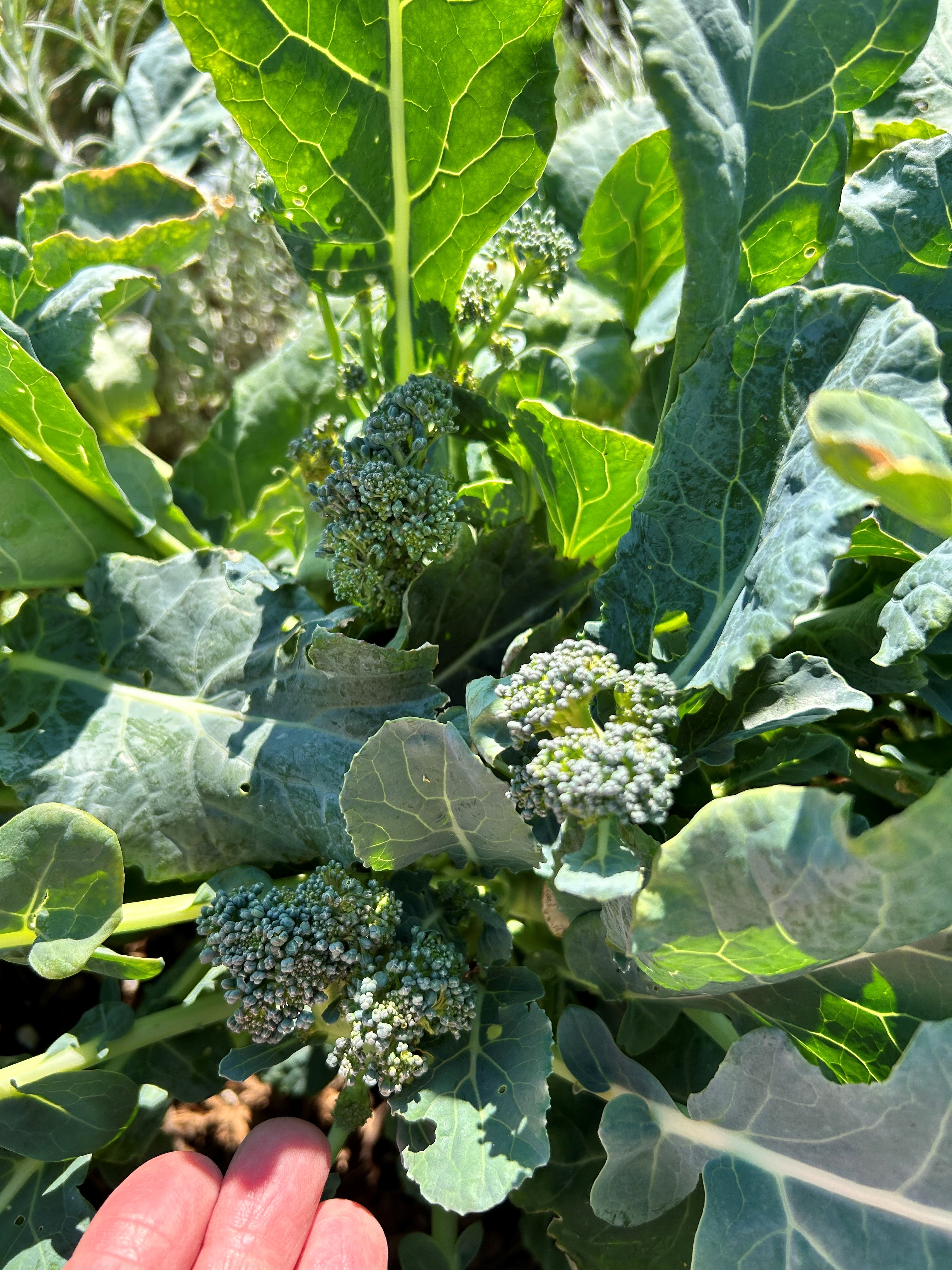
I prefer to grow broccoli varieties that produce side shoots after you harvest the main head.  This increases both your yield and extends the season of your broccoli harvest. 


Harvest broccoli heads when they are tight, firm and green.


Harvest broccoli side shoots when they are still tight buds.


  These broccoli side shoots are elongating, will get woody and go to flower quickly.


In many produce shows, the largest veggie contest is won by a zucchini!  If you've grown zucchini, you know how fast they grow!  Cucumbers, like summer squash, can outgrow their optimum eating stage very quickly.  For best eating quality, harvest when the skin is tender and the seeds are still small.


Starting at the bottom, going clockwise:
The bottom zucchini is almost past prime stage to harvest, the second zucchini could be harvested but it is baby stage, the third zucchini is prime stage to harvest, and the last zucchini is still immature.


    This pickling variety of cucumber is almost at the stage for a large pickle.  If you want small pickles, harvest when the top is barely wider than the tip.

Some pumpkins and winter squash can be harvested immature and eaten like summer squash.  And others will undergo a color change in storage.  It is best to harvest them when they are the color they are supposed to be, the rind is hard and can barely be pierced with a fingernail.


This pumpkin is immature- it is still green.


This pumpkin is beginning to color-up but will not continue to turn orange if harvested at this stage.


These pumpkins and winter squash are all their mature color-- except the spaghetti squash on the lower left-- it is still green. 


Harvest potatoes right after bloom for small, tender 'new' potatoes.  Harvest after the tops die down for potatoes with a tougher skin that will store better. 


These potatoes are starting to die down. 


For more on harvest and storage of vegetables see this Fact Sheet:  Storage of Home-Grown Vegetables – 7.601 - Extension (colostate.edu)


Monday, July 1, 2024

Coming Soon: County Fairs

 Posted by Linda Langelo, Golden Plains Horticulture Specialist

The county fair has something for everyone. Exhibiting is only part of it. Come out and see 4-H. The 4-H members work hard throughout the year and come to the fair to be judged on showmanship competition with their animals.

Open Class Horticulture Entries. Yuma County Fair 2023.

Fairs are about community. As a community member, if you have a craft or hobby such as quilting or photography, exhibit and show people what you do. Just follow the instructions in the fair book and you will be off to a good start! The rules are clearly written. For exhibiting for Open Class there are general rules to follow. If you are exhibiting in horticulture to show off your flowers, the rule might be to use a certain vase. Other rules might be asking you to bring a clean container and one that is weed-free. Be sure to bring the freshest flowers that are pest and disease-free.

"Flowers for Mom" class at the Yuma County Fair. 

Bring your vegetables and exhibit them. Different fairs have different types of exhibits. There is one where the longest zucchini wins! Another is the heaviest zucchini wins! Enjoy the food vendors! Bring your family and bring your friends. Some fairs have rides, and some fairs have concerts. Make it a fun time!

Most fairs have individual plant categories you can enter. 

Come out to the fair and enter.  Give it a try. Nothing ventured, nothing gained! Happy fair time!

Monday, June 24, 2024

The awful, awesome sound of mandibles

 posted by: John Murgel, Douglas County Extension

National Pollinator Week officially ended yesterday, June 23—and I celebrated by stumbling across the largest caterpillar of the season so far!  In the quiet of a Sunday afternoon in the dappled shade of the trees near the house, I settled in to read a book. 

The usual sound of bumblebees ponderously pollinating nearby was punctuated by a rhythmic clicking.  Putnam’s cicadas?  No…not quite right for that.  Looking around, I was suddenly struck by the absence of one of my prized fuchsias, and shortly thereafter by the cause of the absence.

My consternation was tempered by astonishment.  A four-inch-long hornworm perched on what remained of the fuchsia, vacuuming down leaves with steady dedication.  The clicking? The sound of my fuchsia’s demise as the giant (relatively speaking) mandibles did their work.

A green caterpillar on a plant.


The ornate culprit was a fully grown larval Hyles lineata, or white-lined sphinx, one of the “hummingbird moths” that are common in Colorado gardens.  They have a wide host range, including purslane (Portulaca), evening primrose (Oenothera), grapes, apples, and others along with my poor fuchsia (proving that, at least sometimes, plants need not be “native” to host the caterpillars of native moths and butterflies).    

The white-lined sphinx has two generations per year, and probably colonizes Colorado each summer from warmer winter climes.  This caterpillar (murderous fiend!  My fuchsia!) will pupate underground, spending two or three subterranean weeks before emerging as an adult.  Hopefully it will have the decency to pollinate something in the yard before starting the cycle over again.

Green caterpillar


Hornworms are among the most common caterpillars in the United States, and most species develop in trees and shrubs, where their damage isn’t noticed.  Only the tomato- and tobacco hornworms are typically considered “pests,” though with the expansion of the European Paper Wasp in urban and suburban Colorado, even these are rarely problematic for Front Range gardeners.

I watched the caterpillar, and of course called the kids outside to see it.  Because I deliberately garden for invertebrates (especially the cute ones) I was, in reality, happy about the caterpillar, even if annoyed by the disappearance of the fuchsia (was there not enough purslane?!).  The interaction highlights one of the trade-offs of “pollinator gardening,” that is, some of the plants are going to be eaten.  Deliberately choosing to accept this damage as the expense for having desirable insects around comes with the territory.  Had the caterpillar been less mature, I might have moved it to a different host plant.  As it was, after polishing off the fuchsia, it lumbered off, likely to find somewhere to dig its pupation chamber—and I was off to the garden center.


Wednesday, May 15, 2024

Western Slope Wildflowers (And a Shrub)

By Mollie Freilicher, Residential Horticulture Specialist, Tri-River Area

The march of native, spring wildflowers continues in the Grand Valley. While not quite the same show we had after last year’s wet winter, we’re still seeing a lot of our favorites, including many that are also at home in our gardens and planted landscapes. 

Here are a few recent finds:

Colorado paper flower (Psilostrophe bakeri). Colorado paper flower is found in western Colorado as well as in Idaho. Its bright yellow flowers, salt tolerance, and ability to thrive in irrigated and non-irrigated conditions makes this member of the Asteraceae family a nice choice for waterwise gardens.

Colorado paper flower (Psilostrophe bakeri)
flowering in Mesa County in May.

Jones’ bluestar (Amsonia jonesii). This member of the Apocynaceae or dogbane family is one of my all-time favorites and I almost missed seeing it flower this year. It is prolific at one site in Grand Junction. Luckily, this past weekend, I was able to catch the very tail-end of its flowering. 

Jones’ bluestar has whitish-blue flowers that are reminiscent of little stars. And the smell! It is definitely worth getting down to give these beauties a sniff. They have a sweet smell, a little like a lilac. This perennial is a Plant Select and is available at nurseries.  Once established Jones’ bluestar does not need any supplemental water.

Jones' bluestar (Amsonia jonesii) in Mesa County in May 2024. 


Jones' bluestar (Amsonia jonesii) in Mesa County in April 2022.

Fremont’s barberry/ Fremont mahonia (Berberis fremontii). This member of the barberry family (Berberidaceae) is at home on pinyon juniper slopes, as well as in our gardens. This evergreen shrub has blue-green prickly leaves throughout the year and abundant yellow flowers in spring that attract a number of different pollinators. 

At the CSU Extension office in Grand Junction, there is a Fremont’s barberry in the cactus garden that has been trained to a single stem (and others in the Ute Learning Garden) that are more shrubby. This is another native with a sweet, almost honey-scented flower.


Fremont's barberry (Berberis fremontii) flowering in
April. This is the single-stem specimen in the cactus garden.


Fremont's barberry (Berberis fremontii) in flower.

Golden sulphur flower (Eriogonum umbellatum var. aureum). So far this year, I have only seen this member of the buckwheat family (Polygonaceae) flowering in front of the CSU Extension office in Grand Junction. There, we have planted Kannah Creek® buckwheat and it is flowering prolifically right now. The flowers are in umbellate inflorescences and attract a ton of pollinators, including lots of flies. The flowers have a distinct odor, though it isn’t one I linger on, like I do with the bluestar or the Fremont’s barberry. The flowers turn more orangey as they mature, adding some additional color to the landscape. In the fall, the leaves turn reddish-purple, providing some great color over the winter. This is a Plant Select plant that was originally collected around the Grand Mesa.

Kannah Creek® Buckwheat flowering in April.


Kannah Creek® Buckwheat and a honey bee.

Seek out these plants as you make your way around the Western Slope or around nurseries and native seed catalogs. 

Sources:

Ackerfield, J. 2022. Flora of Colorado, 2nd Ed. BRIT: Fort Worth, TX.

Cox, R.W., and J.E. Klett. 1984. Evaluation of Some Indigenous Western Plants for Xeric Landscapes. HortScience 19(6):856-858.

Plant Select, https://plantselect.org/


Thursday, April 18, 2024

Some More Unusual Shrubs to Consider for Colorado

Some More Unusual Shrubs to Consider for Colorado

James E. Klett

Professor Emeritus

The following five shrubs have proven to be tough and reliable options for Colorado Front Range. We have observed their performance over a number of years at the Heritage Arboretum on the Colorado State University Campus. They have shown year after year to be adaptable and very dependable. Most have multiple seasons of interest and ornamental features.


1.       Berberis x ‘Tara’ - Emerald Carousel® Barberry

·         This shrub is a hybrid between B.thunbergia and B.Koreana with deep green summer foliage with persisting red to purplish fall foliage color. It has a rounded growth habit with more arching branches and grows to about 4-5 feet in height and width. It is cold hardy to zone 4 to 6.

·         Sun, xeric

·         Tips and tricks – it has more showy yellow flowers in spring followed by red fruit which can persist after leaf drop. Plant very adaptable to most soil conditions.  


2.       Cornus mas – Cornliancherry Dogwood

·         This dogwood can be grown as a larger shrub or smaller tree maturing to about 15-15 feet in height and width. The yellow flowers before the leaves in March are often the first sign of spring which is followed by red fruit in August that is often sparsely produced due to late spring frost. Hardy to zone 4.

·         Sun, xeric

·         Tips and tricks – the darker green foliage is attractive during the summer with prominent venation and prefers a well-drained soil but is quite pH adaptable.


3.       Foresteria neomexicana - New Mexico Privet

·         This privet is a native Colorado Shrub that can be pruned to a small multi-stem tree by pruning out lower twigs to display light tan to off white bark. It has small yellowish flowers before the leaves in April followed by blue-black fruit on female plants. It can grow 15-18 feet in height and width. Hardy to zone 4 to 7.

·         Sun, xeric

·         Tips and tricks – this is a very drought tolerant shrub and adapts well to well-drained alkaline soil.


4.       Kolkwitzia amabilis (syn. linnaea amabilis) - Beauty Bush

·         Beauty bush is given that name due to the mid-late spring flowers with yellow throats that cover the entire plant for several weeks in late spring. It has a very dense upright arching due to vase shape to fountain like growth habit. The fruit which is a brown universal shaped capsule like fruit that persists into the winter. It is cold hardy to zone 4 to 8.

·         Sun, xeric

·         Tips and tricks – the plant has exfoliating light greyish brown bark that shreds on older stems and is quite disease and pest free. Leaves turn reddish in the fall.


5.       Viburnum burejaeticum ‘P017S’ - Mini Man™ Dwarf Manchurium Viburnum

·       This is a very useful more dwarf shrub that matures to about 4 to 6 feet in height and width with darker green foliage that turns burgundy in the fall. It has white flowers in May that develop into persistent red to black fruit in fall into winter. Hardy zone 4 to 9.

·        Sun, xeric

·    Tips and tricks – Mini Man has good drought tolerance and is a great bird and bee shrub.             


Wednesday, March 13, 2024

Growing Asparagus in the Home Garden

 Written by: Ruth Sens, Weld County Master Gardener

Delicious, fresh asparagus (photo from canva.com)

The best time to plant asparagus was three years ago, the second best time is now. If you love fresh asparagus and want to try growing it in your home garden, the time is now to get started.

While it can be grown from seed, Asparagus is easiest started from bareroot crowns or crowns already growing in pots. You can buy bareroot crowns at your local garden center now. Choose bareroot crowns that have 8-10 large roots and a one or two healthy looking bud clusters.  Already potted crowns become available later in the growing season. Jersey Giant, Jersey Knight, Purple Passion, Millennium and the Washington series are varieties recommended for our area.

Bareroot asparagus crowns (photo from canva.com)

Asparagus can produce for 10-15 years so selecting the right place for the bed is important. Choose a sunny (8 hours/day minimum) spot in your garden with well-drained soil where the plants will be able to grow undisturbed. Before planting, soak the crowns in warm water for 2-4 hours. Thoroughly work in four inches of well-composted organic material to a depth of twelve inches before planting. This extra effort will pay off in larger yields.

Now dig a trench that is 6 inches deep and place the asparagus crowns 12-18 inches apart in the trench by carefully spreading the roots out with the bud cluster facing up. Carefully backfill the trench so the asparagus crowns are covered over with just 1-2 inches of soil at this point. When the crowns start growing, slowly cover the shoots with 1-2 inches soil each week until the trench is filled back up and level with the rest of the garden.

Do not harvest any spears for at least the first two years to allow the crowns and roots to develop fully. Some sources suggest waiting three years. At two or three years, you can harvest asparagus spears for 4-6 weeks in early May to mid-June.

Asparagus emerging in spring (photo from canva.com)

Only harvest spears that are larger than a pencil. Do not over-harvest. Break off the spears or carefully cut with a knife below the soil level being careful to not cut other spears coming up. Then let the ferns grow until fall and stand through winter. Trim back in spring before new spears start appearing.

During the first two years, water 1-2 inches per week. Asparagus is a heavy feeder and benefits from fertilizer (10-16-8) in spring as the growth starts and again mid-summer after the harvest. Mulching around the plants with 2-3 inches of organic material will keep the soil moist, stop weed growth, and protect the plants in winter.  For more information and tips for asparagus planting, visit the CSU Extension Grow & Give website. Want to watch a video on planting? Check it out here.

Now the waiting begins but it will be worth it!

Wednesday, February 21, 2024

A Philospher's Guide to Composting Condoms

Posted by: Derek Lowstuter, Mountain Region Extension

Can a likely made-up story about a famous Greek philosopher help us decide if something should be added to our compost pile?  The answer, much like the question, may surprise you. In a viral story about the Stoic philosopher, Socrates is credited with creating three questions we should ask ourselves before speaking. These “Three Filters” are: Is it True? Is it Good? Is it Necessary?  


These questions can help us understand the potential impact of what we say - before we say it. While this is especially important in an election year, the idea can also help us decide if we should add something to our compost pile. Just because something can be said doesn’t mean that it should be said. Likewise, just because something can be composted doesn’t mean that it should be composted. We can ask ourselves the three questions to help us make those decisions:

Is it True? / Does it decompose?

Is it Good? / Does it improve the compost? And,

Is it Necessary? / Does it need to be composted?

The title of this post wasn’t just to get your attention. I have been asked if all kinds of things can be composted: kitty litter, dryer lint, pet hair, cotton undies, and yes – even latex condoms. Many types of waste are biodegradable and can decompose naturally. However, that alone doesn’t make them good additions to the compost pile.


Let's look at dryer lint as an example of how we can apply the three questions.

Is it True? / Does it decompose? Dryer lint may decompose, depending on the clothes it comes from. Yes, clothes made from natural fibers, such as 100% cotton and wool, produce dryer lint that will decompose in home compost. However, synthetic (plastic) fibers, like polyester or nylon, produce lint full of microplastic pollution that does not decompose.

Is it Good? / Does it improve the compost?  Yes, dryer lint from natural fibers breaks down into organic matter and releases small amounts of plant-available nutrients. However, microplastics in lint from synthetic fibers can fill soil pores and even make their way into the food we grow.    

Is it Necessary? / Does it need to be composted? No, because there are usually other easy ways to dispose of dryer lint. If composting isn’t needed for disposal, then we shouldn’t compost it. Many clothes are made with natural and synthetic fiber blends, which can make it difficult to tell what is in dryer lint. Lint failed the three filters and should not be composted.   


Here are some other examples that could be composted – but should they?

Condoms made with natural latex can be biodegradable but are classified as medical waste, don’t benefit compost when added, and can be easily thrown in the trash. Practice safe compost. 

Wood ash has been used as a mineral fertilizer for thousands of years; however, it can harm compost and soil if overapplied – especially in Colorado’s alkaline soils. 

Animal waste from meat-eaters does decompose but can spread disease and complicate compost management. 

Cooked food waste decomposes quickly, but can attract pests, and promote anaerobic (stinky) compost conditions. 

Diseased plants (ex. tomato blight, powdery mildew) can be composted in active compost that is regularly turned and allowed to go through recommended heating cycles and curing. If you are lazy when it comes to turning your compost *sheepishly raises own hand* it would be safer to take infected plants to a commercial compost facility or create a separate static compost pile that isn’t used on annual crops. Nutrients and beneficial microbes in finished compost have been shown to help plants defend against pests and diseases, but care should be taken when potentially spreading diseases in compost.


To Compost or Not to Compost...

Composting is a simple, powerful tool for turning waste into value for our gardens. When well-managed, compost has been shown to improve soil and plant health, and even increase the nutritional value of produce. The “Three Filters” can help us boost compost benefits and reduce potential issues. 

Remember to ask yourself, 
Is it True? 
Is it Good? 
Is it Necessary?
                                       Happy Composting