CO-Horts

CO-Horts Blog

Showing posts with label aphids. Show all posts

Monday, March 6, 2023

Oleander aphids

By Irene Shonle, Horticulture Specialist, El Paso County Extension


Milkweeds are becoming a popular plant to add to the garden.  The main drivers are that they are native and a host of the increasingly endangered monarch butterfly. However, they also attract a host of other pollinators (and even other milkweed specialists such as the milkweed beetle), and can add beautiful flowers and fragrance to the garden. 

It is important to plant locally native milkweeds, such as Asclepias speciosa, A. tuberosa, and A. incarnata.  There are also 16 other species of Asclepias in Colorado that are very cool, but harder to find, such as Asclepias asperula, A. cryptoceras, A. subverticillata, A. latifolia and more.  If you can find seeds, some of these would be choice in the garden.  I’m particularly fond of the antelope horn milkweed, A. Asperula.


Asclepias asperula, Antelope horn milkweed

Because milkweeds contain both a milky sap (giving them their name) and cardiac glycosides (or cardenolides), most insects that have not evolved to eat them are unable to process the toxins.  Those that do, often sequester the toxins as a protective mechanism, and wear bright warning colors (aposematic coloration) to warn predators.  This is why you often don’t see a lot of insect damage to milkweeds and if you do, it may be something you invited!

However, one insect that has recently come to the party that is an unwanted guest. These are the bright orange aphids with black legs, antennae and cornicles that you often see in clusters on the milkweeds. These are non-native aphids called Oleander aphids. They came in on introduced Oleanders, and the chemistry is similar enough in the plants to allow them to jump from one plant to another.

Oleander aphid, (photo from U. of Wisconsin)


We mostly see aphid populations controlled by birds, ladybugs, parasitic wasps, Syrphid fly larvae, and other predatory insects, but because the Oleander aphids also sequesters the cardenolides, they are often (but not always) avoided by these predators, unlike most other aphids. Oleander aphids are parthenogenic (meaning that there are only females, and they give birth without needing to mate), so populations can rise exponentially.  Really extensive populations are hard on the milkweed because they suck out so much phloem, and coat the plants with honeydew. I have seen some Asclepias asperula fail to flower or set fruit, and sometime even just wither away due to the pressure of the aphids.  Some of the more robust species, such as A. speciosa, probably can withstand higher aphid populations.

If you are seeing large populations and are concerned for your milkweed, don’t get out an insecticide, because that will also impact other insects.  Instead, you can do a couple of things. Improve the health of the milkweed by giving it adequate water, but don’t fertilize it.  You can also wash off the aphids with a stream of water (ensuring there are no desirable insects like monarch caterpillars), or even squish the masses.  You could also use an insecticidal soap on the aphids, but be very careful to check for desirable insects. You’ll probably have to do this a few times during the growing season, but if you can get them early, you might have a chance at winning.


Wednesday, June 29, 2022

Host an Aphid Watch Party This Summer and Look for Biodiversity

Posted by: Lisa Mason, Arapahoe County Extension

Yes, you read that right! Get excited about watching aphids on your plants this summer just as you get excited about your favorite TV show or a new moving coming out! You’re probably asking, “Why would I watch aphids on my plants? Aren’t they a nuisance pest?”

The definition of a nuisance pest depends on who is asking. For instance, if you are a hungry lady beetle, aphids are a feast waiting to be had!

Except for a few species, most aphids cause very little plant damage. Aphids are host-specific meaning that each of Colorado’s 350 aphid species will only feed on certain plants.

Aphids are also one of the insects that excrete honeydew, which is a sweet, sticky substance that coats the plants and anything underneath the plant. 

So, why would you watch aphids on your plants? Aphids attract a wide variety of beneficial insects to our gardens. An aphid infestation can be a hotspot to observe biodiversity in your garden or landscape. For instance, while I was writing this article, I found aphids in my backyard on a sand cherry! So far, I’ve seen lacewing eggs, lady beetle pupa, a katydid nymph, syrphid fly smears, and other insects feeding on the honeydew.
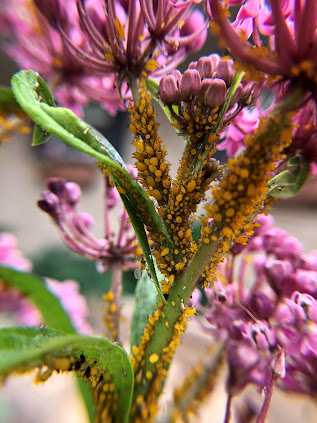
Aphids (Aphis nerii) on a milkweed plant. Photo: Lisa Mason

Here are some fun observations you may witness while you are watching aphids:

Predators Hunting Aphids

Lady beetles (Family: Coccinellidae), also known as lady bugs, are a common insect you’ll find preying on aphids and other soft-bodied arthropods. We have approximately 80 different lady beetle species in Colorado. Lady beetle larvae have a completely different appearance than the adult beetles because they complete a full metamorphosis (egg, larva, pupa, and adult). The larvae look similar to little dragons or alligators, and they are ferocious predators! Their goal is to eat as much as possible! Convergent lady beetle larvae can devour up to 50 aphids a day, often consuming their weight in aphids (Hoffman and Frodsham, 1993). Other species such as the seven-spotted lady beetle may feed on higher numbers of aphids.
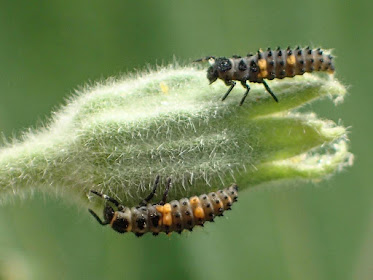
Lady beetle larvae. Photo: Melissa Schreiner

Lady beetles are a natural control option for aphids found in their environment. They are available for purchase at garden centers, but keep in mind that lady beetles can fly away. Since they are so mobile, lady beetles for purchase may not be too effective. However, purchasing and releasing lady beetles can be a great activity for children to help inspire an appreciation for insects and their role in our environment. The lady beetles for purchase are the convergent lady beetle, a native species.

Female lady beetles often lay eggs near an aphid infestation, so look for groups of dark yellow or orange-colored eggs that are oval-shaped and approximately 1 mm long. 

A lady beetle larva preying on an aphid. Photo: Melissa Schreiner

Lacewings (Family: Chrysopidae) are another common predator seen feeding on aphids. Just like lady beetles, the larvae of lacewings are ferocious predators! They earn the nickname “aphid lion” for a reason. In addition to eating up to 200 aphids per week, they can also feed on caterpillars by capturing them with their pair of hooked jaws.

Both green and brown lacewings can be found in Colorado. The adults have long, skinny bodies with membranous wings that that extend over the body forming a triangular or tent-shape.

Lacewings are also available for purchase as a biocontrol for the home garden. They can be more a more effective biocontrol option because they are available as eggs. When they hatch, the larvae will stay in the same place to feed until they reach adulthood.

Lacewing eggs. Photo: Lisa Mason

 Lacewing larva. Photo: Lisa Mason

Syrphid flies are another insect that feed on aphids as larvae, but they are quite elusive. Larvae can feed on 100-400 aphids. They are nondescript, grub-like larvae that vary in color. They leave behind excrement in their path that looks like a black, shiny streak known as a “syrphid smear.”

The adult form of syrphid flies is commonly seen visiting flowers with nectar. They often look like wasps and bees because they exhibit Bastian mimicry i.e., predators may avoid these syrphid flies because they look like stinging insects, though the syrphid flies are harmless. You can differentiate them from wasps and bees by looking for their giant eyes that extend almost to the top of their heads, only one pair of wings, and short antennae.

Syrphid fly. Photo: Lisa Mason

Tiny, parasitoid wasps will prey on aphids by laying eggs inside the aphid. The wasp larvae feed on the aphid. Parasitoid wasps cannot sting people, but they are deadly to aphids! The wasps are so small that they may be hard to observe, but you might see the remnants of them when you see dead aphids on the plant. 

Insects Feeding on Honeydew

Aphid infestations also attract a wide diversity of beneficial insects that feed on the sweet honeydew. You might observe a variety of wasps, ants, flies, and beetles all feeding on honeydew.

Ants and aphids often have a mutually beneficial relationship. Honeydew can be a major food source for ants, and the ants want to protect that food source. Since aphids are easy prey, ants will protect aphids from prey, and in some cases, protect them from fungal pathogens (Nielsen et al., 2009; Rathcke et al., 1967).

Aphid Reproduction and Life Cycle

Most aphids are wingless in a colony. You may observe winged aphids when they need to seek out new plants. Aphids reproduce at an astounding rate because reproduce both sexually and asexually. During the summer, you are likely to see aphids produced by females in asexual process called parthenogenesis. The female aphids give birth to aphids without fertilization. These aphids share the exact same genetics. Later in the season, the colony will produce male aphids to mate with female aphids that are able to reproduce sexually. The female will lay fertilized eggs that overwinter. Many aphid species will complete their life cycle on one plant host. Other species will overwinter on one species of host plant, and after hatching the spring, they will fly to another species of host plant. See Table 2 of the Aphids on Shade Trees and Ornamentals fact sheet for a list of aphids that have two host plants.
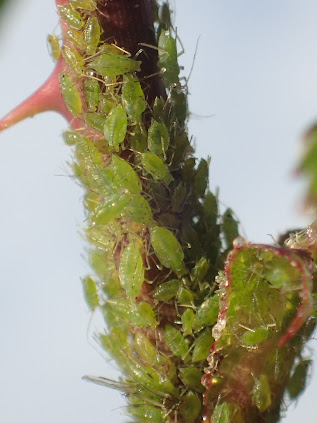
Rose aphids (Macrosiphum rosae) on a rose bush. Photo: Melissa Schreiner

Benefits of Attracting Insects in Your Landscape

Aphids and other pest insects serve an important role in the food web in our garden ecosystems. Just like predatory insects, birds can help keep the pest populations down. Most terrestrial birds rely on insects for a major component of their diet. Hummingbirds will catch up to 2,000 insects per day! They feed on aphids, mosquitos, and a variety of other insects. Consider supporting insects and birds in your landscape by planting a diversity of flowers with nectar and native plants, providing habitat spaces and water sources, and minimizing or eliminating the use of pesticides in the landscape.

Aphid Control Options

Beneficial insects are a great control option for aphids! A few other options are available if additional control is desired. Using a hose with a strong jet of water on the plant will knock aphids down. Since they are a soft-bodied insect, the impact from the water will kill many of them. Horticultural oils are effective at killing overwintering eggs. A variety of insecticide products are available, but use caution because many will kill the beneficial insect predators in your garden. Look for non-persistent contact products like insecticidal soaps that are safer for beneficial insects. As always, follow the label explicitly so that the product is applied effectively and safely. For more information, check out the CSU Extension fact sheet, Aphids on Shade Trees and Ornamentals.

Enjoy Your Backyard Biodiversity!

Have fun making observations this summer. Share photos on social media! Use the hashtag #AphidWatchParty

References

Hoffmann, M.P. and Frodsham, A.C. (1993) Natural Enemies of Vegetable Insect Pests. Cooperative Extension, Cornell University, Ithaca, NY. 63 pp.

Marvin, D. E. (2018) Hummingbirds as Pest Management Partners? New York State Integrated Pest Management, Cornell University. https://blogs.cornell.edu/nysipm/2018/10/11/hummingbirds-as-pest-management-partners/

Nielsen, C., Agrawal, A. A., and Hajek, A. E. (2009) Ants defend aphids against lethal defense. Biology Letters 6: 205-208. https://doi.org/10.1098/rsbl.2009.0743

Rathcke, B., Hamrum, C., and Glass, A. W. (1967) Observations on the interrelationships among ants, aphids, and aphid predators. The Michigan Entomologist, 1(5), 169-173. https://scholar.valpo.edu/cgi/viewcontent.cgi?article=1056&context=tgle

Schuh, M. 2022. Lacewing. University of Minnesota Extension. https://extension.umn.edu/beneficial-insects/lacewing

Statewide Integrated Pest Management Program. (2002) Syrphids (Flower Flies, or Hover Flies). University of California Agriculture and Natural Sciences. https://www2.ipm.ucanr.edu/natural-enemies/syrphids/

Warner, G. (1993) Syrphid Flies (hover flies, flower flies). Washington State University. http://treefruit.wsu.edu/crop-protection/opm/syrphid-flies-hover-flies-flower-flies/


Thursday, September 16, 2021

Downtown Flowers Signal Summertime for Puebloans


 By Sherie Shaffer, Horticulture Agent, CSU Extension-Pueblo County

My favorite part of the flower display, in front of Pueblo Union Depot

These two are Craig's favorite containers

Every year, Puebloans are signaled to the beginning of summer when the huge, beautiful containers of petunias and geraniums appear downtown.

These beauties are in front of local boutique, Razmataz

Everyone loves the smell of fresh petunias in the morning


The Pueblo Union Depot, along with B Street and a good portion of Union Avenue get decked out with these blossoms every year in May, thanks to local business owners the Koncilja’s. The flowers are purchased from a local nursery, but you may be wondering, who cares for them and keeps them looking stunning all summer long?
Looking down B Street from the Union Depot

Patrons of the cafes on B Street get to look at these containers while they dine

Some of the containers are hanging, while some are on the ground

The answer is two guys, Craig and Brandon. We got an opportunity for an insider tour of the daily care of these flowers, thanks to the fact that Craig is my brother. Turns out it’s no small feat to keep these blooms looking brilliant during the heat of a Southern Colorado summer.
Craig with his trusty hose reel 


Turns out it doubles as a fun ride

A close up of the reel


Unless it rains, which is not something that happens often around here, the flowers need to be watered daily. Craig and Brandon have portable hose reels, that they wheel around downtown and hook to multiple different spigots around where the flowers are located. They must start early, not only to beat the heat but also to beat the morning downtown buzz. Turns out it’s a lot easier to stretch the hose out when the foot traffic is low.
Luckily he's tall to reach the hanging containers


The hose spigots have keys to turn them on

As they water each container individually, by hand, they also do whatever deadheading needs to be done on each plant. This keeps the plants looking nice and encourages them to keep blooming all summer long. Sometimes, when a plant gets a little leggy, they will trim them up to keep the shape looking nice and compact.


Right in front of the doors to the Union Depot

These containers are in Tandoori's courtyard

More beautiful flowers

Of course, water and TLC aren’t quite enough to keep the flowers looking their best. They also get fertilized weekly. The Petunias get fed with a 20-3-19 water-soluble Petunia Feed that includes Magnesium. The geraniums get a 20-10-20 general-purpose water-soluble fertilizer. To deliver the fertilizer, they use a Dosatron nutrient injector. First, they mix about 10 cups of the dry fertilizer in a bucket, and fill it with water, this is the concentrate. They then set the injector to the appropriate level and insert the hose of the injector into the concentrate bucket. The water supply is then hooked to the injector and it delivers the desired concentration of fertilizer into the irrigation water.

The fertilizer they use to keep the blooms looking beautiful


The Dosatron fertilizer injector

Pest and disease issues haven’t been too bad in the past. During really hot spells some of the petunia leaves will become sunburnt from the reflected heat of the sidewalk, and they have dealt with some small aphid infestations. Nothing a call to the local Extension Agent/sister and a strong stream of water couldn't handle!


Another view of Tandoori's courtyard


These lucky flowers get some morning shade

So, although it’s no small task to keep these flowers looking great all summer long, the people of Pueblo are so glad that they are purchased and cared for to keep our downtown looking bright and beautiful!


Friday, June 26, 2020

I've got honeydew on my honey-do


Posted by: Todd Hagenbuch, Routt County Extension

The Futura will look brighter after a good wash.
(Well, after that and the paint job I'm pushing for...)
My honey-do list this summer is a long one. Of course, I put a lot of it on there myself, but it includes planting new gardens, tending to the lawn, weeding the existing gardens, keeping an eye out for the usual insects, (yes, I’m talking about you, Columbine Sawfly) and more. I even have some non-yard items on my list, one of which is convincing my mom that we need to restore her 1966 Ford Falcon Sports Coupe. That honey-do actually alerted me to an insect issue in my trees. How, you ask?

I took Mom’s car from her home a couple of weeks ago to get some estimates on the work. In the time since, it’s been in my driveway instead of in her garage. When I met her with the car to discuss the restoration, she questioned what had happened to her already-spoiled paint job. “Honey, what did you do?!?” she exclaimed. “This honey didn’t do anything, Mom,” I replied. “That’s honeydew.”

Nope, that's not custom paint- that's honeydew.
(At least it does bring some shine to the ol' girl!)
Honeydew? Yes, it’s a wonderful, sweet melon and my favorite scientist on the Muppet’s Show, but it’s also the term used for the sticky substance that is excreted from phloem-sucking insects. Scales, adelgids, whiteflies, and aphids all produce honeydew. They pick a spot on a plant leaf or needle and, with their specialized mouth parts, bite down and start sucking the phloem, or plant sap. As with all things eaten, what goes in must come out, and out it comes as honeydew. Then it floats down and finds its way onto things below it.

Like I did with the Falcon, you’ve probably parked a car under a tree seeking shade from the summer sun only to come back and find the windshield sticky with honeydew. Perhaps your deck and railing have become covered with the sticky substance, too, or the sidewalk under a tree. I get calls in the office asking what kind of tree it is that creates the honeydew, or what’s wrong with a tree that's ‘leaking’ sap from above. No one is thrilled to find out it’s actually insect poop that has covered their patio furniture or sunroof.

These shade seekers will find their windshields a sticky mess
at the end of the day as this cottonwood has aphids.
In most areas this time of year, aphids are the creators of honeydew. As one of the only insects that gives live birth, each aphid is born ready to birth to the next generation, and so on. This means that aphids multiply rapidly, and as more are born, more excrete honeydew. One day your deck is fine, and two days later, it’s a sticky mess. And just like that, your honey-do list now includes power washing the deck, scrubbing the outdoor furniture, and washing the car.

Honeydew does have its fans. The hum from the tree near the Falcon isn't the 289 V8 firing all cylinders, but Western Yellowjackets who feed on it and swarm the tree to find it. Ants love it, too, and will roam the plant or tree collecting it and protecting the aphids producing it. 

Plants can be sprayed with an insecticidal soap or pesticides to help control aphids, but I find that just spraying them down with a strong jet of water is effective and causes fewer issues for beneficial insects and the items below the tree. A hard rain will do the same thing and provide relief for a few days, but remember that the aphid population will rebound quickly. Spraying with water again can help keep numbers manageable.
A lower leaf from the cottonwood, sticky with honeydew
For detailed information on how to control aphids on shade trees, add reading CSU Fact Sheet 5.511 to your honey-do list. The control efforts you learn might enable you to knock a few of those other honey-do items of the page.

Thursday, November 21, 2019

Trials of Indoor Gardening pt.1: spider mites, aphids, and thrips oh my...

Posted by: John Stolzle, Jefferson County Extension
One of the best things about indoor gardening is being surrounded by green foliage during winter. But this also brings a potential for pests to thrive 365 days a year.

The indoor garden remains unaffected by an early season blizzard; fresh produce as of this publication date!
One of the greatest challenges my garden has faced has been a battle against aphids and spider mites. In outdoor environments, natural predators do much to keep populations of pests (like aphids and spider mites) in check. But in the climate-controlled world of an indoor garden or greenhouse pests can reproduce unchecked by predators and lead to imbalanced (aka. out of control!) populations.

Where did they come from?
With a few exceptions, plants which I started from seed have remain unscathed; however, a few plants which were placed next to incoming nursery stock encountered problems.
Damage from inadequate watering and spider mites on a Jalapeño
Case in Point: one poor Jalapeño (photo above) that was started from seed caught a bad case of spider mites from another pepper plant which was purchased from a commercial nursery/greenhouse. Initially things in the garden were great but while I went away on vacation, insects were busy chowing down on my pepper plants. I returned to what you see in the picture.

Some time after this, I purchased a sad looking (#discount) Taro plant. I placed it in the garden, wiped off its leaves and stalks with a damp paper towel, and watched it closely. After some weeks, I began to notice many tiny glistening, sticky spots on its leaves; the spots were honeydew, evidence (waste) left by aphids. I took a closer look (picture below) and saw tiny green insects (aphids) moving around the leaves.

Aphids on a Taro leaf
A lack of patience.
One pepper which had become infested with spider mites appeared to stop growing after treatment. I became frustrated because it hadn’t produced a new leaf over the course of two months! So, I decided to rip out the pepper and use the pot for something else.
Pepper plant after 3 months of growth in an 18cm (7in) diameter pot.
Little had I known that the plant had been developing a very robust root system. Sigh.. a root system that would have been able to support many specialty peppers. On the flip side, now I know the plants are growing and that this container was likely too small for the plant anyway. Recommendations for adequate container sizes can be found herehttps://cmg.extension.colostate.edu/Gardennotes/724.pdf


What can be done... aside from tearing out a plant?
It is important to first know what may be attacking a plant. For example, after looking for some time (phone cameras, magnifying glasses, hand lenses, and microscopes can be helpful!) I observed not only spider mites but also thrips on my pepper plants! These two insects require slightly different management strategies. Note: Information on thrips is linked-to at the end of this post.

Spider mites and aphids lay eggs on plant material and go through a roughly 2-week life cycle (important to know when planning follow-up treatments). A jet of water is often enough to dislodge these pests from many plants. Have a spider plant (‘Chlorophytum comosum’with spider mite webbing between its leaves? - Give it a shower in the sink!

It is easier to battle 10 insects than it is 10,000. Washing a nursery plant upon its arrival can save headaches  by preventing major outbreaks from ever occurring. Note: Not all plants like to have wet leaves. It can be helpful to look up a plant’s general care recommendations.

Insecticide products do exist for treating spider mites, aphids, thrips, and other various plant pests. Insecticidal Soaps with the active ingredient Potassium Salts of Fatty Acids, and Horticulture Oils (e.g. Neem, Cottonseed) can be effective parts of an integrated pest management strategy. It may not seem like it, but Insecticidal Soaps and Horticultural Oils can be harmful to humans and pets and other non-target organisms. Pesticide product labels should always closely be followed and adhered to. Note: when applying an insecticidal soap (active ingredient: 'Potassium Salts of Fatty Acids') any insect not completely wetted (e.g. an aphid hidden in a rolled up leaf) will not be affected.

What I wish I would have known.
  • That placing plants in the shower or sink or (even better!) taking them outdoors prior to treatment can make cleanup a much easier process.
  • Some plants can react poorly to Insecticidal Soap and/or Horticultural Oil treatments. It can be mildly traumatic to see a plant drastically defoliate a day after being treated.
  • Yellow sticky pads can be incredibly effective at managing indoor populations of fungus gnats (sometimes mistakenly referred to as fruit flies).
  • Patience is key (in reference to the pepper I tore out).
For more information on a variety of topics, please see the links, below.

As a fun aside, insects (like 'Lady Bug' and Lacewing larvae) which feed on spider mites, aphids, etc. can be purchase from locations around the USA. Here is a very impressive list of BioControls and example locations from across the US where they can be acquired: https://webdoc.agsci.colostate.edu/bspm/InsectInformation/Factsheets/BioControlSuppliers.pdf

For an introduction to this indoor garden, please see this blog post: https://csuhort.blogspot.com/2019/09/reflections-on-season-of-indoor.html

 Best of Luck in all your gardening endeavors! 
- John 

Monday, September 30, 2019

Reflections on a season of indoor gardening

Posted by: John Stolzle, Jefferson County Extension
This post details what can happen when a plant enthusiast with a will to tinker moves into an apartment. In this post, I have overviewed some of the setup, challenges, current outcomes, and tips gleaned from my trials with indoor gardening. 

moved into an apartment about a year ago. It had one large south facing window which was light limited by surrounding structures. It had no patio, nor space to grow plants outdoors, nor were there open community garden patches nearby. Slowly, in the back of my mind, the urge to cultivate my apartment space grew. I eventually purchased a few houseplants, yet, I was unsatisfied. I wanted to tinker, I wanted a challenge, I wanted to pick fruit and see flowers. 

One morning, I decided that I wanted a garden and that apartment life was not going to stand in my way. I had grand visions of tomatoes and peppers in winter. I wanted a challenge and a challenge is what I got. 

Early March 2019 - Late September 2019 (Click to enlarge)

Stage 1: The Set Up

Plants need a whole bunch of things to thrive, but for the sake of this post I am going to drastically simplify them as: Soil, Water, Light, and Space. 

I began with a garden plan in my mind; however, most of my plans went out the window as soon as I first arrived at a nursery. There were just too many possibilities and so I opted to make a game out of my garden – What could I keep alive in this plant-unfriendly environment? 

Due to ad hoc planning and prep, I made multiple trips to hardware stores and nurseries; it was fairly inefficient, but I eventually ended up with a selection of plants, containers, and soil. I drilled drainage holes in the bottom of 5 gallon HDPE buckets (for tomatoes and peppers) and purchased short lipped storage bins to catch water. Beneath the storage bins and lids, I placed paper towels to help monitor for moisture and facilitate sliding the containers around. I have heard reports that moisture can seep from terracotta/clay containers and damage floors, and so all of the plants were placed on plastic lids or in bins. 

Note: If I were to restart the project, I would use boot/shoe trays sold at hardware stores. They would likely be less expensive, and I believe that they would be easier to position in such limited space. 

Note the white growth on the soil in the picture on the right; this a type of saprophytic fungi which feeds on decaying plant matter (generally not a major concern for plants). 

Here are some references for starting out
* Container Gardening (Great Overview); https://extension.colostate.edu/docs/pubs/garden/07238.pdf
* Vegetable Gardening in Containers (Space); https://cmg.extension.colostate.edu/Gardennotes/724.pdf
* Soil (Potting soil is important!); https://web.extension.illinois.edu/containergardening/soil.cfm
* Watering: https://planttalk.colostate.edu/topics/houseplants/1318-houseplants-watering/
* Light: https://planttalk.colostate.edu/topics/houseplants/1352-interior-plants-light/
* Insect Control: https://extension.colostate.edu/docs/pubs/insect/05595.pdf

Stage 2: Environmental Modification

After a month, many of the plants began to show significant stress. Some were spindly (in search of sunlight), the Asiatic Lilies were succumbing to disease and hadn’t grown but 2 millimeters, and the Lamb’s Ear was slowly losing its leaves. The plants had been carefully watered, planted in decent potting soil with room to grow, but needed more light. 
I thought it would fun to try growing a Mammoth Sunflower (Helianthus giganteus); the kind that can grow 10ft+ tall. It grew 3 feet with artificial support, flowered and then died shortly thereafter.
I eventually acquired and installed a broad spectrum led grow light; the plants didn’t rebound quickly but they did show signs of increased vigor… And then I began to notice the insects. 

I had attempted to avoid an insect outbreak by rinsing the foliage of each plant in my kitchen sink and then spraying some of the plants with Neem oil and/or insecticidal soap. Despite my best efforts, I have found myself locked in battle with aphids and spider mites. In this protected environment, the pesky bugs are able to feed and reproduce without a check or pressure from predators. At one point, I considered releasing predatory insects but then had visions of Cane Toads in Australia… I have so far opted to not venture into this territory, though I am very tempted.

Wiping down and then spraying the plants does seem to provide a brief reprieve from the infestation. I currently believe my challenge of aphid and spider mite management to be two-fold: 1, I occasionally re-infest my garden with new insects as I add different/new plants (to replace those which didn’t make it), and 2, my soap and horticultural oil treatments need to be better timed.  

Additional References

Additionally, I have learned that many potting soil mixes come pre-packaged with fungus gnats eggs. Upon adding water, these eggs hatch, and adults will soon be flying all around indoor environments.  These insects are very minor plant pests, but can be an incredible nuisance. I have had huge success managing the insects with yellow sticky paper; noted in this factsheet on Fungus Gnats: ://extension.colostate.edu/docs/pubs/insect/05584.pdf.


To any adventuresome gardeners considering an indoor garden, I had the greatest struggle with: Asiatic Lilies, Snap Dragons, Sunflowers, Sweet/sugar Peas, Daffodil bulbs, and ornamental grasses. The grasses struggled and failed in the most spectacular fashion.

The tomatoes and peppers seem to struggle up to a certain point of development, after which they grow quite rapidly. The Scotch Bonnet (nursery started) has done amazingly well. It did have a significant set back due to an insect outbreak and me burning it with oils, but three weeks later, it is now flowering again. I have also been surprised by how well the Bougainvillea, Mandevilla, and Pineapple have done.

Stage 3: Success?

What does success look like in a mad-gardener’s laboratory?  I have lost many plants along the way and have added some fun new players such as Purple Passion Gynura aurantiaca, Lavender, and Taro. It has been a worthwhile experiment in my mind. Yields have been low, but my vegetables are just starting to produce... And who knows, maybe I’ll have fresh tomatoes in winter. 

A bit of gardening chaos; perhaps it's time for a mid-season prune.
I have many tales to tell from my trials with indoor gardening: of tomato training, of the importance of wind and humidity, supplemental lighting, container rotation, fertilizing, and manual pollination...  Perhaps this will be the first in a series of indoor gardening blog posts.  

For more information on houseplants, check out this blog posted last Monday: https://csuhort.blogspot.com/2019/09/plant-parenthood-rise-again-of.html

 Best of Luck in all your gardening endeavors! 
- John