CO-Horts

CO-Horts Blog

Showing posts with label biodiversity. Show all posts

Wednesday, June 29, 2022

Host an Aphid Watch Party This Summer and Look for Biodiversity

Posted by: Lisa Mason, Arapahoe County Extension

Yes, you read that right! Get excited about watching aphids on your plants this summer just as you get excited about your favorite TV show or a new moving coming out! You’re probably asking, “Why would I watch aphids on my plants? Aren’t they a nuisance pest?”

The definition of a nuisance pest depends on who is asking. For instance, if you are a hungry lady beetle, aphids are a feast waiting to be had!

Except for a few species, most aphids cause very little plant damage. Aphids are host-specific meaning that each of Colorado’s 350 aphid species will only feed on certain plants.

Aphids are also one of the insects that excrete honeydew, which is a sweet, sticky substance that coats the plants and anything underneath the plant. 

So, why would you watch aphids on your plants? Aphids attract a wide variety of beneficial insects to our gardens. An aphid infestation can be a hotspot to observe biodiversity in your garden or landscape. For instance, while I was writing this article, I found aphids in my backyard on a sand cherry! So far, I’ve seen lacewing eggs, lady beetle pupa, a katydid nymph, syrphid fly smears, and other insects feeding on the honeydew.
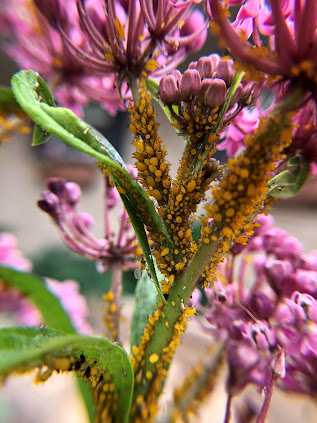
Aphids (Aphis nerii) on a milkweed plant. Photo: Lisa Mason

Here are some fun observations you may witness while you are watching aphids:

Predators Hunting Aphids

Lady beetles (Family: Coccinellidae), also known as lady bugs, are a common insect you’ll find preying on aphids and other soft-bodied arthropods. We have approximately 80 different lady beetle species in Colorado. Lady beetle larvae have a completely different appearance than the adult beetles because they complete a full metamorphosis (egg, larva, pupa, and adult). The larvae look similar to little dragons or alligators, and they are ferocious predators! Their goal is to eat as much as possible! Convergent lady beetle larvae can devour up to 50 aphids a day, often consuming their weight in aphids (Hoffman and Frodsham, 1993). Other species such as the seven-spotted lady beetle may feed on higher numbers of aphids.
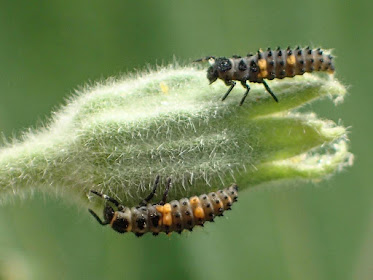
Lady beetle larvae. Photo: Melissa Schreiner

Lady beetles are a natural control option for aphids found in their environment. They are available for purchase at garden centers, but keep in mind that lady beetles can fly away. Since they are so mobile, lady beetles for purchase may not be too effective. However, purchasing and releasing lady beetles can be a great activity for children to help inspire an appreciation for insects and their role in our environment. The lady beetles for purchase are the convergent lady beetle, a native species.

Female lady beetles often lay eggs near an aphid infestation, so look for groups of dark yellow or orange-colored eggs that are oval-shaped and approximately 1 mm long. 

A lady beetle larva preying on an aphid. Photo: Melissa Schreiner

Lacewings (Family: Chrysopidae) are another common predator seen feeding on aphids. Just like lady beetles, the larvae of lacewings are ferocious predators! They earn the nickname “aphid lion” for a reason. In addition to eating up to 200 aphids per week, they can also feed on caterpillars by capturing them with their pair of hooked jaws.

Both green and brown lacewings can be found in Colorado. The adults have long, skinny bodies with membranous wings that that extend over the body forming a triangular or tent-shape.

Lacewings are also available for purchase as a biocontrol for the home garden. They can be more a more effective biocontrol option because they are available as eggs. When they hatch, the larvae will stay in the same place to feed until they reach adulthood.

Lacewing eggs. Photo: Lisa Mason

 Lacewing larva. Photo: Lisa Mason

Syrphid flies are another insect that feed on aphids as larvae, but they are quite elusive. Larvae can feed on 100-400 aphids. They are nondescript, grub-like larvae that vary in color. They leave behind excrement in their path that looks like a black, shiny streak known as a “syrphid smear.”

The adult form of syrphid flies is commonly seen visiting flowers with nectar. They often look like wasps and bees because they exhibit Bastian mimicry i.e., predators may avoid these syrphid flies because they look like stinging insects, though the syrphid flies are harmless. You can differentiate them from wasps and bees by looking for their giant eyes that extend almost to the top of their heads, only one pair of wings, and short antennae.

Syrphid fly. Photo: Lisa Mason

Tiny, parasitoid wasps will prey on aphids by laying eggs inside the aphid. The wasp larvae feed on the aphid. Parasitoid wasps cannot sting people, but they are deadly to aphids! The wasps are so small that they may be hard to observe, but you might see the remnants of them when you see dead aphids on the plant. 

Insects Feeding on Honeydew

Aphid infestations also attract a wide diversity of beneficial insects that feed on the sweet honeydew. You might observe a variety of wasps, ants, flies, and beetles all feeding on honeydew.

Ants and aphids often have a mutually beneficial relationship. Honeydew can be a major food source for ants, and the ants want to protect that food source. Since aphids are easy prey, ants will protect aphids from prey, and in some cases, protect them from fungal pathogens (Nielsen et al., 2009; Rathcke et al., 1967).

Aphid Reproduction and Life Cycle

Most aphids are wingless in a colony. You may observe winged aphids when they need to seek out new plants. Aphids reproduce at an astounding rate because reproduce both sexually and asexually. During the summer, you are likely to see aphids produced by females in asexual process called parthenogenesis. The female aphids give birth to aphids without fertilization. These aphids share the exact same genetics. Later in the season, the colony will produce male aphids to mate with female aphids that are able to reproduce sexually. The female will lay fertilized eggs that overwinter. Many aphid species will complete their life cycle on one plant host. Other species will overwinter on one species of host plant, and after hatching the spring, they will fly to another species of host plant. See Table 2 of the Aphids on Shade Trees and Ornamentals fact sheet for a list of aphids that have two host plants.
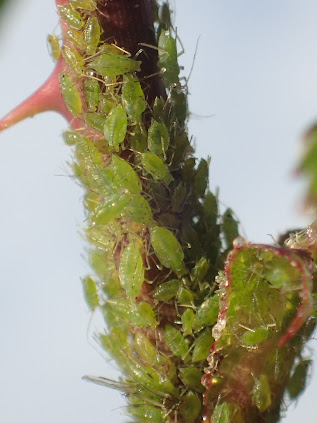
Rose aphids (Macrosiphum rosae) on a rose bush. Photo: Melissa Schreiner

Benefits of Attracting Insects in Your Landscape

Aphids and other pest insects serve an important role in the food web in our garden ecosystems. Just like predatory insects, birds can help keep the pest populations down. Most terrestrial birds rely on insects for a major component of their diet. Hummingbirds will catch up to 2,000 insects per day! They feed on aphids, mosquitos, and a variety of other insects. Consider supporting insects and birds in your landscape by planting a diversity of flowers with nectar and native plants, providing habitat spaces and water sources, and minimizing or eliminating the use of pesticides in the landscape.

Aphid Control Options

Beneficial insects are a great control option for aphids! A few other options are available if additional control is desired. Using a hose with a strong jet of water on the plant will knock aphids down. Since they are a soft-bodied insect, the impact from the water will kill many of them. Horticultural oils are effective at killing overwintering eggs. A variety of insecticide products are available, but use caution because many will kill the beneficial insect predators in your garden. Look for non-persistent contact products like insecticidal soaps that are safer for beneficial insects. As always, follow the label explicitly so that the product is applied effectively and safely. For more information, check out the CSU Extension fact sheet, Aphids on Shade Trees and Ornamentals.

Enjoy Your Backyard Biodiversity!

Have fun making observations this summer. Share photos on social media! Use the hashtag #AphidWatchParty

References

Hoffmann, M.P. and Frodsham, A.C. (1993) Natural Enemies of Vegetable Insect Pests. Cooperative Extension, Cornell University, Ithaca, NY. 63 pp.

Marvin, D. E. (2018) Hummingbirds as Pest Management Partners? New York State Integrated Pest Management, Cornell University. https://blogs.cornell.edu/nysipm/2018/10/11/hummingbirds-as-pest-management-partners/

Nielsen, C., Agrawal, A. A., and Hajek, A. E. (2009) Ants defend aphids against lethal defense. Biology Letters 6: 205-208. https://doi.org/10.1098/rsbl.2009.0743

Rathcke, B., Hamrum, C., and Glass, A. W. (1967) Observations on the interrelationships among ants, aphids, and aphid predators. The Michigan Entomologist, 1(5), 169-173. https://scholar.valpo.edu/cgi/viewcontent.cgi?article=1056&context=tgle

Schuh, M. 2022. Lacewing. University of Minnesota Extension. https://extension.umn.edu/beneficial-insects/lacewing

Statewide Integrated Pest Management Program. (2002) Syrphids (Flower Flies, or Hover Flies). University of California Agriculture and Natural Sciences. https://www2.ipm.ucanr.edu/natural-enemies/syrphids/

Warner, G. (1993) Syrphid Flies (hover flies, flower flies). Washington State University. http://treefruit.wsu.edu/crop-protection/opm/syrphid-flies-hover-flies-flower-flies/


Monday, April 26, 2021

A Wasp-Benefit Analysis – Part II: Social Wasps

Posted by: Lisa Mason, Arapahoe County Extension

In case you missed it, click here to read Part 1. We covered the purpose of wasps in the ecosystem and answered questions on the Asian giant hornet that made headlines in 2020. Part II will cover social wasps, their role in the ecosystem, and possible control methods if they become a nuisance.

Wasps sometimes get a bad reputation because they can sting and are sometimes a nuisance. We have one species of wasp that can be particularly aggressive: the western yellowjacket. Don’t let one or two species of nuisance wasps ruin your opinion of all wasps. Wasps are a diverse group of insects that provide important ecosystem services such as pest control.

Social Wasps

Social wasps are probably the most familiar wasps to people because they are easily seen in the yard and landscape. Social wasps live in a colony together. They have a similar lifecycle to a bumble bee (Bombus spp.).  A new colony is started each year by a fertilized queen that survived the winter. She will lay several generations of female workers throughout the season. Towards the mid-to-end of the summer, she will lay eggs that are male wasps and potential queens. The males and potential queens will leave the colony to find a mate. Once cold temperatures arrive, the current colony will die except for the newly mated queens. The cycle will repeat and the following spring, when the new queens begin a new colony. Social wasps always build a new colony each year. They never reuse old nests, which is important to note if you’re looking to control nuisance wasps. Social wasps make their nests out of chewed up wood, creating a paper nest. Social wasps also feed on insects like caterpillars, providing important pest control in our backyards. The western yellowjacket is a scavenger feeding on carrion and human sources of food such as trash.

Let’s discuss five species of social wasps that are found in Colorado. Understanding the life history of social wasps can help you control them if they become a nuisance in your landscape, and build appreciation for their complex social biology, along with the pest control services they provide.

A western yellowjacket. Photo: Lisa Mason

Western Yellowjackets

Western yellowjackets (Vespula pensylvanica) are a native, social wasp that you will find at your family BBQ, picnics, trash cans, etc. They are very common in urban landscapes and can become a nuisance. Like social wasps, they create a new colony each year. The paper comb nest is usually underground or in a cavity that is well-protected. While yellowjackets are commonly seen, their nesting site can be difficult to find.

Yellowjackets can be aggressive, especially when defending their nest and are responsible for 90% of the insect stings in Colorado. They are scavenging insects feeding on carrion, dead earthworms, garbage, human foods including meats, and sweet, sugary foods. They also will feed on honeydew, a sweet substance excreted by aphids and soft scale insects.  Scavengers are the clean-up crew for ecosystems and play an important role in the food web. Yellowjackets tend to get more aggressive in the fall as food can be harder to find. 

If yellowjackets tend to be a nuisance in your landscape, you can purchase a yellowjacket trap available at hardware and garden stores. The traps contain heptyl butyrate which yellowjackets are attracted to. Traps will be most effective if they are placed outdoors in the early spring to capture the overwintering queens before they start their new colonies. Nest removal can be a dangerous task and difficult because their nests are so well-protected. Insecticide treatments often aren’t effective because it is difficult to get the insecticides inside the colony. Hiring a professional is often necessary. Remember, the colony will only last for one season.

An underground entrance to a western yellowjacket nest. Photo: Nancy Bonita

European Paper Wasps

European paper wasps (Polistes dominula) are much less aggressive, but they often build their nests close to human activity. They are a non-native insect that has become well-established in Colorado. They first appeared in Colorado in the late 1990s/early 2000s. They prey on caterpillars and other insects and feed their young live insects. Common prey includes hornworms and cabbageworms. They also will feed on honeydew secreted from aphids. The papery comb nests are often found under house eaves, overhangs, sheds, pipes, and other hollow spaces in human infrastructure. 

If the paper wasp nest is located in an area that won’t be disturbed by people, the nest can be left alone, and the wasps likely won’t be a nuisance. The current colony won’t survive when temperatures cool in the fall. If the nest is close to human activity, there are insecticide treatments to destroy the nest. Following instructions on the insecticide label is critical. Insecticides should be applied at night when most wasps are present at the nest. The nest should be destroyed afterwards to also kill the capped larvae in the nest. The location of the nest site should be thoroughly washed to prevent any remaining wasps from building a new nest. 

Traps that attract yellowjackets will not attract paper wasps. There are no effective trap methods for paper wasps.

A European paper wasp. Photo: Lisa Mason

Baldfaced Hornets and Aerial Yellowjackets

Baldfaced hornets (Dolichovespula maculata) and aerial yellowjackets (Dolichovespula arenaria) are common in Colorado but are less likely to be a nuisance around human activity. They are only aggressive when their nest is threatened. They develop a large papery comb nest usually high in large trees and shrubs. They feed on caterpillars, other insects, and honey dew. If you find a nest in your tree or shrub, it may look intimidating, but the nest can likely be left alone if the nest can be left undisturbed. These two wasps can be common visitors in our landscapes but often go unnoticed by people.

A baldfaced hornet. Photo: Joe Boggs, Ohio Sate University Extension


A baldfaced hornet nest. Photo: Joe Boggs, Ohio Sate University Extension

Western Paper Wasp

The western paper wasp (Mischocyttarus flavitarsis) is a native paper wasp in Colorado and the western US. They have a similar biology to the European paper wasp. They are capable of building paper nests close to human infrastructure and activity, but they are not nearly as common as the non-native European paper wasp. They can sting if their nest is threatened, they often prefer to “ram” into the person or animal that is threatening the nest (Snelling, 1953). Like other paper wasps, they prey on caterpillars, flies, and other pests, bring the prey back to the nest to feed the young wasps the live insects. Adult wasps may also forage for nectar on flowers.

A western paper wasp visiting my cup of tea earlier in April. Photo: Lisa Mason

A Note About Insect Stings

Western yellowjackets are responsible for 90%+ of all stings in Colorado. When someone says, “I was stung by a bee,” they were likely stung a yellow jacket.

Both bees and wasps can sting. A stinger is a modified ovipositor (the egg-laying mechanism in insects), so only females have the ability to sting. The purpose of a stinger is defense, and in some species, predation. Generally, insects will only sting if they are provoked or their colony is disturbed.  Both social and solitary wasps and bees can have the ability to sting, but social insects are more likely to sting because they need to protect their colony.

Bees

Honey bees prefer to forage on flowers and go about their business in their hive, but they can sting if they need to protect their hive. Honey bees can sting only once. They have a barb at the end at the end of their stinger that stays in your skin. The barb is attached to the internal guts of the bee, so when the bee tries to fly away, the guts are ripped out of the bee’s body, which kills the bee.

Bumble bees have the ability to sting but will only sting if their colony is disturbed. They can also sting more than once unlike honey bees. Bumble bees are not aggressive and prefer to forage on flowers and go about their business. Many native bees are not able to sting or will only sting if handled.

Wasps

Wasps can sting more than once. Solitary wasps will only sting if they are pressed up against your skin, or you try hard to provoke them. They prefer to fly away and stay away from human activity. Social wasps can be very defensive if their nest is disturbed. They also can sting if they are away from their nest and provoked. The western yellowjacket is much more likely to sting because they are scavengers and attracted to human foods sources. They tend to get more aggressive in the fall when temperatures cool down and food is harder to find. Other social wasps including the European paper wasp are generally not aggressive unless their nest is disturbed. The European paper wasp tends to build nests close to human activity on buildings, sheds, and other structures, which can increase the chance of nest disturbance.

Learn More

Western yellowjackets and European paper wasps can be a nuisance to people and often attract attention, but these wasps and other social wasps represent a small part of wasp diversity. Look for a future post on the CO-Horts Blog about solitary hunting wasps. These wasps often go unnoticed in the landscape, but provide valuable pest control services!