CO-Horts

CO-Horts Blog

Showing posts with label Colorado Insects. Show all posts

Wednesday, July 6, 2022

The Grub that Got Away...

 Posted by Hania Oleszak and Mari Hackbarth, Jefferson County Extension


With summer finally in full swing, we’ve been wading knee-deep in plant and insect samples over at the Jefferson County Plant Diagnostic Clinic. With that in mind, we thought it would be fun to clue you in to some of the pests and diseases that we’ve been seeing lately. See if you can identify any of the following samples as we walk you through some of the key steps of our identification processes…

~~~~~~~~~~~~~~~~~~~~~~~~~~~~~~~

Our first culprit is a first to our clinic. With a piercing, sucking mouthpart originating from in front of its eyes and long, segmented antennae, this insect appears to fall under the Hemiptera order.


Bee Assassin Bug; photo credit: Whitney Cranshaw, Colorado State University

This sample came with a critical piece of information for its identification: the environment in which it was found. Specifically, this insect was found attacking a honey bee near a hive.


 In addition to the dorsal and ventral markings on the insect and the fact that the mouthpart had three segments, these clues all indicate that this insect is…drumroll please…a bee assassin (Apiomerus spp.)! There are three species of bee assassins within Colorado and they often hide and wait for their prey before ambushing them. While we all prize our bees and dislike anything that harms them, bee assassins have not been identified as a threat to our bees and are actually generalist predators, meaning they feed on a range of insects.

~~~~~~~~~~~~~~~~~~~~~~~~~~~~~~~

Our next culprit makes its way, unfortunately, into our clinic a handful of times a year. Like the bee assassin, this sample was also identified to the Hemiptera order, which is also the order referred to as “true bugs”.  Additionally, this sample was found in an assisted living facility bedroom…any ideas yet?
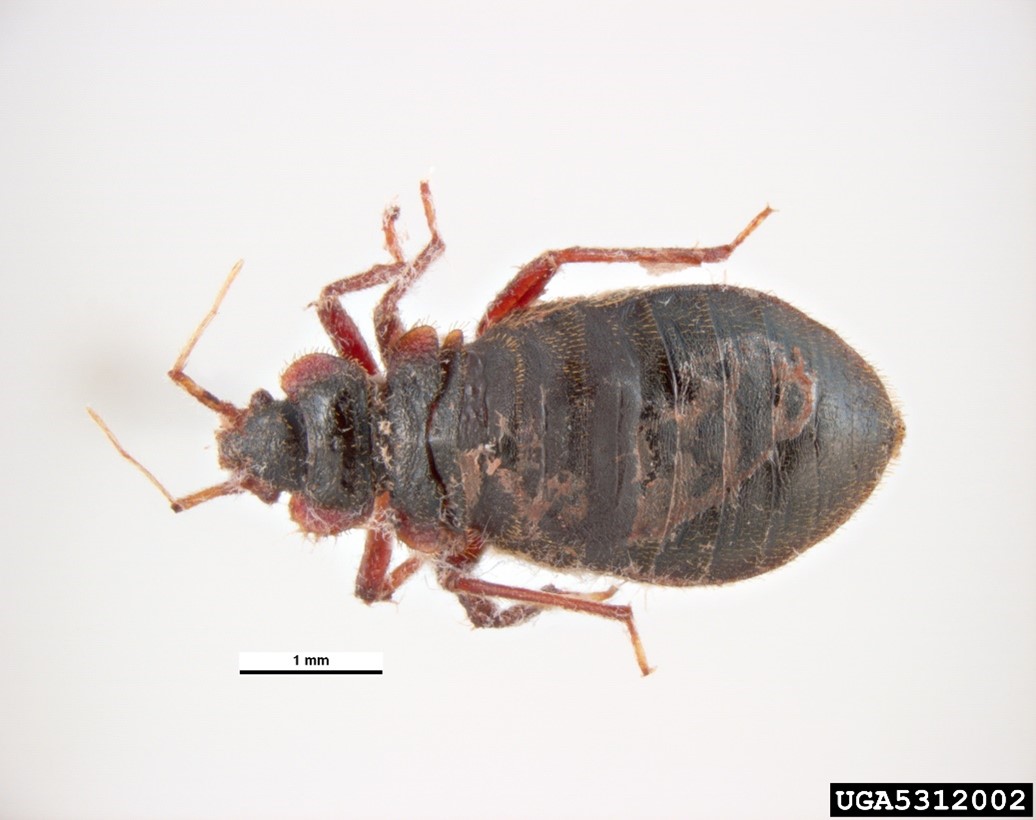

Bedbug, Cimex Lectularius dorsal view; photo credit Pest and Diseases Image Library,


Bedbug, Cimex Lectularius ventral view; photo credit  Gary Alpert, Harvard

Note: the piercing, sucking mouthpart originating from in front of the eyes and the long antennae broken into 4 segments.
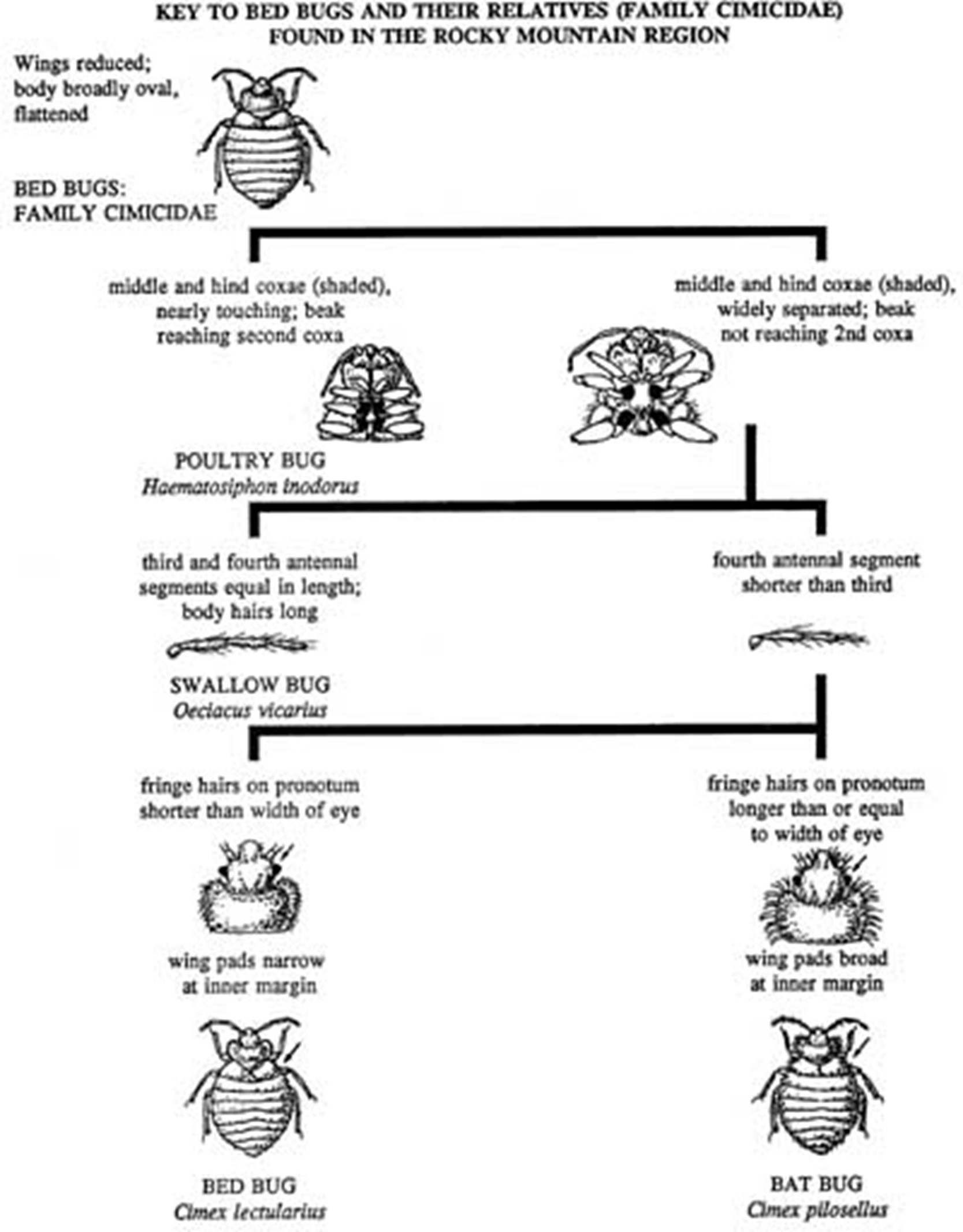
 Based on context and morphology, our insect appears to be either a bed bug or a bat bug (both belonging to the Cimicidae family). To differentiate the two, it’s important to observe the fringe hairs on the pronotum and the wing pads, as noted in the figure below.


 Bed Bug Identification Key; figure credit: CSU Extension


What’s the final verdict? It’s a bed bug (Cimex lectularius), ew! Bed bugs are bloodsucking insects, often feeding in the middle of the night. They do not transmit disease.  People often develop red, itchy swellings from bed bugs, but these bites alone are not enough to diagnose a bed bug problem.  Identification requires microscopic examination of the beak length, antennae and pronotal hairs.  Bed bug interceptors, basically traps that bed bugs can’t climb out of, can be placed underneath the bed post in order to monitor for bed bugs.

 ~~~~~~~~~~~~~~~~~~~~~~~~~~~~~~~

Next up, we have a raspberry plant that was brought in for management advice. This sample already had been diagnosed upon entering the plant clinic, but we won’t give you the answer that quickly! The key symptom in this diagnosis is that the shoot tips of the raspberries are wilting. Additionally, there are two rows of punctures along the stem, beneath the point of wilting.

Spoiler alert: these two rows of punctures are actually made by female Raspberry cane borers (Oberea perspicillata), surrounding the point at which eggs have been laid in the pith of the raspberry cane. Upon hatching, larvae burrow down through the pith, making it down about an inch or two from the punctures by the first winter, and eventually making it down to ground level. To control for the Raspberry cane borer, it’s best to prune the raspberry canes below the puncture marks, or as far down as there is evident damage to the pith of the cane.


Raspberry Wilting; photo credit: Mark Longstroth, MSU Extension


Raspberry Cane Borer Larva; photo credit: Alan T. Eaton

 ~~~~~~~~~~~~~~~~~~~~~~~~~~~~~~~

Next in our line-up is a crabapple tree with an array of symptoms that are quite telling and commonly seen in our clinic. Looking at the crabapple branch, we could see darkened, mummified fruit, as well as blackened and crooked shoot tips (which we refer to as shepherd’s crooking).


Shepherd’s crooking symptom of Fire blight; Photo credit Don Hershman, Bugwood.org

Upon further investigation in the lab, we could see under the microscope that there was bacterial streaming (i.e. the movement of bacteria out of the cut tissue) present in the fruit. Watch a youtube video of bacterial streaming HERE.  So cool!  This confirmed our suspicion that this crabapple tree has…Fire blight! Fire blight is a bacterial disease, caused by the bacteria Erwinia amylovora, that affects members of the rose family. The bacteria can be spread by insects, rain, or contaminated pruning tools, which is why rainy springs are conducive to the spread of Fire blight and why we recommend to disinfect pruning tools between every cut when working with plants of the rose family. Blossom blight (blackened, dead flower blooms) and oozing exudate from the tree or fruit are other tell-tale signs that your plant may have Fire blight. Unfortunately, there is no cure for Fire blight, so it’s best to prevent the spread of the disease and remove infected plant parts.

~~~~~~~~~~~~~~~~~~~~~~~~~~~~~~~

Last, but not least, is the grub that got away! Late one afternoon, we received a sample of a grub that was found in a mulch pile and placed it, along with some mulch, in a closed petri dish overnight. To our surprise, the grub was nowhere to be found the following morning – all that remained in the petri dish was mulch (see below).


Photo credit: Mari Hackbarth, Jeffco Plant Diagnostic Clinic

 Later that week, we received a sample of very similar-looking grubs. Upon morphological inspection (i.e. looking at the rastral pattern, or the arrangement of short hairs located above the anal slit of the abdomen), we were able to deduce that the grubs were likely bumble flower beetle larvae.


Rastral Pattern on Grub; photo credit: Mari Hackbarth, Jeffco Plant Diagnostic Clinic

Interestingly, bumble flower beetles form oval, earthen pupal cases as they mature into their adult forms and, looking more closely at second sample, we were even able to find some (see below)!
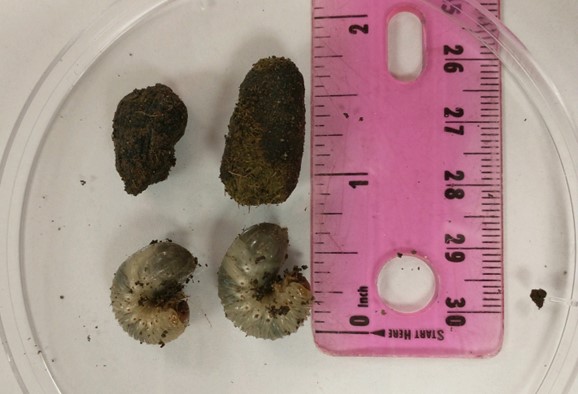


Bumble Flower Beetle Larvae and Pupae; photo credit: Mari Hackbarth, Jeffco Plant Diagnostic Clinic


Wait a minute!  If bumble flower beetles form pupae that look like big chunks of soil, and if our initial grub that got away looked very similar to the bumble flower beetle grubs…could our initial grub actually still be hiding in our petri dish in a pupa? What do you think?


References:

 Bee Assassin Bug:

Wednesday, June 29, 2022

Host an Aphid Watch Party This Summer and Look for Biodiversity

Posted by: Lisa Mason, Arapahoe County Extension

Yes, you read that right! Get excited about watching aphids on your plants this summer just as you get excited about your favorite TV show or a new moving coming out! You’re probably asking, “Why would I watch aphids on my plants? Aren’t they a nuisance pest?”

The definition of a nuisance pest depends on who is asking. For instance, if you are a hungry lady beetle, aphids are a feast waiting to be had!

Except for a few species, most aphids cause very little plant damage. Aphids are host-specific meaning that each of Colorado’s 350 aphid species will only feed on certain plants.

Aphids are also one of the insects that excrete honeydew, which is a sweet, sticky substance that coats the plants and anything underneath the plant. 

So, why would you watch aphids on your plants? Aphids attract a wide variety of beneficial insects to our gardens. An aphid infestation can be a hotspot to observe biodiversity in your garden or landscape. For instance, while I was writing this article, I found aphids in my backyard on a sand cherry! So far, I’ve seen lacewing eggs, lady beetle pupa, a katydid nymph, syrphid fly smears, and other insects feeding on the honeydew.

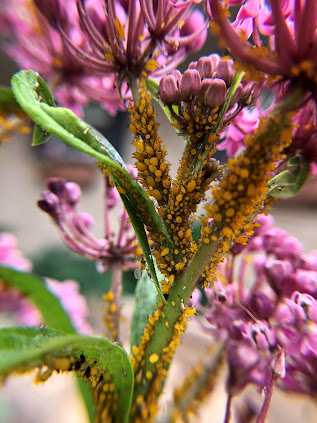
Aphids (Aphis nerii) on a milkweed plant. Photo: Lisa Mason

Here are some fun observations you may witness while you are watching aphids:

Predators Hunting Aphids

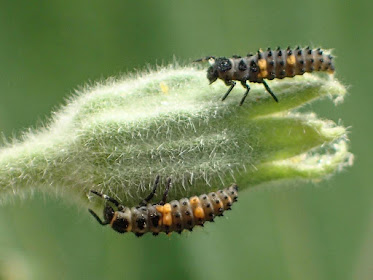
Lady beetles (Family: Coccinellidae), also known as lady bugs, are a common insect you’ll find preying on aphids and other soft-bodied arthropods. We have approximately 80 different lady beetle species in Colorado. Lady beetle larvae have a completely different appearance than the adult beetles because they complete a full metamorphosis (egg, larva, pupa, and adult). The larvae look similar to little dragons or alligators, and they are ferocious predators! Their goal is to eat as much as possible! Convergent lady beetle larvae can devour up to 50 aphids a day, often consuming their weight in aphids (Hoffman and Frodsham, 1993). Other species such as the seven-spotted lady beetle may feed on higher numbers of aphids.

Lady beetle larvae. Photo: Melissa Schreiner

Lady beetles are a natural control option for aphids found in their environment. They are available for purchase at garden centers, but keep in mind that lady beetles can fly away. Since they are so mobile, lady beetles for purchase may not be too effective. However, purchasing and releasing lady beetles can be a great activity for children to help inspire an appreciation for insects and their role in our environment. The lady beetles for purchase are the convergent lady beetle, a native species.

Female lady beetles often lay eggs near an aphid infestation, so look for groups of dark yellow or orange-colored eggs that are oval-shaped and approximately 1 mm long. 

A lady beetle larva preying on an aphid. Photo: Melissa Schreiner

Lacewings (Family: Chrysopidae) are another common predator seen feeding on aphids. Just like lady beetles, the larvae of lacewings are ferocious predators! They earn the nickname “aphid lion” for a reason. In addition to eating up to 200 aphids per week, they can also feed on caterpillars by capturing them with their pair of hooked jaws.

Both green and brown lacewings can be found in Colorado. The adults have long, skinny bodies with membranous wings that that extend over the body forming a triangular or tent-shape.

Lacewings are also available for purchase as a biocontrol for the home garden. They can be more a more effective biocontrol option because they are available as eggs. When they hatch, the larvae will stay in the same place to feed until they reach adulthood.

Lacewing eggs. Photo: Lisa Mason

 Lacewing larva. Photo: Lisa Mason

Syrphid flies are another insect that feed on aphids as larvae, but they are quite elusive. Larvae can feed on 100-400 aphids. They are nondescript, grub-like larvae that vary in color. They leave behind excrement in their path that looks like a black, shiny streak known as a “syrphid smear.”

The adult form of syrphid flies is commonly seen visiting flowers with nectar. They often look like wasps and bees because they exhibit Bastian mimicry i.e., predators may avoid these syrphid flies because they look like stinging insects, though the syrphid flies are harmless. You can differentiate them from wasps and bees by looking for their giant eyes that extend almost to the top of their heads, only one pair of wings, and short antennae.

Syrphid fly. Photo: Lisa Mason

Tiny, parasitoid wasps will prey on aphids by laying eggs inside the aphid. The wasp larvae feed on the aphid. Parasitoid wasps cannot sting people, but they are deadly to aphids! The wasps are so small that they may be hard to observe, but you might see the remnants of them when you see dead aphids on the plant. 

Insects Feeding on Honeydew

Aphid infestations also attract a wide diversity of beneficial insects that feed on the sweet honeydew. You might observe a variety of wasps, ants, flies, and beetles all feeding on honeydew.

Ants and aphids often have a mutually beneficial relationship. Honeydew can be a major food source for ants, and the ants want to protect that food source. Since aphids are easy prey, ants will protect aphids from prey, and in some cases, protect them from fungal pathogens (Nielsen et al., 2009; Rathcke et al., 1967).

Aphid Reproduction and Life Cycle

Most aphids are wingless in a colony. You may observe winged aphids when they need to seek out new plants. Aphids reproduce at an astounding rate because reproduce both sexually and asexually. During the summer, you are likely to see aphids produced by females in asexual process called parthenogenesis. The female aphids give birth to aphids without fertilization. These aphids share the exact same genetics. Later in the season, the colony will produce male aphids to mate with female aphids that are able to reproduce sexually. The female will lay fertilized eggs that overwinter. Many aphid species will complete their life cycle on one plant host. Other species will overwinter on one species of host plant, and after hatching the spring, they will fly to another species of host plant. See Table 2 of the Aphids on Shade Trees and Ornamentals fact sheet for a list of aphids that have two host plants.

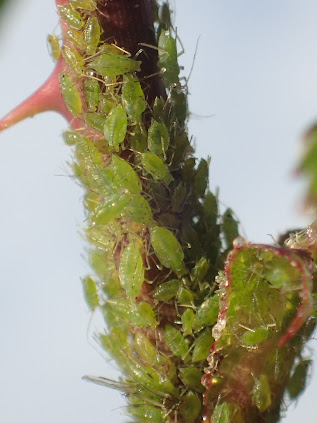
Rose aphids (Macrosiphum rosae) on a rose bush. Photo: Melissa Schreiner

Benefits of Attracting Insects in Your Landscape

Aphids and other pest insects serve an important role in the food web in our garden ecosystems. Just like predatory insects, birds can help keep the pest populations down. Most terrestrial birds rely on insects for a major component of their diet. Hummingbirds will catch up to 2,000 insects per day! They feed on aphids, mosquitos, and a variety of other insects. Consider supporting insects and birds in your landscape by planting a diversity of flowers with nectar and native plants, providing habitat spaces and water sources, and minimizing or eliminating the use of pesticides in the landscape.

Aphid Control Options

Beneficial insects are a great control option for aphids! A few other options are available if additional control is desired. Using a hose with a strong jet of water on the plant will knock aphids down. Since they are a soft-bodied insect, the impact from the water will kill many of them. Horticultural oils are effective at killing overwintering eggs. A variety of insecticide products are available, but use caution because many will kill the beneficial insect predators in your garden. Look for non-persistent contact products like insecticidal soaps that are safer for beneficial insects. As always, follow the label explicitly so that the product is applied effectively and safely. For more information, check out the CSU Extension fact sheet, Aphids on Shade Trees and Ornamentals.

Enjoy Your Backyard Biodiversity!

Have fun making observations this summer. Share photos on social media! Use the hashtag #AphidWatchParty

References

Hoffmann, M.P. and Frodsham, A.C. (1993) Natural Enemies of Vegetable Insect Pests. Cooperative Extension, Cornell University, Ithaca, NY. 63 pp.

Marvin, D. E. (2018) Hummingbirds as Pest Management Partners? New York State Integrated Pest Management, Cornell University. https://blogs.cornell.edu/nysipm/2018/10/11/hummingbirds-as-pest-management-partners/

Nielsen, C., Agrawal, A. A., and Hajek, A. E. (2009) Ants defend aphids against lethal defense. Biology Letters 6: 205-208. https://doi.org/10.1098/rsbl.2009.0743

Rathcke, B., Hamrum, C., and Glass, A. W. (1967) Observations on the interrelationships among ants, aphids, and aphid predators. The Michigan Entomologist, 1(5), 169-173. https://scholar.valpo.edu/cgi/viewcontent.cgi?article=1056&context=tgle

Schuh, M. 2022. Lacewing. University of Minnesota Extension. https://extension.umn.edu/beneficial-insects/lacewing

Statewide Integrated Pest Management Program. (2002) Syrphids (Flower Flies, or Hover Flies). University of California Agriculture and Natural Sciences. https://www2.ipm.ucanr.edu/natural-enemies/syrphids/

Warner, G. (1993) Syrphid Flies (hover flies, flower flies). Washington State University. http://treefruit.wsu.edu/crop-protection/opm/syrphid-flies-hover-flies-flower-flies/


Thursday, July 29, 2021

Music for a Summer Evening


Posted by John Murgel, Douglas County Extension

The “dog days” of summer bring with them some of the most noticeable insect activity of the year—the sounds of insect calls.  Step outside during the afternoon or evening and you’re likely to hear a raucous mix of invertebrate “vocalizing”.  Here are three of the most common.

1. Crickets.  You’re probably familiar with the black, ground-dwelling Field Cricket.  And yes, they chirp.  But in areas with trees and shrubs (like most neighborhoods!) one of the most audibly noticeable crickets is the tree cricket.  They are green and slender and smaller than field crickets, and spend most of their lives in trees and shrubs.  Last year one of these managed to find its way into my house, and I can attest that they are loud.  Shockingly so.

     Primarily carnivorous (preying on other insects), the only plant damage that they cause is during egg-laying, when females make small wounds in twigs in which to oviposit.  These wounds can be unsightly as the plant grows over them, and may become entry sites for fungi.  The Showy Tree Cricket is famous for chirping in correlation with temperature.  Count the number of chirps you hear in 15 seconds and add 40—you should have the temperature in Fahrenheit!  Good luck doing this when it's hot.  

Tree cricket on pink flowers
A tree cricket 


2. Cicadas.  Colorado is home to several species of cicada, though the famous “periodical cicadas” are not among them (they occur mostly east of the Mississippi).  The largest and loudest cicadas we have get going in late summer.  The “Plains Harvest-fly” (Megatbicen dealbatus) and “Giant Grasslands Cicada” (M. dorsatus) are most common.  In order to attract females, males “sing” by using tymbal organs on their abdomen, producing sounds that are amplified by resonating throughout the insect’s body (much like the resonator on a musical instrument).  Adult cicadas usually live a month or two, but their juvenile phase, which takes place underground, can last several years.

close up of cicada face.
Dog-day cicada, head on!


3. Katydids.  In Colorado, the most common katydid is the Broadwinged Katydid, Microcentrum rhombifolium.  They mature in late summer, and are quite large—up to two inches from head to wing-tips.  They are well camouflaged, being green with very leaf-like venation on their wings.  Unlike their eastern relative, the “true” Katydid, Broadwinged Katydids do not make a “katy-did” call, rather they click and hiss softly by using specialized structures on their wings.  You might find katydid egg masses on twigs in your trees or shrubs; they are flat, tan, and laid in a double-row often resembling shingles or scales.  They are laid in late summer and fall and won’t hatch until the following spring—keep an eye out for them while you’re doing your wintertime pruning!

broadwinged katydid adult
An adult broadwinged katydid. 


If you can’t get enough bugs, or just wonder what insects and other arthropods you  might see out and about in our state, check out the Arthropods of Colorado site, developed by CSU Extension’s entomology program.


Friday, June 4, 2021

UnBEElievable: The Benefits of Pollinators in Our World

Posted by: Lisa Mason, Arapahoe County Extension

Let’s celebrate pollinators! June is Colorado Pollinator month and June 21-27th is National Pollinator Week!

Pollinators provide so many benefits to humans and ecosystems that they deserve more recognition than just one month out of the year! Education and awareness is critical because pollinators are declining all over the world for a variety of reasons including habitat loss, pesticides, parasites, diseases, climate change, etc.

Pollinators around the world include bees, bats, flies, beetles, wasps, ants, butterflies, moths, and some species of reptiles and small mammals. Bees are among the most efficient pollinators because the pollen sticks to the hairs on a bee.

Why should we care about pollinators?

Pollinators provide valuable ecosystems services. They transfer pollen grains from one flower to another which enables the plants to reproduce. Here is a closer look at the value pollinators have to humans and ecosystems:

  • 75% of more than 240,000 plant species rely on pollinators for reproduction.
  • The global production of crops that depend on pollinators is an industry worth up to US $577 billion annually.
  • Bees help to pollinate 1/3rd of the human diet including the most nutritious part of our diet—fruits, vegetables and nuts.
  • In addition to crops, they pollinate the food for livestock that contributes to the meat and dairy industry.

In addition to providing nutritious food, pollinators offer a variety of other ecosystem services that are less known. Think of all the benefits that plants provide us. We can thank pollinators for facilitating plant reproduction for many of those plants. Examples of ecosystem services include:

  • Raw material production
  • Recreation
  • Climate regulation
  • Erosion control
  • Nutrient cycling
  • Clean air
  • Cultural value
  • Medicinal plants
  • Plant-based dyes
  • And more!

The Buzz with Bees

All bees should be celebrated! Our planet has an incredible amount of bee diversity! We have approximately 20,000 species of bees worldwide. We have over 900 species in Colorado! Most of us are familiar with the honey bee (Apis mellifera), a non-native bee species to the United States. The honey bee was brought over from Europe in the 1600’s and is a domesticated species. While they are not at risk of going extinct, they do face a variety of challenges like varroa mites. Honey bees are an important species economically and for pollinating food crops. They also provide us with honey, wax, and other products. Native bees provide an incredible amount of biodiversity and many native bees have specialist relationships with the plants they pollinate meaning other bees are unable to pollinate those specific plants. A couple of examples include squash bees that are very efficient at pollinating pumpkins and squash, and bumble bees that “buzz pollinate” plants. Buzz pollination occurs when a bee has a strong vibration frequency that allows the plant to release the pollen. Plants that need buzz pollination include tomatoes and peppers.

While writing this blog post, I took a break to water flowers in my yard. I came across this little bee who landed on my hand. This bee was less than a quarter of an inch, but she was working hard a pollinating the catmint (Nepeta spp.). She is closely related to Mason bees (Osmiini Tribe). We need a microscope to determine the exact genus, but she is likely a Hoplitis spp. or Heriades spp. bee. She has special pollen-collecting hairs on the underside of her abdomen. She is also a cavity-nesting bee.

How are you going to celebrate Colorado Pollinator Month?

Here are some ideas:

  • Observe pollinators in your backyard, parks, or open spaces. Look for visiting insects and birds that might be pollinating blooming flowers. Notice the diversity of flower visitors, and how hard they work at collecting pollen and nectar. If you take photos, you can upload them to iNaturalist, a biodiversity science database of observations. You can also explore iNaturalist to see what others are observing. 
  • Plant flowers and provide pollinator habitat in your landscape. No landscape is too small or too big. Planting some pollinator-friendly flowers or providing some habitat space will benefit the pollinators that visit. How can you provide habitat space? Keep in mind that approximately 90% of bees are solitary which means they mostly do not interact with other bees with the exception of mating.  Of the solitary bees, about 70% live underground and the other 30% are cavity nesters.  Here are some resources:
  • Join the Native Bee Watch Community Science program! All training free and provided. You can watch bees in your landscape and collect data on your observations. Register here by June 13th. Learn more about the program at NativeBeeWatch.org. Check out the CSU Source Story on Native Bee Watch.
  • Attend a virtual class during National Pollinator Week! Register here to take a one-hour class on June 25th at 12pm on who the pollinators are and how to support them. 
  • Spread the word! Check out the resources for National Pollinator Week and share with your friends, families, and neighbors. Share your photos on social media and use the hashtags: #ColoradoPollinators #PollinateCO #NativeBeeWatch #CSUExtension 


Monday, April 26, 2021

A Wasp-Benefit Analysis – Part II: Social Wasps

Posted by: Lisa Mason, Arapahoe County Extension

In case you missed it, click here to read Part 1. We covered the purpose of wasps in the ecosystem and answered questions on the Asian giant hornet that made headlines in 2020. Part II will cover social wasps, their role in the ecosystem, and possible control methods if they become a nuisance.

Wasps sometimes get a bad reputation because they can sting and are sometimes a nuisance. We have one species of wasp that can be particularly aggressive: the western yellowjacket. Don’t let one or two species of nuisance wasps ruin your opinion of all wasps. Wasps are a diverse group of insects that provide important ecosystem services such as pest control.

Social Wasps

Social wasps are probably the most familiar wasps to people because they are easily seen in the yard and landscape. Social wasps live in a colony together. They have a similar lifecycle to a bumble bee (Bombus spp.).  A new colony is started each year by a fertilized queen that survived the winter. She will lay several generations of female workers throughout the season. Towards the mid-to-end of the summer, she will lay eggs that are male wasps and potential queens. The males and potential queens will leave the colony to find a mate. Once cold temperatures arrive, the current colony will die except for the newly mated queens. The cycle will repeat and the following spring, when the new queens begin a new colony. Social wasps always build a new colony each year. They never reuse old nests, which is important to note if you’re looking to control nuisance wasps. Social wasps make their nests out of chewed up wood, creating a paper nest. Social wasps also feed on insects like caterpillars, providing important pest control in our backyards. The western yellowjacket is a scavenger feeding on carrion and human sources of food such as trash.

Let’s discuss five species of social wasps that are found in Colorado. Understanding the life history of social wasps can help you control them if they become a nuisance in your landscape, and build appreciation for their complex social biology, along with the pest control services they provide.

A western yellowjacket. Photo: Lisa Mason

Western Yellowjackets

Western yellowjackets (Vespula pensylvanica) are a native, social wasp that you will find at your family BBQ, picnics, trash cans, etc. They are very common in urban landscapes and can become a nuisance. Like social wasps, they create a new colony each year. The paper comb nest is usually underground or in a cavity that is well-protected. While yellowjackets are commonly seen, their nesting site can be difficult to find.

Yellowjackets can be aggressive, especially when defending their nest and are responsible for 90% of the insect stings in Colorado. They are scavenging insects feeding on carrion, dead earthworms, garbage, human foods including meats, and sweet, sugary foods. They also will feed on honeydew, a sweet substance excreted by aphids and soft scale insects.  Scavengers are the clean-up crew for ecosystems and play an important role in the food web. Yellowjackets tend to get more aggressive in the fall as food can be harder to find. 

If yellowjackets tend to be a nuisance in your landscape, you can purchase a yellowjacket trap available at hardware and garden stores. The traps contain heptyl butyrate which yellowjackets are attracted to. Traps will be most effective if they are placed outdoors in the early spring to capture the overwintering queens before they start their new colonies. Nest removal can be a dangerous task and difficult because their nests are so well-protected. Insecticide treatments often aren’t effective because it is difficult to get the insecticides inside the colony. Hiring a professional is often necessary. Remember, the colony will only last for one season.

An underground entrance to a western yellowjacket nest. Photo: Nancy Bonita

European Paper Wasps

European paper wasps (Polistes dominula) are much less aggressive, but they often build their nests close to human activity. They are a non-native insect that has become well-established in Colorado. They first appeared in Colorado in the late 1990s/early 2000s. They prey on caterpillars and other insects and feed their young live insects. Common prey includes hornworms and cabbageworms. They also will feed on honeydew secreted from aphids. The papery comb nests are often found under house eaves, overhangs, sheds, pipes, and other hollow spaces in human infrastructure. 

If the paper wasp nest is located in an area that won’t be disturbed by people, the nest can be left alone, and the wasps likely won’t be a nuisance. The current colony won’t survive when temperatures cool in the fall. If the nest is close to human activity, there are insecticide treatments to destroy the nest. Following instructions on the insecticide label is critical. Insecticides should be applied at night when most wasps are present at the nest. The nest should be destroyed afterwards to also kill the capped larvae in the nest. The location of the nest site should be thoroughly washed to prevent any remaining wasps from building a new nest. 

Traps that attract yellowjackets will not attract paper wasps. There are no effective trap methods for paper wasps.

A European paper wasp. Photo: Lisa Mason

Baldfaced Hornets and Aerial Yellowjackets

Baldfaced hornets (Dolichovespula maculata) and aerial yellowjackets (Dolichovespula arenaria) are common in Colorado but are less likely to be a nuisance around human activity. They are only aggressive when their nest is threatened. They develop a large papery comb nest usually high in large trees and shrubs. They feed on caterpillars, other insects, and honey dew. If you find a nest in your tree or shrub, it may look intimidating, but the nest can likely be left alone if the nest can be left undisturbed. These two wasps can be common visitors in our landscapes but often go unnoticed by people.

A baldfaced hornet. Photo: Joe Boggs, Ohio Sate University Extension


A baldfaced hornet nest. Photo: Joe Boggs, Ohio Sate University Extension

Western Paper Wasp

The western paper wasp (Mischocyttarus flavitarsis) is a native paper wasp in Colorado and the western US. They have a similar biology to the European paper wasp. They are capable of building paper nests close to human infrastructure and activity, but they are not nearly as common as the non-native European paper wasp. They can sting if their nest is threatened, they often prefer to “ram” into the person or animal that is threatening the nest (Snelling, 1953). Like other paper wasps, they prey on caterpillars, flies, and other pests, bring the prey back to the nest to feed the young wasps the live insects. Adult wasps may also forage for nectar on flowers.

A western paper wasp visiting my cup of tea earlier in April. Photo: Lisa Mason

A Note About Insect Stings

Western yellowjackets are responsible for 90%+ of all stings in Colorado. When someone says, “I was stung by a bee,” they were likely stung a yellow jacket.

Both bees and wasps can sting. A stinger is a modified ovipositor (the egg-laying mechanism in insects), so only females have the ability to sting. The purpose of a stinger is defense, and in some species, predation. Generally, insects will only sting if they are provoked or their colony is disturbed.  Both social and solitary wasps and bees can have the ability to sting, but social insects are more likely to sting because they need to protect their colony.

Bees

Honey bees prefer to forage on flowers and go about their business in their hive, but they can sting if they need to protect their hive. Honey bees can sting only once. They have a barb at the end at the end of their stinger that stays in your skin. The barb is attached to the internal guts of the bee, so when the bee tries to fly away, the guts are ripped out of the bee’s body, which kills the bee.

Bumble bees have the ability to sting but will only sting if their colony is disturbed. They can also sting more than once unlike honey bees. Bumble bees are not aggressive and prefer to forage on flowers and go about their business. Many native bees are not able to sting or will only sting if handled.

Wasps

Wasps can sting more than once. Solitary wasps will only sting if they are pressed up against your skin, or you try hard to provoke them. They prefer to fly away and stay away from human activity. Social wasps can be very defensive if their nest is disturbed. They also can sting if they are away from their nest and provoked. The western yellowjacket is much more likely to sting because they are scavengers and attracted to human foods sources. They tend to get more aggressive in the fall when temperatures cool down and food is harder to find. Other social wasps including the European paper wasp are generally not aggressive unless their nest is disturbed. The European paper wasp tends to build nests close to human activity on buildings, sheds, and other structures, which can increase the chance of nest disturbance.

Learn More

Western yellowjackets and European paper wasps can be a nuisance to people and often attract attention, but these wasps and other social wasps represent a small part of wasp diversity. Look for a future post on the CO-Horts Blog about solitary hunting wasps. These wasps often go unnoticed in the landscape, but provide valuable pest control services! 


Monday, November 4, 2019

Where Do Bees Go in the Winter?


Posted by: Lisa Mason, Arapahoe County Extension

I have been asked a few times this season what happens to the bees in the winter. Bees and other insects have special adaptations, so their species survives from year to year. Here is a look at bee adaptations and life cycles in the winter time.

Honey Bees
Worker bees foraged all summer and into fall bringing in food reserves to last them the winter. When temperatures start to drop, honey bees huddle together to make a cluster and shiver their wings. Shivering provides warmth for the hive. Their main goal is to keep the queen warm so the colony can survive. The core temperature in the hive can be as high as approximately 91 degrees Fahrenheit. A healthy hive with adequate food storage is more likely to survive, which reinforces the importance of best beekeeping practices by the beekeeper all year. Read how to prep a hive for winter here.
A honey bee, Apis mellifera. Photo: Lisa Mason
Solitary Bees
Solitary bees live a one-year life cycle. During the life cycle, a female bee builds a nest underground or in a cavity. She will collect pollen and nectar to bring back to the nest. All the collected pollen and nectar is made into a ball called “bee bread” which will be all the food needed for one growing bee. The female lays an egg on the bee bread and seals up the nest. After the egg hatches, the larva will go through full metamorphosis from a larva, to a pupa, and on to an adult before emerging from the nest the following season. The lives ended for the female and male solitary bees we saw flying around this summer, but their brood is warm for the winter underground or in a cavity, and will emerge next summer.
An overview of the solitary bee life cycle. Graphic: Lisa Mason

A native bee emerging from her underground nest. Photo: MaLisa Spring
Bumble Bees
Bumble bees live underground or in large cavities and have a one-year life cycle, like a solitary bee. During the summer, new queens and male bees hatched. They left their colonies to mate. As temperatures dropped, the male bees and worker bees from the current season’s colony died. The new, mated queens found a place to rest and hibernate over the winter, usually underground. When spring arrives, she will emerge, begin to forage, build a new nest, and lay eggs. The eggs will mostly be female worker bees at the beginning of the season. The queen will continue to lay eggs throughout the season. In late summer, new queens and male bumble bees will hatch and leave the colony and the cycle repeats itself. Queen bumble bees are capable of living alone, unlike honey bee queens.
A bumble bee, Bombus sp. Photo: Lisa Mason
For more information on bee life cycles, you can read the Native Bee Watch Citizen Science Field Guide.

For more information on what happens to other insects in the winter, you can refer to this CO-Horts Blog post written by Jessica Wong.

Monday, June 3, 2019

Colorado's Yellow Stripey Things (Stinging Insects)

Posted by: Abi Saeed, Garfield County Extension

Colorado is home to endless outdoor activities, especially in the summer months. The state is also home to an abundance of flora and fauna, including native and non-native species of some stinging insects, which can sometimes get in the way of that outdoor fun. Most of the time, a select few of these nuisance species are responsible for most stings and unpleasant encounters. However, not every yellow stripey buzzing thing is a pest, and most bees and wasps mind their own business, and go about their day collecting food and resources (seldom noticed by anyone). In fact most of these insects (including those mentioned below) are considered to be beneficial organisms that play a role in providing valuable services: bees are well-known pollinators and most wasps are important predators and parasitoids of several other arthropods, which help keep pest populations at manageable levels.

A European Paper Wasp Nest located in a Western Colorado shed:
Nests like these in high-traffic areas can lead to unpleasant interactions.
(Photo: Abi Saeed)
Here are two of the most common stinging wasps of Colorado:
  1. Western Yellowjacket (Vespula pensylvanica)The Western Yellowjacket is a common, ground-nesting wasp, and can be aggressive if you are near their nest. They can be found scavenging a variety of foods, including sugary foods high in energy, dead insects / animal carcasses, and trash. They are a social wasp, meaning that they nest communally (with 100s of individuals in a strong nest) and work together to gather and protect resources. This wasp is commonly found in outdoor areas, and their nesting choices can sometimes bring them in close proximity with outdoor enthusiasts, gardeners, and picnic-goers. This insect is the most important stinging pest in the Western United States, and can be aggressive if you find yourself too close to their nest. Their nests are not readily visible, because they are underground- and Yellowjackets will abandon their nests and rebuild a new one each year.
  2. European Paper Wasp (Polistes dominula)
    Similar in appearance to yellowjackets, European Paper Wasps are non-native wasps (arriving to Colorado in 2000). They create a small paper nest (made of chewed up wood fibers), and will readily utilize small spaces in which to build them (including under leaves, overhangs, and small cavities). Their nests (and colony size) will grow over the course of the summer- and larger nests can have up to 100 individuals. These are predatory social wasps, which hunt and capture other live insects to feed on. They are also an annual wasp, and will rebuild their nests every year.

    Aside from the above wasps, there are a few other insects that are known to sting (though, usually only when disturbed/threatened):
  3. Baldfaced Hornet (Dolichovespula maculata)
    Baldfaced hornets produce a large characteristic above-ground paper-enclosed nest (usually placed in trees/shrubs and other out of the way places). Colonies of these social wasps contain 400-700 workers, and have omnivorous feeding habits. They will abandon their nest in the fall and rebuild a new nest the following year. They are a beneficial insect, playing a role as a predator of several arthropods.
  4. Bumble Bees (Bombus sp.)
    Bumble bees will nest in existing cavities in the ground (such as old rodent burrows) and build a nest to start a colony. Number of bees within a nest can vary between 50-400 individuals, depending on the species. They build a new nest each year, but a new queen can find and use the same cavity to build a nest the following year. Bumble bees are vital pollinators and provide valuable ecosystem services.
  5. Honey Bees (Apis mellifera)
    Honey bees, arguably the most famous stinging insect and most charismatic pollinator, are often blamed for stings that come from other insects. European honey bees are usually mild-mannered, making them a great human companion (just ask a beekeeper!). They nest in large perennial colonies, ranging from 10,000 – 50,000 (or more) individuals in a nest (usually in hives tended by humans or cavities found in nature). These bees will only sting if they perceive a threat, and can guard their hives from predators and honey-loving scavengers. Workers in a hive can only sting once, due to a barbed stinger (that will lodge itself into the victim, and remove the connected digestive system- resulting in the bee’s death). Queen bees (smooth stinger) can sting repeatedly, though they usually only use this as a weapon against other queen bees when competing for a nest. Honey bees are vital pollinators, and provide important ecosystem and agricultural services (including crop pollination across the world). 
It is important to consider the fact that: although many of these insects have the capability to sting- they provide important ecosystem services including pollination and pest control, without which our landscape would be very different from what we see today. Minimizing the proximity to their nests can play a role in reducing unpleasant interactions, and removing colonies from high-risk areas (including near playgrounds, schools, indoor structures, and patios) can sometimes be necessary.

An abandoned Baldfaced Hornet Nest, opened up to demonstrate
the inner cell structure, and external paper coverings.
These nests will be abandoned in the fall, and rebuilt in the spring.
(Photo: Abi Saeed)
To learn more about some of these nuisance wasps, and how to trap them, check out this Blog Post:
http://csuhort.blogspot.com/2019/04/springs-not-so-nice-things.html

For more information summarizing these stinging insects, check out these resources:
https://webdoc.agsci.colostate.edu/ipm/COStingingInsectsFINALgb.pdf
https://extension.colostate.edu/topic-areas/insects/nuisance-wasps-and-bees-5-525/
https://extension.colostate.edu/topic-areas/insects/european-paper-wasp-5-611/