CO-Horts

CO-Horts Blog

Showing posts with label apricot. Show all posts

Wednesday, April 6, 2022

Spring Frosts and Fruit Tree Buds


By Amy Lentz, Boulder County CSU Extension

One can grow several different types of fruit trees in Colorado with some performing better than others depending on where and at what elevation you live. Along the Front Range, apples and cherries used to be staple industries prior to the 1950’s. A few rough weather years along with changing market forces moved the industries to other states, but these types of fruit trees along with pears and plums can be quite fruitful (pardon the pun) along the Front Range. Other types of fruit trees will struggle in this region to produce a crop, whereas if you are on the Western Slope, several different types of fruit trees will give you a dependable fruit crop due to the benefit of warmer winds…perfect for growing those coveted peaches.

A lot of the potential to get a decent harvest from a fruit tree in Colorado boils down to phenology. What’s that, you ask? Phenology is a branch of science dealing with the relationship between climate and periodic biological phenomena (definition from Merriam-Webster) such as bird migrations and, in this case, flowering patterns of plants. In more simple terms, this is often referred to as bloom stage or growth stage. Fruit trees will go through various bloom stages as they wake up each spring. For example, apple trees have nine stages of blooms from dormant to fruit set as seen in this pictorial chart from Cornell University:

Apple Phenology Chart - Cornell University

Back to why it’s not easy to have a productive fruit tree in Colorado…springtime frosts! It’s safe to say that you never know when that last spring frost will come in Colorado. And when it does, how low will it go? This is the key to whether or not you will get a decent fruit crop from year to year – it’s the combination of the low temperatures experienced in the spring and the stage of bloom at that time. For example, if your leaves and/or flowers are just starting to emerge (at the ‘green tip’ stage of development), your tree’s flower buds can take some pretty low temperatures and can easily survive a light frost. However, if you tree is in full bloom, you will lose many of those flowers if the temperatures dip a just a few degrees below freezing. The following chart shows the various bloom stages for tart and sweet cherry and peaches:

% Bloom Loss vs. Temperature vs. Bloom Stage - Utah State University

Notice for tart cherries that even at temperatures down to 15° F, only 10% of the blooms will be damaged or killed if they are just swollen and have not broken through yet. Conversely, with that same tree in full bloom, you will see around 90% of the blooms (and future fruit) damaged or killed if the temperature gets down to just 25° F. The relationship is similar for peaches and other fruit trees, as well. Simply put, the further along in bloom, the more susceptible the buds are to being killed by a spring frost.

Undamaged peach flower bud compared to damaged bud after exposure to very low temperatures (-15°F). Photos: Amy Lentz

Throw in crazy Colorado weather and it’s a fool’s bet! The timing of these stages will vary from year to year, making it hard to predict when your tree will be in full bloom. The following photos were taken in the Fort Collins area in 2017 for an apple tree. The dates of each stage of flower are marked above each picture taken of the same branch over time. Just one year later in 2018, the same tree was more than two weeks later in its timing for each bloom stage.


Pink Stage occurred on April 12, 2017. In 2018, the same stage occurred about 16 days later, showing up on April 28th. Photos: Amy Lentz

There are not many options to outsmart Mother Nature and prevent your fruit tree from receiving some damage during a spring frost and some trees will fare better than others. Apricots are usually the first to bloom, followed by peaches, cherries, plums, pears and apples will usually be last. Here is one tip if you haven’t yet planted your tree…place it on the north or northeast side of a structure or house; close enough that it’s shaded in the winter and far enough that it’s in full sun later in the summer when the sun is higher in the sky. This can provide more consistent winter temperatures, hopefully keeping the tree dormant for just a bit longer and delaying flower development. Even a week of two can make all the difference!


Thursday, June 30, 2016

Cherries, Apricots and Peaches, Oh My!

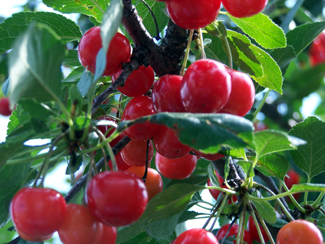
Fruits of the Grand Valley are abundant this year.  A mild spring with good rain actually gave us cherries and apricots this year.  Depending on who you talk to and where they are located, people will tell you that we only get a cherry crop every 4-10 years due to late frosts.  So cherish those sweet cherries, hopefully we will have lots of them next year, but only Mother Nature knows.  Cherries in our area do require control of the Western Cherry Fruit Fly.  If not controlled, you get little worms in your cherries, not very appetizing.  Here is how to control them.  https://extension.usu.edu/files/publications/factsheet/western-cherry-fruit-flies06.pdf.
The apricots due get Coryneum blight, also called shot hole disease because spots form on the leaves and then drop out.  The fruit gets red spots mainly on the upper surface where the rain sits.  Unfortunately, the best time to control this disease is in the fall.  Removal of infected twigs and branches helps too.  Here is our information on this fungal disease.  In the home garden, you can cut out these bad spots in the fruit, but it certainly does not make the fruit saleable.
I did one site visit very early on to a peach orchard that had very early signs of coryneum blight and the grower was able to do some spraying to control it.  Luckily it was only in one low lying corner of the field.  Where plants grow really does make a difference.  A few very early peaches are coming to market now but we will see the bulk of early yummy Palisade peaches hit the market in about two weeks.  Bob Hammon, our Entomologist tells me we will also see Olathe Sweet, Sweet Corn about July 11th.  Can I say again, YUM.  Nothing better than fresh produce.


Back to the peaches.  I am on a Working Group to help find disease controls for Cytosphora which is a fungal disease that has no cure.  We believe many stressors’ contribute to this disease starting with proper planting techniques, insect control, care and maintenance and cleanliness.  A new Plant Pathologist, Jane Stewart, on campus is studying the effects of different fungicides as a control.  Samples are being sent to her from our area.  But we still need to find out the why.  My big point to you, the reader, is that fruit trees are very hard to grow, take a lot of time and responsibility to grow and not spread any pests.  In fact, I would say fruit trees are the highest maintenance plant one can grow. 

Yes, I do have some fruit trees on my property, but luckily my husband also has a horticulture degree so he does most of the insect control, we split the pruning duties, both pick and guess who does most of the canning?  Thou he has gotten into drying.  He dried cherries last weekend.  So in the end, appreciate all the hard work that went into the fresh fruit, support your local growers and a good thank you would go a long way too.  Enjoy.

Susan Carter
CSUE Tri River Area Horticulture Agent