CO-Horts

CO-Horts Blog

Showing posts with label fire blight. Show all posts

Wednesday, July 6, 2022

The Grub that Got Away...

 Posted by Hania Oleszak and Mari Hackbarth, Jefferson County Extension


With summer finally in full swing, we’ve been wading knee-deep in plant and insect samples over at the Jefferson County Plant Diagnostic Clinic. With that in mind, we thought it would be fun to clue you in to some of the pests and diseases that we’ve been seeing lately. See if you can identify any of the following samples as we walk you through some of the key steps of our identification processes…

~~~~~~~~~~~~~~~~~~~~~~~~~~~~~~~

Our first culprit is a first to our clinic. With a piercing, sucking mouthpart originating from in front of its eyes and long, segmented antennae, this insect appears to fall under the Hemiptera order.


Bee Assassin Bug; photo credit: Whitney Cranshaw, Colorado State University

This sample came with a critical piece of information for its identification: the environment in which it was found. Specifically, this insect was found attacking a honey bee near a hive.


 In addition to the dorsal and ventral markings on the insect and the fact that the mouthpart had three segments, these clues all indicate that this insect is…drumroll please…a bee assassin (Apiomerus spp.)! There are three species of bee assassins within Colorado and they often hide and wait for their prey before ambushing them. While we all prize our bees and dislike anything that harms them, bee assassins have not been identified as a threat to our bees and are actually generalist predators, meaning they feed on a range of insects.

~~~~~~~~~~~~~~~~~~~~~~~~~~~~~~~

Our next culprit makes its way, unfortunately, into our clinic a handful of times a year. Like the bee assassin, this sample was also identified to the Hemiptera order, which is also the order referred to as “true bugs”.  Additionally, this sample was found in an assisted living facility bedroom…any ideas yet?
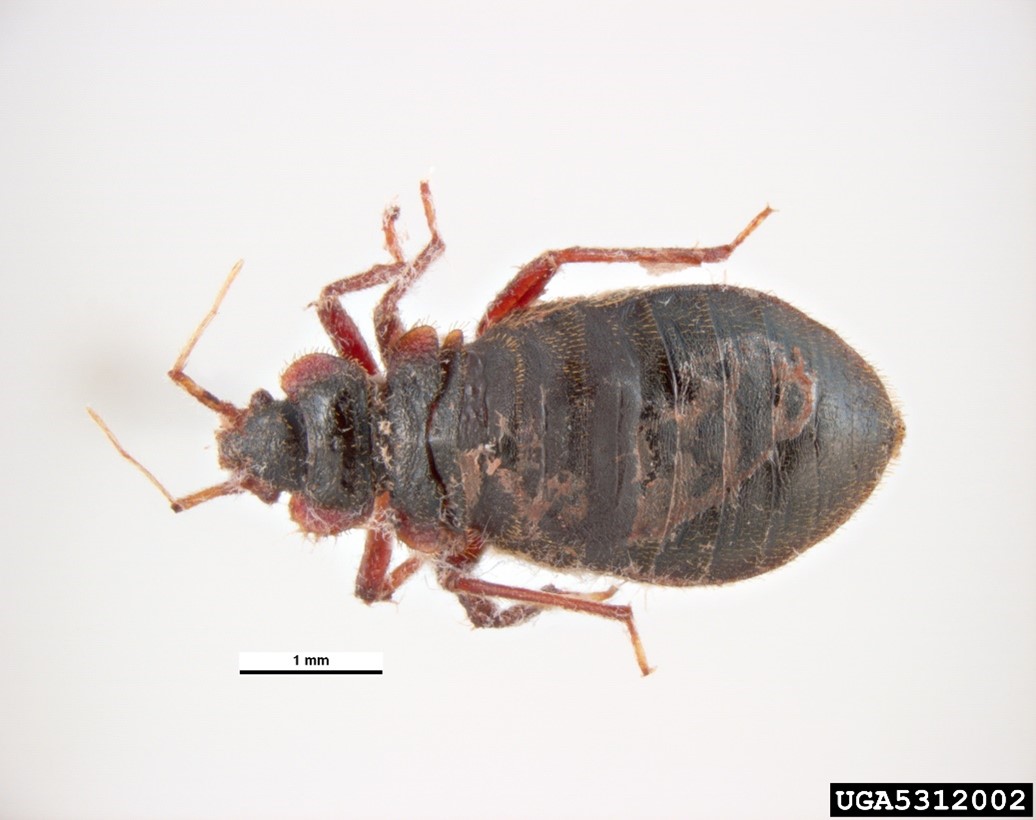

Bedbug, Cimex Lectularius dorsal view; photo credit Pest and Diseases Image Library,


Bedbug, Cimex Lectularius ventral view; photo credit  Gary Alpert, Harvard

Note: the piercing, sucking mouthpart originating from in front of the eyes and the long antennae broken into 4 segments.
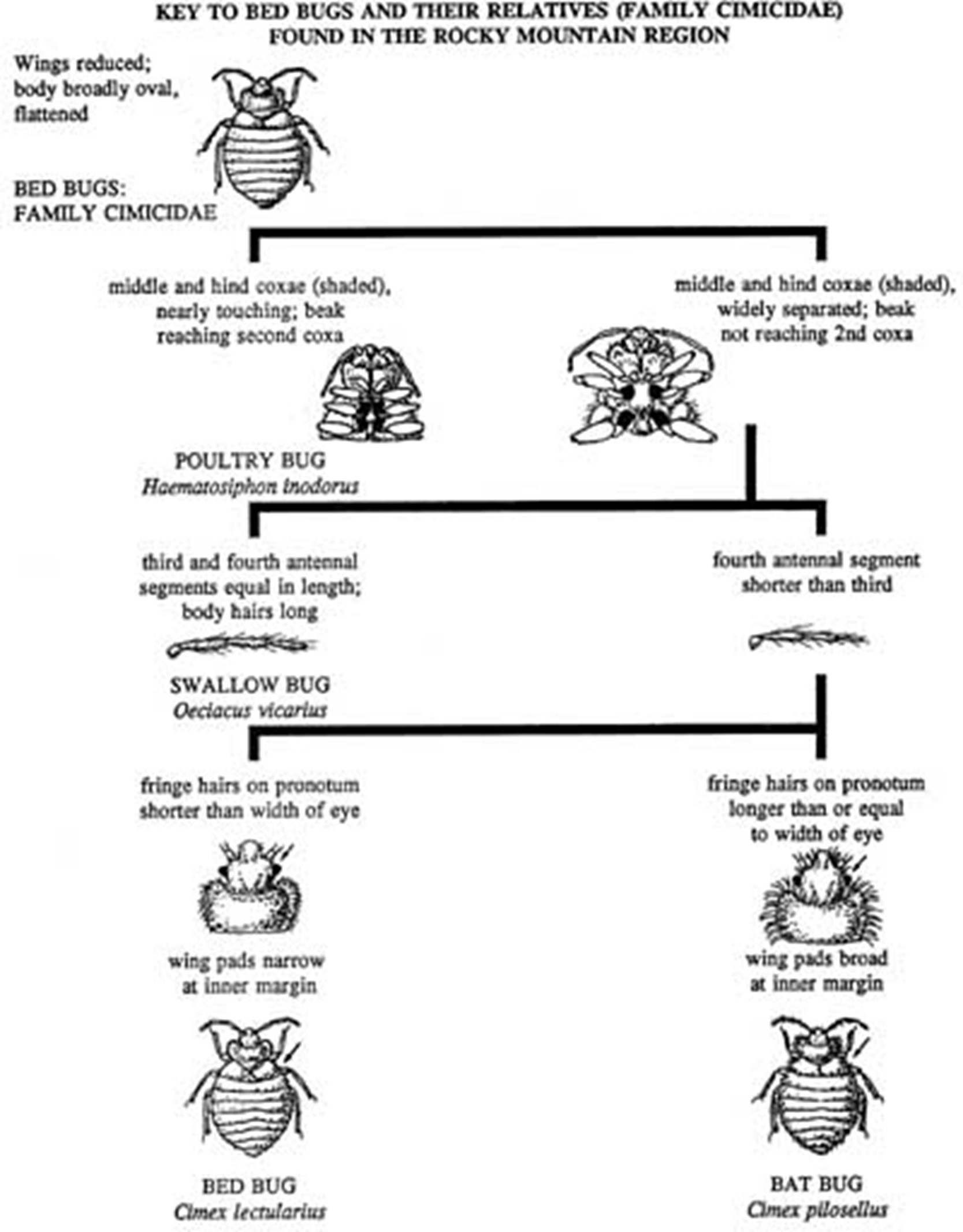
 Based on context and morphology, our insect appears to be either a bed bug or a bat bug (both belonging to the Cimicidae family). To differentiate the two, it’s important to observe the fringe hairs on the pronotum and the wing pads, as noted in the figure below.


 Bed Bug Identification Key; figure credit: CSU Extension


What’s the final verdict? It’s a bed bug (Cimex lectularius), ew! Bed bugs are bloodsucking insects, often feeding in the middle of the night. They do not transmit disease.  People often develop red, itchy swellings from bed bugs, but these bites alone are not enough to diagnose a bed bug problem.  Identification requires microscopic examination of the beak length, antennae and pronotal hairs.  Bed bug interceptors, basically traps that bed bugs can’t climb out of, can be placed underneath the bed post in order to monitor for bed bugs.

 ~~~~~~~~~~~~~~~~~~~~~~~~~~~~~~~

Next up, we have a raspberry plant that was brought in for management advice. This sample already had been diagnosed upon entering the plant clinic, but we won’t give you the answer that quickly! The key symptom in this diagnosis is that the shoot tips of the raspberries are wilting. Additionally, there are two rows of punctures along the stem, beneath the point of wilting.

Spoiler alert: these two rows of punctures are actually made by female Raspberry cane borers (Oberea perspicillata), surrounding the point at which eggs have been laid in the pith of the raspberry cane. Upon hatching, larvae burrow down through the pith, making it down about an inch or two from the punctures by the first winter, and eventually making it down to ground level. To control for the Raspberry cane borer, it’s best to prune the raspberry canes below the puncture marks, or as far down as there is evident damage to the pith of the cane.


Raspberry Wilting; photo credit: Mark Longstroth, MSU Extension


Raspberry Cane Borer Larva; photo credit: Alan T. Eaton

 ~~~~~~~~~~~~~~~~~~~~~~~~~~~~~~~

Next in our line-up is a crabapple tree with an array of symptoms that are quite telling and commonly seen in our clinic. Looking at the crabapple branch, we could see darkened, mummified fruit, as well as blackened and crooked shoot tips (which we refer to as shepherd’s crooking).


Shepherd’s crooking symptom of Fire blight; Photo credit Don Hershman, Bugwood.org

Upon further investigation in the lab, we could see under the microscope that there was bacterial streaming (i.e. the movement of bacteria out of the cut tissue) present in the fruit. Watch a youtube video of bacterial streaming HERE.  So cool!  This confirmed our suspicion that this crabapple tree has…Fire blight! Fire blight is a bacterial disease, caused by the bacteria Erwinia amylovora, that affects members of the rose family. The bacteria can be spread by insects, rain, or contaminated pruning tools, which is why rainy springs are conducive to the spread of Fire blight and why we recommend to disinfect pruning tools between every cut when working with plants of the rose family. Blossom blight (blackened, dead flower blooms) and oozing exudate from the tree or fruit are other tell-tale signs that your plant may have Fire blight. Unfortunately, there is no cure for Fire blight, so it’s best to prevent the spread of the disease and remove infected plant parts.

~~~~~~~~~~~~~~~~~~~~~~~~~~~~~~~

Last, but not least, is the grub that got away! Late one afternoon, we received a sample of a grub that was found in a mulch pile and placed it, along with some mulch, in a closed petri dish overnight. To our surprise, the grub was nowhere to be found the following morning – all that remained in the petri dish was mulch (see below).


Photo credit: Mari Hackbarth, Jeffco Plant Diagnostic Clinic

 Later that week, we received a sample of very similar-looking grubs. Upon morphological inspection (i.e. looking at the rastral pattern, or the arrangement of short hairs located above the anal slit of the abdomen), we were able to deduce that the grubs were likely bumble flower beetle larvae.


Rastral Pattern on Grub; photo credit: Mari Hackbarth, Jeffco Plant Diagnostic Clinic

Interestingly, bumble flower beetles form oval, earthen pupal cases as they mature into their adult forms and, looking more closely at second sample, we were even able to find some (see below)!
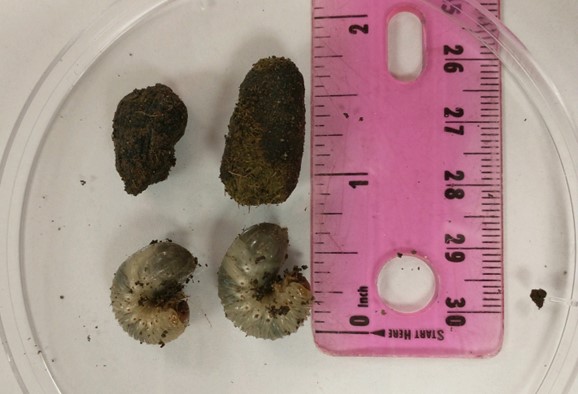


Bumble Flower Beetle Larvae and Pupae; photo credit: Mari Hackbarth, Jeffco Plant Diagnostic Clinic


Wait a minute!  If bumble flower beetles form pupae that look like big chunks of soil, and if our initial grub that got away looked very similar to the bumble flower beetle grubs…could our initial grub actually still be hiding in our petri dish in a pupa? What do you think?


References:

 Bee Assassin Bug:

Wednesday, March 11, 2020

The Basics of Fruit Tree Pruning

By Amy Lentz – Weld County CSU Extension

The season for pruning fruit trees has been in full swing lately. My colleagues and I have been busy teaching classes, talking with the public and helping growers “get their fruit tree pruning on”. It can be an intimidating task for some - "What if I prune out too much?" or "What types of cuts should I make?" With a little extra patience, basic research and confidence, you can do it...I promise.


Weld CMG's helping teach residents of a community.
Larimer CMG's learning to prune.


Here are some questions and answers that might help you get started (or finished) with your pruning needs.


1. Are fruit trees different than shade trees?

Yes! Fruit trees are pruned differently than shade trees. With fruit trees, you are growing a crop, maybe even for monetary gain. Therefore, you will be manipulating the tree’s growth more than you would when pruning shade trees. The three D’s (disease, damage and dead wood) still apply, but you will also be making cuts for other reasons, such as to increase fruit production or to fill an empty space with more branches. When trying to decide what to prune and what to not prune, look for strong branches with wide branch angles, which are more capable of holding a heavy load. You want to keep those! It's better to remove branches that have a very narrow, or weak, branch angle. Also, you would not be pruning your shade trees as often or as heavily as you would fruit tree! 

2. How should I prune a young tree vs. an older tree?

Young  fruit trees are much more forgiving than older fruit trees, so go lightly if you are pruning an older tree that needs a good deal of thinning. Spread out your pruning cuts to open up the canopy by pruning it lightly over several years. You can prune your young trees (say up to 5 years old or so) a little harder - and they are easier to train when they are young. So start with young trees if possible. Here is an example of how to train a tree over 5 growing seasons from a one year old whip (spreaders were added after the 4th spring):


3.  How do I know where the fruit will be?

Most fruit trees often bloom on old wood. Apples and pears, for example, grow on spurs which can begin developing after 2 years and last a long time, up to 20 years. Plums and cherries also have fruiting buds that occur on old wood, at least 2 years old, either on spurs or along the stems. Peaches, on the other hand, are developing fruit buds on last years growth, so annual pruning to encourage new growth is important for peaches. It's important to know the difference between fruiting buds and vegetative buds. You will be removing some fruiting wood during the regular pruning process, but you don’t want to inadvertently prune off all those little spurs, which will lead to fruit during the upcoming season.

Photos from University of Maine Cooperative Extension: https://extension.umaine.edu/fruit/growing-fruit-trees-in-maine/pruning/
4.. When is the best time to prune my fruit trees?

With the warmth of spring happening more often lately, it’s time to get outside and finish up those pruning jobs if you haven’t already. The best time to prune is in late winter or early spring when the trees are still dormant (which is hard to judge in Colorado!). Either way, you want to stop pruning when the buds first begin to swell and break. It’s best to prune older trees first to make sure they have enough time to heal before spring and leave the younger trees until later in the pruning season. 

Another reason we prune when the trees are dormant is to reduce the spread of diseases like fire blight, that affects those fruit trees in the Rose Family, such as apples and pears. This particular disease can easily be identified and pruned out in the winter. 

For more information on Fireblight, see the following fact sheet from CSU: https://extension.colostate.edu/topic-areas/yard-garden/fire-blight-2-907/
Another good source of information on fireblight, more for the commercial orchard, can be found here from Washington State University: http://treefruit.wsu.edu/crop-protection/disease-management/fire-blight/

5. What are my goals and objectives when pruning fruit trees? 

Approx. 5 year old cherry trees after pruning to thin the canopy.
Your main goal when pruning fruit trees is to open up the canopy of the tree to allow increased light penetration and increased air movement in the center of the canopy, where fruit spurs are located. 

You want to encourage outward growth on the tree to get branches to grow into open space. This is done by pruning to an outward facing branch or bud. Along with the three D’s (diseased, dead or damaged), look for crossing branches, branches that are shading or crowding one another and branches pointing back toward the tree. Don’t remove more than 25% a single pruning season, less for older trees so you don’t stress the tree too much. This will help with fruit development, as well as, decreasing the prevalence of insects and disease. 

To do this, remove crowded branches by making reduction or thinning cuts back to branches that are facing outward, away from the trunk. Reserve heading cuts (where you cut back to a small bud) for only those branches where you want to encourage new growth, such as lower branches or young branches. As you remove some of the twigs and branches to allow for more space in the tree, you will also, in effect, be reducing the number of fruit buds on the tree as you remove wood, so you will also be increasing the energy allotted to the fruit buds that remain – creating larger fruits that have ample sun and lots of space around them. This is the goal of growing fruit trees!

Finally...How can I build my confidence to prune my fruit tree?

Pruning fruit trees takes time, patience and a little critical thinking. A hands-on approach helps a great deal to make these concepts sink in. Definitely look beyond this blog because there is a lot more information than what I could provide here. When doing your research, be sure to look toward education- or research-based information and watch videos to help you make sound decisions when pruning. You can always remove a branch…but you can’t put it back on! Take your time, think about the branches you want to remove and what you want to keep. You can do it!

For more information on pruning fruit trees, check out the following sources from Colorado State and other universities:

Cornell Cooperative Extension - Pruning Apple Trees
http://chemung.cce.cornell.edu/resources/pruning-apple-trees

CSU Fact Sheet - Training and Pruning Fruit Trees 

Utah State - Pruning Fruit Trees: Clip with Confidence!

Educational Video Series from Montana State 

Thursday, July 24, 2014

A Darn Good Year for Fire Blight

Posted by: Alison O'Connor, Larimer County Extension

It seems that the summer of 2014 has been the "best year ever" for fire blight. I've never seen it so much and for awhile, our Extension Office phones were ringing off the hook about people seeing brown branches and crooked twigs from this bacterial disease. Fortunately CSU has a very good Fact Sheet on the subject.

If you haven't seen fire blight, it's characterized by the tip of the branch curling over, resembling a Shepard's crook:
The Shepard's crook of fire blight
If you look further down the branch, most of the leaves will be brown and you'll see a distinct darkening along the stem where the canker has infected tissues:
The bacteria turns the branch/stem a dark brown/black color
So what is fire blight? Well, as I mentioned, it's a bacterial infection caused by Erwinia amylovora that only occurs on plants in the Roseaceae family (apples, crabapples, mountain-ash, hawthorn, etc.). Remember, the Roseaceae family is one of the largest families in our landscapes, so it can affect a number of plants.

Infection can occur in a number of ways...through cracks in the bark or pores in leaves, on insect bodies, by splashing of the spores via rainfall or irrigation and through other natural openings. There seems to be a correlation between fire blight and hail-damaged trees from the previous summer. The bacteria kills cambial tissue (where the xylem and phloem are located) and continues to move down the branch.
Everything brown on this tree is fire blight
It's important to note that the tree will try to ward off the spread of the bacteria. Some species and cultivars are better at doing this than others. While a tree may be labeled as "resistant" to fire blight, it can still get the bacterial infection, but it's better at "sealing" off tissues to stop infection. The bacteria survives winter inside infected tissues and tends to ramp up during warm, wet springs. There is generally bacterial ooze associated with this disease.

So what can you do? Well, the best control is to plant resistant varieties. But that's easier said than done. You can prune out infected tissues during the growing season, but it's crucial that you sanitize your pruning tools between each and every cut. That means you have to spray them with Lysol or Listerine or dip them in a 10% bleach solution. Does this sound like a pain to you? It is. I've done it.

Or you can live with the ugliness of the tree this summer and prune out infected areas during the dormant season. By waiting, you don't have to sanitize. But you have to wait.

Regardless of when you prune, the current recommendation is to cut 8-12" below the edge of visible infection. This is a lot of extra branch you're taking off. And if the infection has moved into the main trunk of the tree, it's best to make a final pruning cut at the base.

For a personal anecdote, I was just at the Gardens on Spring Creek in Fort Collins. One of their apples was absolutely annihilated with fire blight. The director and the city forester were discussing the tree and they came to the conclusion to remove the tree. After making all the pruning cuts to remove the infected branches, the tree would have looked unsightly and wouldn't resemble the proper shape.

There are some pesticides that can be used, both as a dormant control and during flowering. The University of Minnesota Fact Sheet has information on the various types of pesticides that can be used to prevent new infections.